
-1.svg)
ADHD medication helps teenagers with attention-deficit/hyperactivity disorder think more clearly, sit with tasks longer, and act with less impulsivity. These medicines work by adjusting brain chemistry so a teen can focus during school and daily life.
Most teens take one of two kinds: stimulants or nonstimulants. The right choice depends on a teen's symptoms, health history, and how their body responds, which a psychiatric provider decides together with the family.
Key Takeaways
- Stimulant medications are the first-line treatment for adolescents with ADHD, according to the American Academy of Pediatrics, because they reduce inattention and impulsivity faster than other options.
- ADHD has a global prevalence of roughly 5% in children and adolescents, based on figures cited in peer-reviewed psychiatric literature.
- When stimulants cause hard side effects or do not work, providers turn to nonstimulants such as atomoxetine and guanfacine, which carry no risk of misuse.
- The NIMH Multimodal Treatment Study of ADHD found that combining medication with behavioral support produced stronger results than either approach alone for many children.
What Are ADHD Medications?
ADHD medications are prescription medicines that ease the core symptoms of attention-deficit/hyperactivity disorder in teenagers. These drugs target inattention, hyperactivity, and impulsivity, the three symptom clusters defined in the DSM-5-TR.
What Does ADHD Medicine Do?
ADHD medicine sharpens a teen's ability to start tasks, hold attention, and pause before acting. The medication raises signaling in the prefrontal cortex, the brain region that governs executive function such as planning and self-control.
Parents often notice their teen completing homework, following instructions, and managing frustration with less conflict. These changes reflect improved brain chemistry, not a shift in the teen's underlying personality.
Types of ADHD Medication for Teenagers
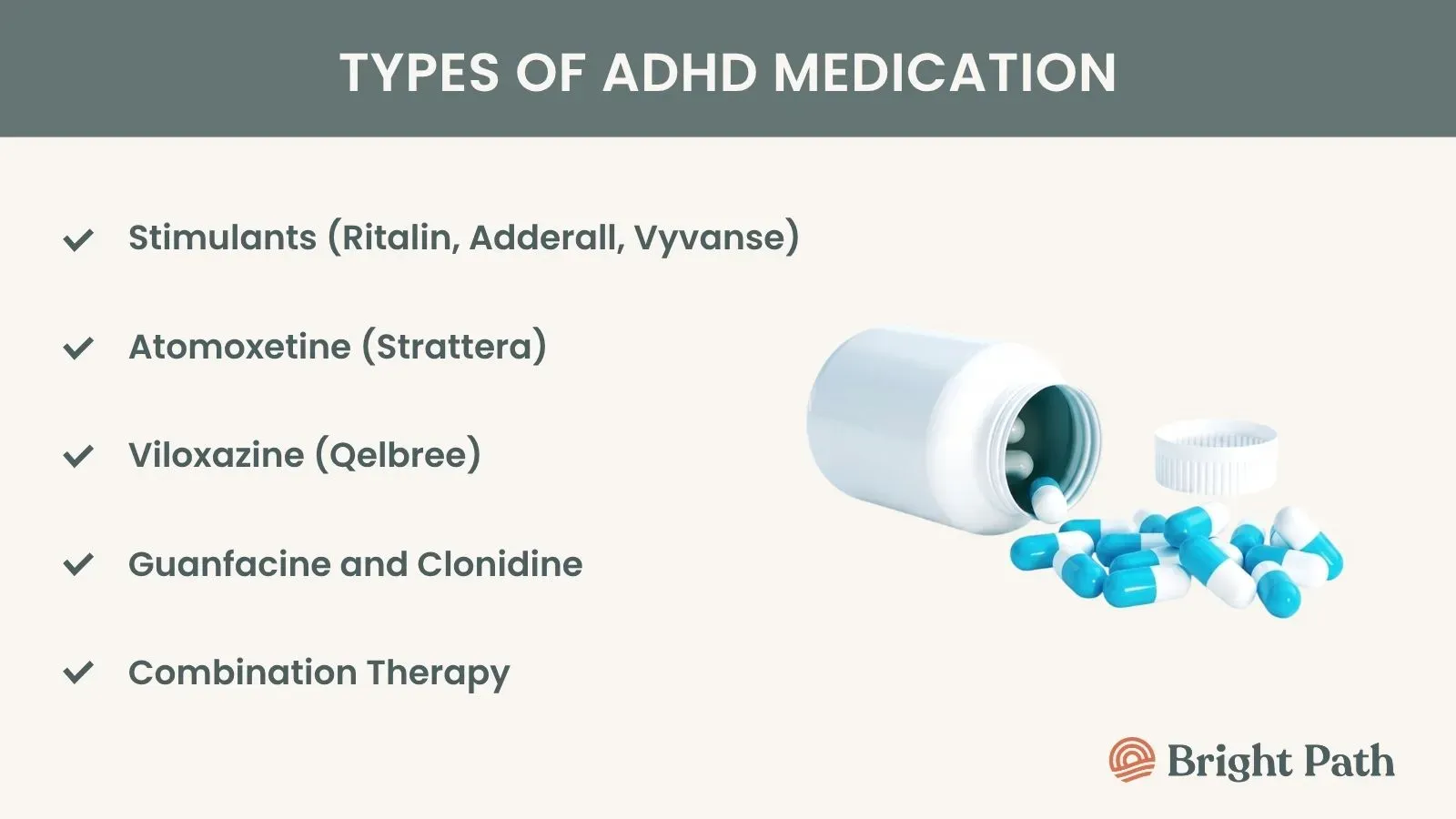
ADHD medication for teenagers falls into two main groups: stimulants and nonstimulants. Stimulant drugs work quickly and serve as the first option, while nonstimulants offer an alternative when stimulants fall short.
Stimulant ADHD Medications
Stimulant drugs are the most common ADHD medications for teens. Stimulants divide into two families, methylphenidate-based and amphetamine-based, both of which raise dopamine activity in the brain.
- Methylphenidate-based options: This group includes Ritalin, Concerta, and Focalin, which release the active medicine at different speeds across the day.
- Amphetamine-based options: This group includes Adderall, Vyvanse (lisdexamfetamine), and Dexedrine, which many teens take once each morning.
- Long-acting formulations: Extended-release adhd pills such as Concerta and Jornay PM smooth out symptom control and reduce the need for a midday school dose.
Nonstimulant ADHD Medications
Nonstimulants treat ADHD without controlled-substance risks. These adhd meds suit teens who cannot tolerate stimulant side effects or who have a history of substance misuse.
- Atomoxetine (Strattera): This selective norepinephrine reuptake inhibitor raises norepinephrine in the prefrontal cortex and is often considered the most effective nonstimulant.
- Viloxazine (Qelbree): This newer nonstimulant works in a similar way to atomoxetine and gained FDA approval for youth in 2021.
- Alpha-2A agonists: Guanfacine (Intuniv) and clonidine (Kapvay) calm hyperactivity and impulsivity and pair well with a stimulant when used together.
How ADHD Medications Work in the Brain
ADHD medications work by correcting the brain chemistry behind attention and self-control in teenagers. Dysregulation of dopamine and norepinephrine signaling drives the inattention and impulsivity that define ADHD, so each medication class targets these chemical messengers in a specific way.
ADHD stems from underactive signaling of dopamine and norepinephrine in the prefrontal cortex, the brain's command center for focus. This reward and control network struggles to sustain attention without enough of these two chemicals.
Stimulant medications block the dopamine and norepinephrine transporters, which raises the levels of both chemicals available between brain cells. This boost strengthens prefrontal signaling so a teen can filter distractions and stay on task.
Nonstimulant medications adjust the same chemical systems through a slower, steadier route. Atomoxetine selectively blocks the norepinephrine transporter, while alpha-2A adrenergic agonists like guanfacine strengthen prefrontal signaling directly.
Research clarifies how these mechanisms hold up over time. The NIMH Multimodal Treatment Study of ADHD (MTA), led by researchers including James Swanson and Stephen Hinshaw, established that medication combined with behavioral therapy outperformed either treatment used on its own for many children.
How Long ADHD Medications Take to Work?
ADHD medications start working on different timelines depending on whether a teen takes a stimulant or a nonstimulant. Stimulants act within hours, while nonstimulants build their effect over several weeks.
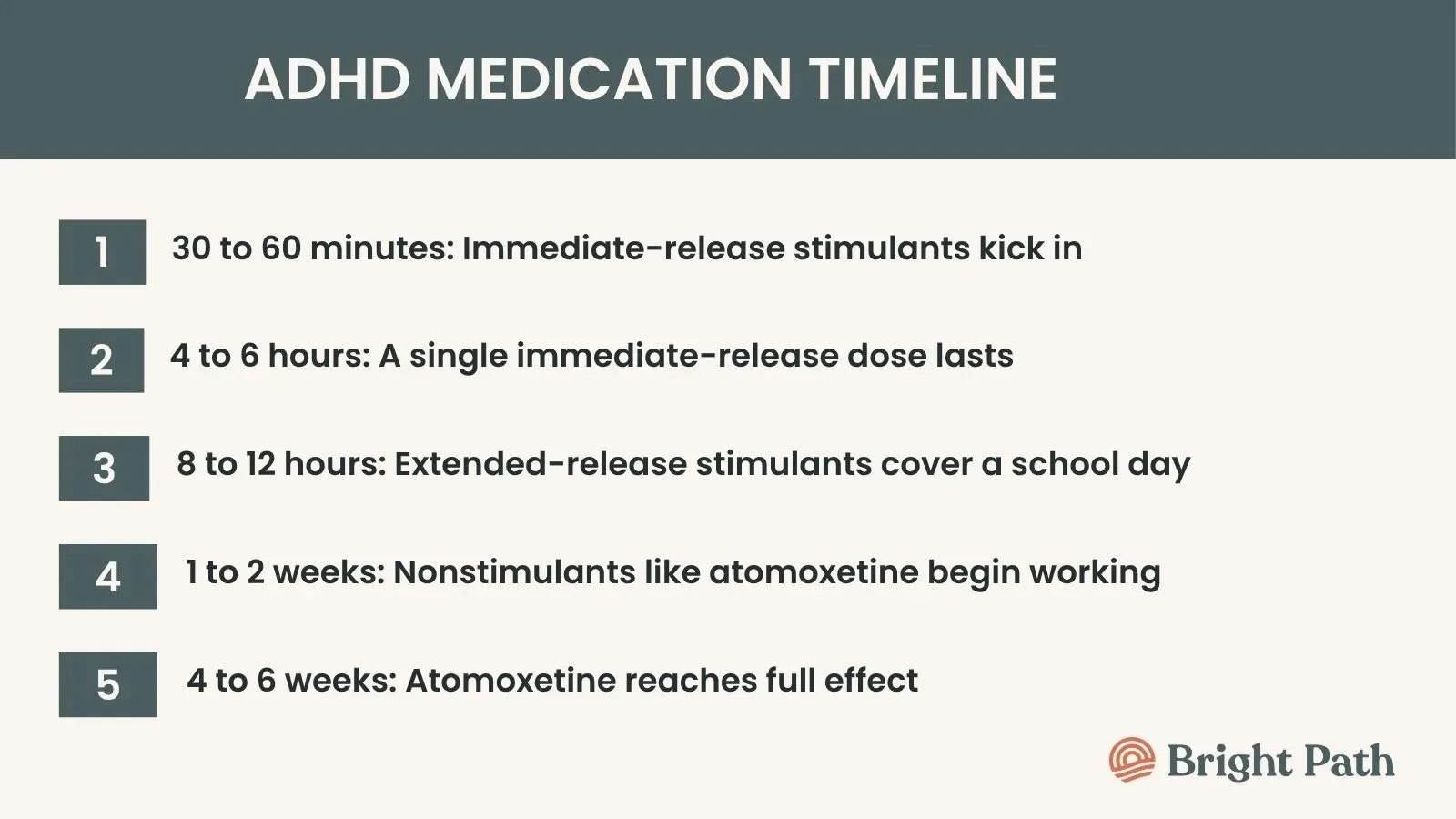
The timeline below shows when each adhd medicine begins working and how long a single dose lasts for a typical teenager.
- 30 to 60 minutes: Immediate-release stimulants such as Ritalin and Adderall begin reducing inattention within this window after a dose.
- 4 to 6 hours: A single immediate-release stimulant dose controls symptoms across this span, which is why some teens need a second school dose.
- 8 to 12 hours: Extended-release stimulants such as Concerta and Vyvanse cover most of a school day from one morning dose.
- 1 to 2 weeks: Nonstimulants like atomoxetine produce early, partial improvement during this initial period.
- 4 to 6 weeks: Atomoxetine reaches its full effect across this longer stretch, so families should not judge it too early.
Why Timing Matters for Teens
Medication timing shapes a teen's school performance and evening behavior. A stimulant that wears off in the afternoon can produce a brief return of symptoms, a pattern clinicians call rebound, which a different formulation often solves.
Teens managing both ADHD and mood symptoms may need careful scheduling. Coordinating medication with treatment for co-occurring conditions helps a provider balance focus during the day against sleep at night.
What Are the Side Effects of ADHD Medications?
ADHD medication side effects in teenagers range from mild and common to rare but serious. Most side effects of adhd medication appear early and fade as a teen's body adjusts, though some require prompt medical attention.
Common Side Effects
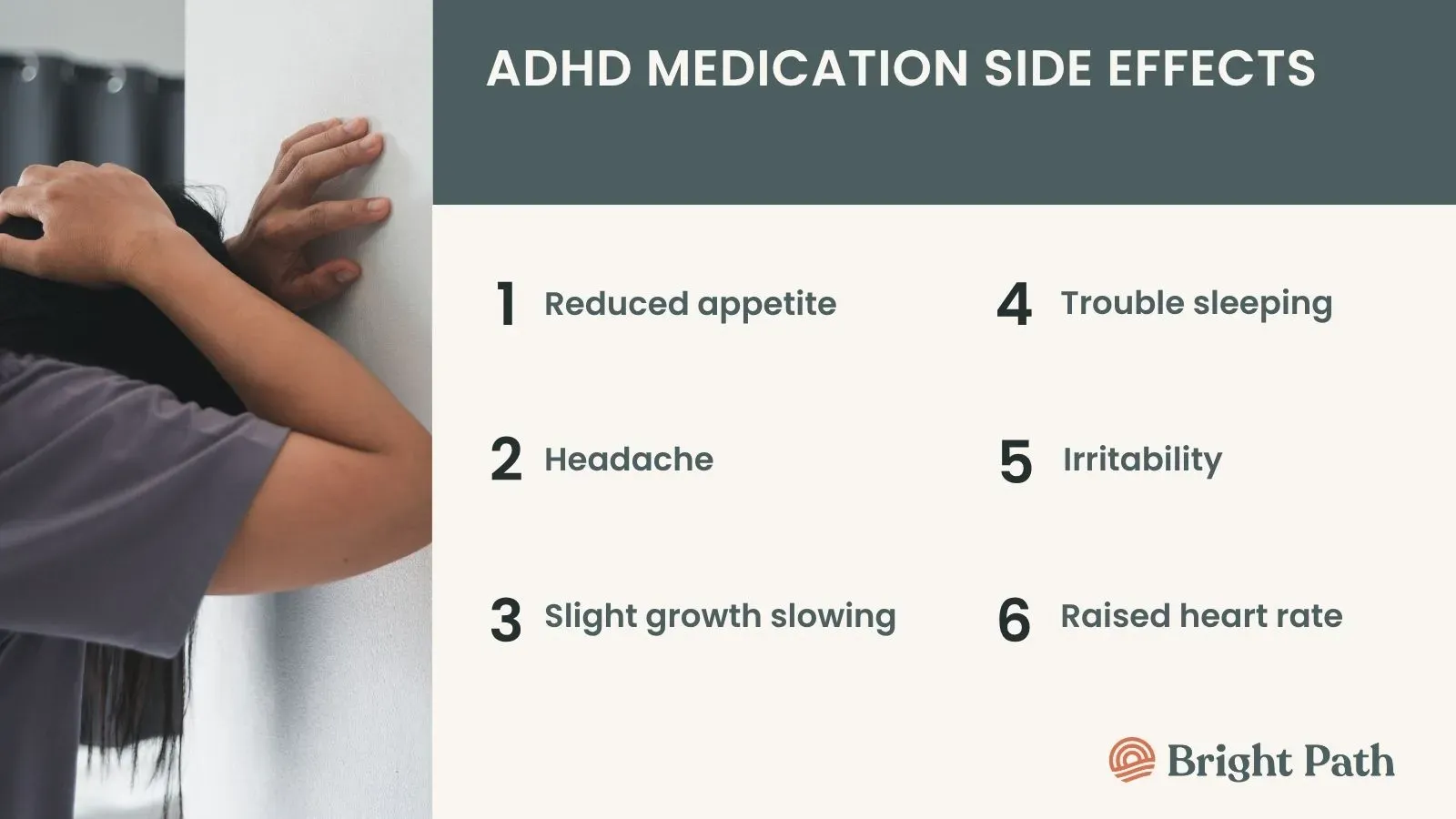
Common stimulant side effects are usually mild and short-lived. These effects often ease within the first few weeks of treatment as the dose stabilizes.
- Reduced appetite: Stimulants suppress hunger signals, so many teens eat less during the day and make up calories at dinner.
- Trouble sleeping: A stimulant taken too late can delay sleep onset, which providers address by adjusting the dose timing.
- Headache and stomachache: These effects often appear in the first week and typically settle without stopping the medicine.
- Irritability as the dose fades: Some teens feel moody when a stimulant wears off, a pattern that signals a need to review the formulation.
Severe Side Effects
Serious side effects are uncommon but need immediate attention. These reactions call for a prompt call to the prescribing provider.
- Heart-rate and blood-pressure changes: Stimulants raise heart rate and blood pressure, so providers screen for heart conditions before prescribing.
- Suicidal thoughts on atomoxetine: The FDA warns that atomoxetine may raise the risk of suicidal ideation in teens, especially those with co-occurring adolescent depression, so families should monitor mood closely after starting it.
- Misuse risk: Stimulant drugs are controlled substances, and a teen or peer can misuse them, which makes secure storage essential at home.
Long-Term Effects
Long-term considerations deserve ongoing monitoring: A provider tracks these areas at regular medication-review visits.
- Growth monitoring: Stimulants can slow growth slightly, so providers chart height and weight at each visit and adjust the plan if needed.
- Cardiovascular checks: Ongoing blood-pressure and heart-rate tracking keeps long-term stimulant use safe for most teens.
- Dose review across development: A teen's growing body changes how it processes medicine, so periodic reassessment keeps the dose right.
Stimulant vs Nonstimulant ADHD Medication
Stimulant and nonstimulant ADHD medications differ in how fast they work, how long families use them, and their potential for misuse. Understanding these differences helps parents take part in treatment decisions with confidence. The table below compares the two adhd medication options across the criteria that matter most for teenagers.
Criteria | Stimulants | Nonstimulants |
Examples | Ritalin, Adderall, Vyvanse, Concerta | Strattera, Qelbree, Intuniv, Kapvay |
Onset | 30 to 60 minutes | 1 to 6 weeks |
Main brain target | Dopamine and norepinephrine | Norepinephrine or alpha-2A receptors |
Controlled substance | Yes | No |
Typical role | First-line treatment | When stimulants fail or cause side effects |
When Two ADHD Medications Are Combined
Providers sometimes combine two ADHD medications when one medicine alone does not fully control a teen's symptoms. This approach, called augmentation, pairs medications that act on different brain chemicals.
Using Strattera and Vyvanse Together
A provider may prescribe Strattera and Vyvanse together to reach symptom control that neither achieves alone. Atomoxetine raises norepinephrine steadily while the stimulant boosts dopamine, so the two cover complementary parts of the attention network.
Research supports careful combination in teens who need it. A study led by Timothy Wilens found that adding OROS methylphenidate to atomoxetine cut ADHD rating-scale scores nearly in half for children whose symptoms remained high on the nonstimulant alone.
Emerging ADHD Meds
New ADHD medications continue to reach families through FDA review. Onyda XR (clonidine), the first liquid nonstimulant with nighttime dosing, gained FDA approval in 2024, while centanafadine, a triple-reuptake inhibitor, has shown promise for teens in Phase 3 trials but awaits FDA submission.
Teen ADHD Treatment at Bright Path Behavioral Health
Bright Path Behavioral Health treats teens with ADHD through integrated psychiatric care that pairs medication support with skill-building therapy. The CARF-accredited program serves adolescents ages 12 to 18 in Wake Forest, North Carolina, and never requires medication for admission.
Bright Path delivers ADHD support inside structured day programs matched to each teen's needs. The partial hospitalization program offers the most intensive daily support for teens whose symptoms disrupt school and home life.
Teens ready for less intensive care step into the intensive outpatient program that serves families across North Carolina. Each level coordinates psychiatric care with DBT skills groups that build the executive-function and emotion-regulation skills medication alone cannot teach.
Bright Path coordinates academic support so ADHD treatment does not cost a teen classroom progress. An education liaison contacts the teen's school, sets up homebound status, and supports any IEP or 504 plan during treatment.
Frequently Asked Questions
At what age can a teen start ADHD medication?
Most FDA-approved ADHD medications are cleared for children ages 6 and older, so teenagers fall well within the approved range. A psychiatric provider weighs symptom severity, health history, and the teen's own input before prescribing.
Can a teenager take ADHD medication only on school days?
Some families use stimulant medication only on school days, often called a drug holiday, under provider guidance. This approach can ease appetite or growth concerns, but nonstimulants generally require daily use to stay effective.
Do ADHD medications stunt growth in teenagers?
Stimulant medications can slow growth modestly, which is why providers chart height and weight at every visit. Any slowing is usually small, and providers adjust the plan if a teen's growth pattern shifts noticeably.
Is it safe to drink caffeine while on ADHD medication?
Caffeine and stimulant medication both raise heart rate, so combining heavy caffeine with a stimulant can increase jitteriness and sleep problems. Teens should keep caffeine moderate and discuss energy-drink use with their provider.
Can a teen become addicted to ADHD stimulant medication?
Taken as prescribed, stimulant medication carries low addiction risk for teens with ADHD. Because stimulants are controlled substances, families should store them securely and watch for any sign of misuse by the teen or peers.
What happens if a teen stops ADHD medication suddenly?
Stopping stimulant medication does not cause dangerous withdrawal, but ADHD symptoms typically return. Nonstimulants like guanfacine should be tapered rather than stopped abruptly to avoid a rise in blood pressure.
References
- American Academy of Pediatrics. (2019). Clinical practice guideline for the diagnosis, evaluation, and treatment of attention-deficit/hyperactivity disorder in children and adolescents. Pediatrics, 144(4).
- Centers for Disease Control and Prevention & CHADD National Resource Center on ADHD. (2025). ADHD medications approved by the US FDA. CHADD.
- Moran, L. V., et al. (2019). Psychosis with methylphenidate or amphetamine in patients with ADHD. New England Journal of Medicine, 380(12), 1128–1138.
- National Institute of Mental Health. (n.d.). The Multimodal Treatment of Attention Deficit Hyperactivity Disorder Study (MTA): Questions and answers. NIMH.
- Wilens, T. E., et al. (2009). A pilot study for augmenting atomoxetine with methylphenidate: Safety of concomitant therapy in children with attention-deficit/hyperactivity disorder. Child and Adolescent Psychiatry and Mental Health, 3(1).
- Wolraich, M. L., et al. (2003). Psychometric properties of the Vanderbilt ADHD Diagnostic Parent Rating Scale. Journal of Pediatric Psychology, 28(8), 559–568.
- American Psychiatric Association. (2022). Diagnostic and statistical manual of mental disorders (5th ed., text rev.).
- U.S. Food and Drug Administration. (2024). Onyda XR (clonidine hydrochloride) highlights of prescribing information. FDA