
-1.svg)
Distress tolerance skills are DBT tools that help a teen survive an intense emotional crisis without making it worse through self-harm or impulsive choices.
The goal is to get through the moment safely, not to fix the problem right away.
Marsha Linehan built these skills for situations a teen cannot change in the moment, where the only useful move is to ride out the wave.
For families, the skills offer something specific to do when a teen is spiraling, instead of arguing, pleading, or freezing.
Knowing which skill fits which kind of crisis is what makes them work.
Key Takeaways
- Crisis-survival purpose: Distress tolerance skills help a teen get through an overwhelming moment without self-harm, substance use, or another impulsive act that creates new problems.
- Strong adolescent evidence: In a 2014 randomized trial led by Lars Mehlum, dialectical behavior therapy reduced self-harm in teens more than enhanced usual care, with the effect holding at one-year follow-up.
- Widespread need: The CDC's 2023 Youth Risk Behavior Survey found that about 40% of U.S. high school students reported persistent feelings of sadness or hopelessness.
- Body-first skills: The TIPP skill changes a teen's physiology in minutes, which lowers the intensity of emotion before any thinking strategy can work.
- Acceptance is a skill: Radical acceptance teaches teens to stop fighting an unchangeable reality, which frees energy for coping rather than resistance.
What are distress tolerance skills?
Distress tolerance skills are short, concrete actions that help a teen tolerate emotional pain when a situation cannot be solved immediately. They form one of the four modules in DBT skills for teens, alongside mindfulness, emotion regulation, and interpersonal effectiveness.
These skills do not lower the size of a problem. They lower the chance a teen reacts to a problem in a way that creates a second crisis.
- Crisis survival skills: STOP, TIPP, ACCEPTS, and IMPROVE the moment carry a teen through a peak emotion without harmful action.
- Reality acceptance skills: Radical acceptance and willingness help a teen stop battling facts they cannot change right now.
- A measurable target: Clinicians track progress with the Difficulties in Emotion Regulation Scale (DERS), which scores how well a teen accesses coping strategies under stress.
Why do teens struggle to tolerate distress?
Teens struggle to tolerate distress because the adolescent brain feels emotions intensely while the systems that calm those emotions are still developing. Linehan's biosocial model describes this as emotional vulnerability meeting an environment that misreads or dismisses big feelings.
When that pairing repeats, a teen never learns that strong emotions pass on their own. Instead, the teen reaches for fast relief, which is where self-harm and impulsive behavior take hold.
- Heightened sensitivity: An emotionally sensitive teen reacts faster, peaks higher, and returns to baseline slower than peers, the pattern Linehan called emotional vulnerability.
- Reward for fast relief: Self-harm and avoidance deliver immediate relief, which trains the brain to repeat them and crowds out slower coping.
- Skills gap, not defiance: A teen who cannot tolerate distress is missing a learned skill, not refusing to behave, which is why direct teaching outperforms punishment.
What are the main DBT distress tolerance skills?
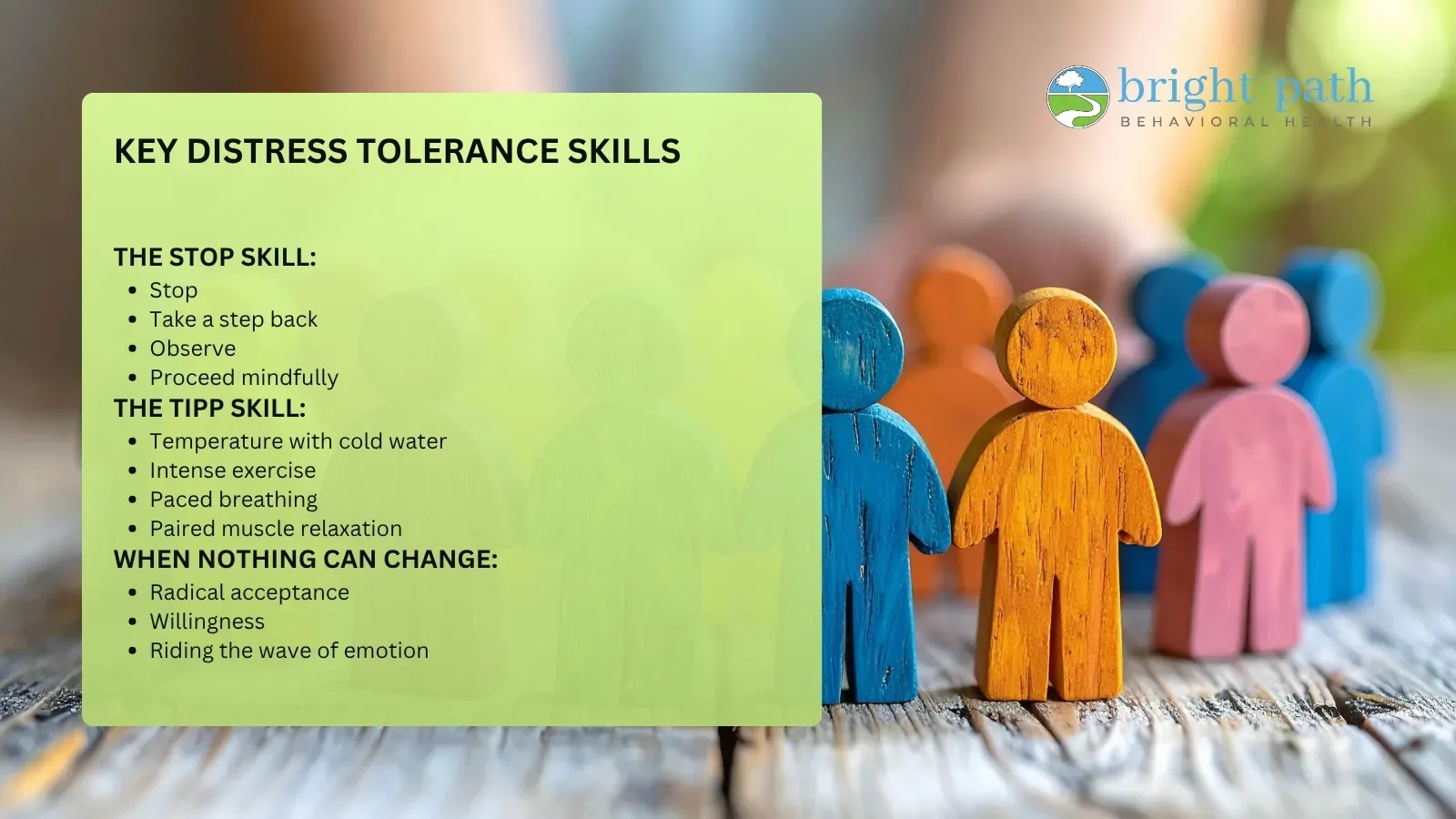
The main distress tolerance skills are STOP, TIPP, ACCEPTS, IMPROVE the moment, and radical acceptance, and each fits a different intensity of crisis. Bright Path teaches every one of these in its intensive outpatient program.
The STOP skill
The STOP skill gives a teen a four-step pause that interrupts an impulsive reaction before it starts.
- Stop: The teen freezes the moment instead of acting on the first urge, which breaks the automatic chain from trigger to harm.
- Take a step back: Physical or mental distance lowers the pull of the emotion enough to think.
- Observe and proceed mindfully: The teen checks the facts, then chooses a response that fits their goals rather than the feeling.
The TIPP skill
The TIPP skill changes body chemistry fast, which is the quickest way to bring a high-intensity emotion down.
- Temperature: Cold water on the face triggers a calming reflex that slows the heart rate within seconds.
- Intense exercise: A short burst of movement burns off the stress chemistry driving the emotion.
- Paced breathing and paired muscle relaxation: Slowing the exhale and releasing tense muscles signal safety to an overactivated nervous system.
ACCEPTS and IMPROVE
ACCEPTS and IMPROVE help a teen get through medium-intensity distress by shifting attention and adding comfort.
- ACCEPTS distracts: Activities, contributing, comparisons, opposite emotions, pushing away, other thoughts, and sensations move attention off the pain briefly.
- IMPROVE soothes: Imagery, meaning, prayer, relaxation, one thing at a time, a mental vacation, and encouragement make a hard moment more bearable.
- When change is impossible: Radical acceptance takes over when no distraction or comfort can alter the reality a teen faces.
How do teens use distress tolerance skills in a crisis?
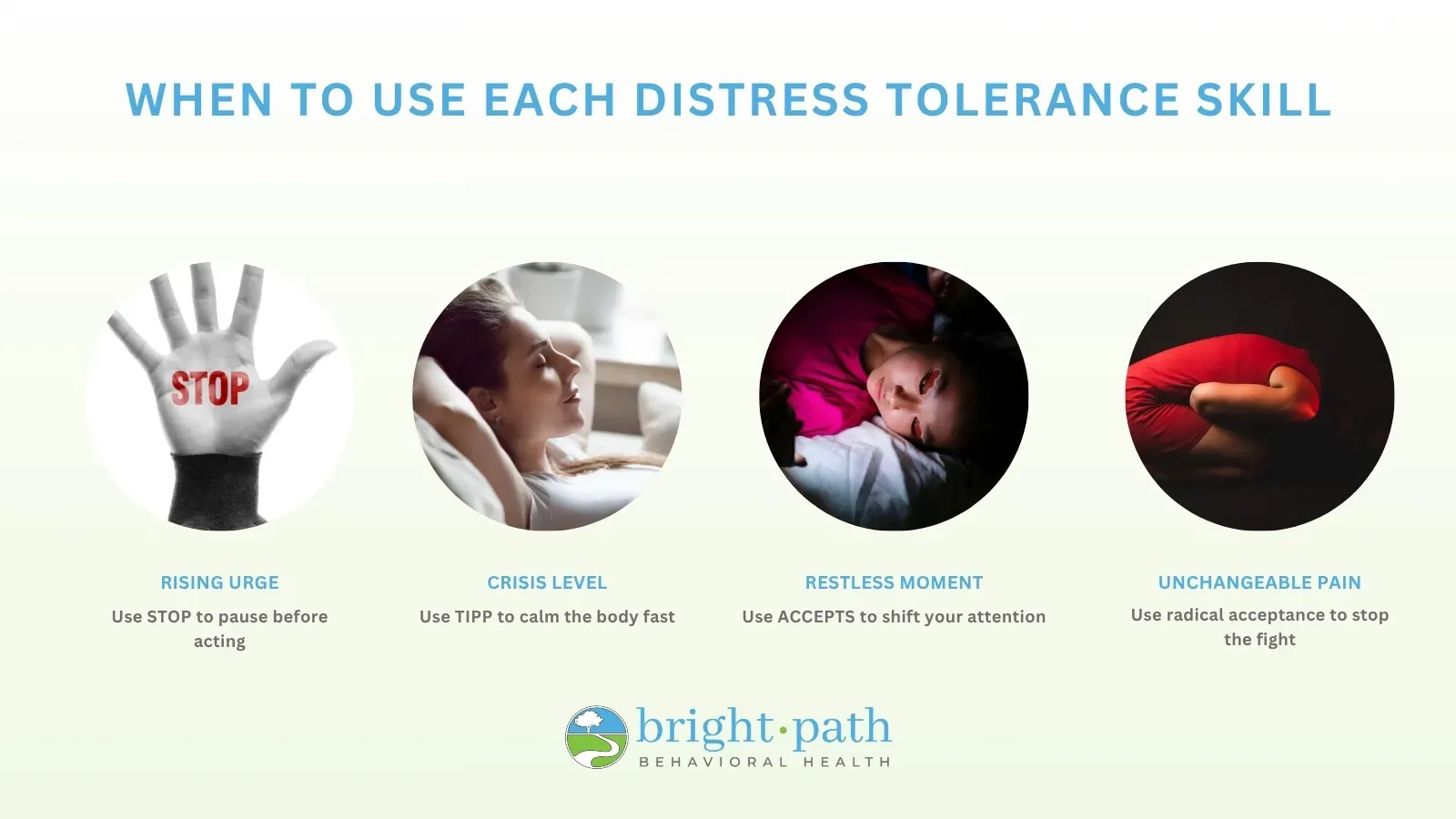
Teens use distress tolerance skills by matching the skill to the intensity of the moment, starting with the body when emotion is highest. A clear order keeps a teen from freezing when they need a tool most.
- Step 1, name the intensity: The teen rates the emotion, because a 9 out of 10 needs a body skill before any thinking skill will land.
- Step 2, cool the body with TIPP: Cold water or intense movement lowers the physical charge within minutes.
- Step 3, pause with STOP: Once the body settles, the teen stops, steps back, and observes before acting.
- Step 4, distract or soothe: ACCEPTS and IMPROVE carry the teen through the remaining wave until the emotion passes.
- Step 5, accept what stays: For pain that cannot be changed, radical acceptance ends the exhausting fight against reality.
If a teen is in immediate danger or talking about suicide, call or text 988 for the Suicide and Crisis Lifeline, or call 911.
Distress tolerance vs emotion regulation: what is the difference?
Distress tolerance and emotion regulation are different DBT modules with different timing. Distress tolerance gets a teen through a crisis safely in the moment, while emotion regulation lowers the frequency and intensity of painful emotions over time.
FeatureDistress toleranceEmotion regulation
Timing
During a crisis, in the moment
Before and after, over weeks
Goal
Survive without making it worse
Feel painful emotions less often and less intensely
Example skills
STOP, TIPP, ACCEPTS
Opposite action, check the facts, PLEASE
Question it answers
How do I get through right now?
How do I have fewer of these moments?
The two work together. A teen uses distress tolerance to survive the storm, then opposite action and other regulation skills to make storms rarer.
How does Bright Path teach distress tolerance to teens?
Bright Path teaches distress tolerance in small groups where teens learn a skill and rehearse it the same afternoon. The River track introduces these skills from the foundation, and tracks cap at 12 teens so each adolescent practices with support.
Skills practiced in real situations
- Challenge Group: Teens face fears together in a structured group, which lets them use distress tolerance skills while the emotion is live rather than hypothetical.
- Horticulture therapy: Grounding through nature gives teens a non-verbal way to settle the body, reinforcing the same regulation TIPP targets.
Skills that support self-harm recovery
- Direct safety focus: For teens who use self-harm to cope, distress tolerance replaces the harmful behavior with a survivable alternative.
- Daily safety planning: Each teen builds a personal plan that lists which skills work for them, so the right tool is ready before the next crisis.
Savanna Stone, LCSWA, a psychotherapist at Bright Path, describes the shift this way: "Teens come in believing a wave of emotion will last forever, so they do anything to stop it. Distress tolerance teaches them the wave always crests and falls, and that they can ride it without hurting themselves."
Frequently Asked Questions
What is the easiest distress tolerance skill for a teen to start with?
The TIPP skill is the easiest to start with because it works on the body, not the mind. Splashing cold water on the face or doing jumping jacks lowers emotional intensity quickly, even when a teen is too overwhelmed to think clearly.
How is distress tolerance different from avoidance?
Avoidance escapes a problem permanently and lets it grow. Distress tolerance is a brief, intentional pause that helps a teen get through a peak emotion so they can face the problem afterward with a clearer head.
Can distress tolerance skills replace self-harm?
Yes. These skills give a teen a safer way to handle the same overwhelming feelings that drive self-harm. With practice and clinical support, distress tolerance becomes the automatic response instead of the harmful one.
When should a teen use distress tolerance instead of solving the problem?
A teen should use distress tolerance when the problem cannot be solved right away or when emotion is too high to think. Once the wave passes, problem-solving and emotion regulation skills take over.
Do these skills work for anxiety and panic?
Yes. Paced breathing and temperature change calm the physical surge of panic, while distraction skills interrupt the spiral of anxious thoughts. Many teens use them for test anxiety and social fear.
How long until distress tolerance skills feel automatic?
Most teens grasp the skills within a few weeks but need 12 to 24 weeks of practice before reaching for them on their own. Repetition in real situations is what makes them automatic.
Can parents use distress tolerance skills too?
Yes, and it helps. When parents use the same skills, the home stays calmer during a teen's crisis, and shared language lowers conflict. Bright Path's weekly parent group teaches these tools to families.
References
- Linehan, M. M. (2015). DBT Skills Training Manual (2nd ed.). Guilford Press.
- Mehlum, L., Tørmoen, A. J., Ramberg, M., Haga, E., Diep, L. M., Laberg, S., ... Grøholt, B. (2014). Dialectical behavior therapy for adolescents with repeated suicidal and self-harming behavior: A randomized trial. Journal of the American Academy of Child & Adolescent Psychiatry, 53(10), 1082-1091.
- Mehlum, L., Ramberg, M., Tørmoen, A. J., Haga, E., Diep, L. M., Stanley, B. H., ... Grøholt, B. (2016). Dialectical behavior therapy compared with enhanced usual care for adolescents with repeated suicidal and self-harming behavior: Outcomes over a one-year follow-up. Journal of the American Academy of Child & Adolescent Psychiatry, 55(4), 295-300.
- Gratz, K. L., & Roemer, L. (2004). Multidimensional assessment of emotion regulation and dysregulation: Development, factor structure, and initial validation of the Difficulties in Emotion Regulation Scale. Journal of Psychopathology and Behavioral Assessment, 26(1), 41-54.
- McCauley, E., Berk, M. S., Asarnow, J. R., Adrian, M., Cohen, J., Korslund, K., ... Linehan, M. M. (2018). Efficacy of dialectical behavior therapy for adolescents at high risk for suicide: A randomized clinical trial. JAMA Psychiatry, 75(8), 777-785.
- Centers for Disease Control and Prevention. (2024). Youth Risk Behavior Survey Data Summary & Trends Report: 2013-2023. U.S. Department of Health and Human Services.
- Substance Abuse and Mental Health Services Administration. (2023). Understanding mental health and crisis support. U.S. Department of Health and Human Services.
- American Psychiatric Association. (2022). Diagnostic and Statistical Manual of Mental Disorders (5th ed., text rev.).