
-1.svg)
Wise mind is the DBT skill that helps a teen make decisions from a calm, grounded place instead of from raw emotion or cold logic alone.
Marsha Linehan placed wise mind at the center of DBT because every other skill works better once a teen can reach it. It is the balance point where feeling and reason meet.
For families, wise mind explains why a teen can swing from impulsive to rigid and back, and it offers a way back to steady ground.
The skill is simple to name and harder to live, which is why teens practice it daily.
Key Takeaways
- Three states of mind: Wise mind is the integration of emotion mind and reasonable mind, the place where a teen acts on both feelings and facts.
- Foundation of DBT: Wise mind sits inside the mindfulness module, which Marsha Linehan designed as the base that makes all other DBT skills usable.
- Why teens need it now: The CDC's 2023 Youth Risk Behavior Survey reported that about 40% of U.S. high school students experienced persistent feelings of sadness or hopelessness, often paired with impulsive decisions.
- Evidence base: A 2018 randomized trial led by Elizabeth McCauley found that dialectical behavior therapy reduced suicidal behavior in high-risk adolescents more than individual and group therapy alone.
- Reachable with practice: Teens access wise mind through brief mindfulness exercises like following the breath, not through being told to calm down.
What is wise mind in DBT?
Wise mind is the state where a teen's emotional experience and rational thinking work together to guide a decision. It is one of three states of mind that Marsha Linehan defined within the mindfulness module of DBT skills for teens.
Linehan described it as an inner knowing that feels both calm and certain. A teen often recognizes wise mind as the quiet "this is right" that arrives after the noise settles.
- It blends two sources: Wise mind draws on emotion and logic at once, rather than letting either one run the decision alone.
- It is felt, not forced: Teens reach wise mind through attention and breath, not by overriding feelings with willpower.
- It steadies choices: Decisions made from wise mind hold up later, because they account for what a teen feels and what is true.
What are the three states of mind?
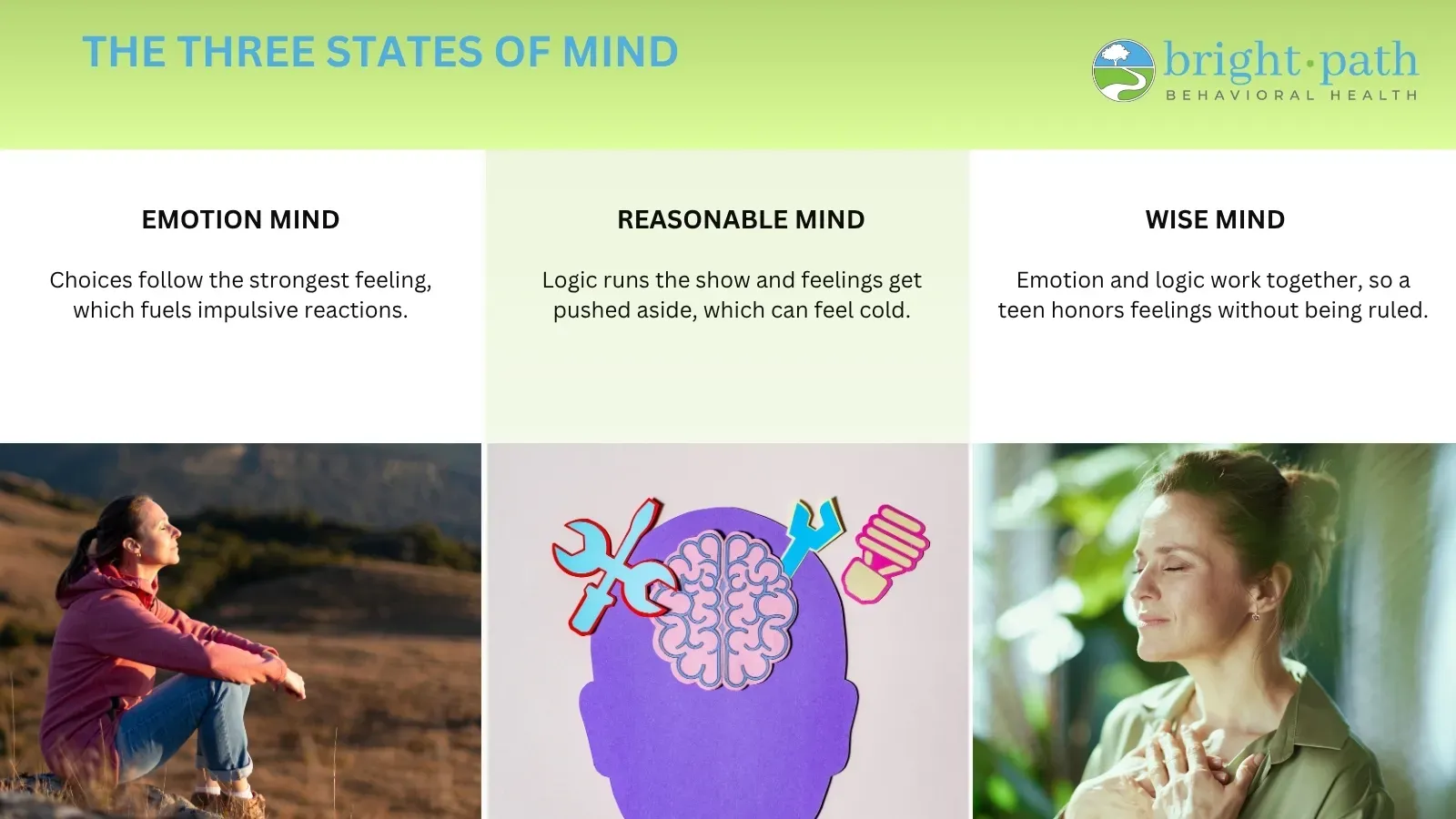
The three states of mind are emotion mind, reasonable mind, and wise mind, and a teen moves between them throughout a day. Knowing which state is driving helps a teen choose whether to act now or pause.
Emotion mind
- Feelings in control: In emotion mind, a teen's choices follow the strongest feeling, which fuels impulsive texts, outbursts, or shutdown.
- Fast and hot: Emotion mind reacts before facts register, the same surge that drives crisis moments addressed by distress tolerance skills.
Reasonable mind
- Logic in control: In reasonable mind, a teen thinks in facts, plans, and rules, with feelings pushed aside.
- Useful but cold: Reasonable mind solves problems well but can ignore what a teen actually needs, which makes decisions feel hollow.
Wise mind
- Both at once: Wise mind holds the feeling and the fact together, so a teen honors emotion without being ruled by it.
- The DBT goal: Most DBT practice aims to widen the moments a teen spends in wise mind rather than swinging between the other two.
How can a teen find their wise mind?
A teen finds wise mind through short mindfulness practices that quiet emotion mind and reasonable mind long enough for the steady middle to surface. The path is attention, not pressure.
- Step 1, pause and breathe: The teen follows several slow breaths, which lowers the volume of emotion mind enough to notice it.
- Step 2, ask the wise mind question: The teen asks, "What does my wise mind say?" and waits rather than answering instantly.
- Step 3, locate the calm certainty: Teens often feel wise mind as a settled sense in the body, a contrast to the buzz of emotion mind.
- Step 4, check it against facts: The teen confirms the answer fits both how they feel and what is actually true.
- Step 5, act from there: The teen makes the choice from that grounded state, then notices the result to build trust in the skill.
Wise mind vs emotion mind: how are they different?
Wise mind and emotion mind differ in what drives the decision. Emotion mind lets the strongest feeling decide, while wise mind weighs that feeling against the facts before acting.
FeatureEmotion mindWise mind
What leads
The strongest current feeling
Feeling and fact together
Speed
Instant, reactive
Paused, considered
Typical result
Impulsive choices, later regret
Steady choices a teen stands by
How to shift
Notice the heat rising
Breathe, then ask wise mind
Neither state is bad. Emotion mind carries real information, and wise mind simply makes sure that information shares the decision with the facts, a balance that supports teens managing anxiety.
When does wise mind help a teen most?
Wise mind helps most during high-stakes decisions where a teen feels pulled between what they feel and what they know. Naming the state turns a reactive moment into a chosen one.
- Conflict with parents or peers: Wise mind lets a teen feel anger and still respond in a way that protects the relationship.
- Urges to self-harm: For teens with self-harm urges, the pause of wise mind opens space to use a safer skill instead.
- Low or hopeless moods: Wise mind helps a teen with depression separate a painful feeling from the false belief that the feeling is permanent.
If a teen is in immediate danger or talking about suicide, call or text 988 for the Suicide and Crisis Lifeline, or call 911.
How does Bright Path teach wise mind to teens?
Bright Path teaches wise mind through daily mindfulness practice woven into small group programming. Teens learn the three states of mind early, then rehearse reaching wise mind in the situations that usually trip them up.
Mindfulness built into the day
- Morning huddle: Each day opens with a check-in and intention-setting, which gives teens a calm starting point to notice their state of mind.
- Mindfulness-based self-compassion: Teens practice treating themselves like a friend, which quiets the harsh self-talk that locks them in emotion mind.
Practice that transfers home
- Process group: In a teen-led group, adolescents practice responding from wise mind while real feelings are present, not hypothetical.
- Step-down support: The intensive outpatient program reinforces wise mind after partial hospitalization, so the skill survives the return to daily life.
Kendall Baker, LCMHCA, a psychotherapist at Bright Path, puts it simply: "Teens already have a wise mind. Our job is to help them trust the quiet voice underneath the panic, and to slow down long enough to actually hear it before they act."
Frequently Asked Questions
What does wise mind feel like for a teen?
Wise mind usually feels like a calm, settled certainty in the body, different from the buzz of strong emotion. Many teens describe it as a quiet sense that a choice is right, even when it is not the easiest option.
Is wise mind the same as intuition?
It is close but not identical. Intuition can be pure gut feeling, while wise mind deliberately combines that feeling with the facts of a situation. Wise mind is intuition that has been checked against reality.
How is wise mind different from just calming down?
Calming down lowers emotion. Wise mind goes further by keeping the emotion in the room and adding logic, so the teen acts on a full picture rather than a numbed one. It is balance, not suppression.
Can a teen be in wise mind when very upset?
Yes, with practice. A teen first lowers the intensity using breath or a distress tolerance skill, then asks the wise mind question. Reaching it takes longer when emotion is high, but it is still possible.
Why is wise mind part of mindfulness?
Wise mind requires noticing your own state without judging it, which is the core of mindfulness. A teen cannot reach wise mind without first observing whether emotion mind or reasonable mind is in charge.
Does wise mind work for anxiety?
Yes. Anxiety lives in emotion mind, where fear outruns the facts. Wise mind helps a teen check whether the threat is as large as it feels, which lowers the spiral and supports clearer choices.
How long does it take to learn wise mind?
Teens grasp the idea in one or two sessions but need weeks of daily practice to reach wise mind reliably under stress. Like other DBT skills, repetition in real situations is what makes it dependable.
References
- Linehan, M. M. (2015). DBT Skills Training Manual (2nd ed.). Guilford Press.
- McCauley, E., Berk, M. S., Asarnow, J. R., Adrian, M., Cohen, J., Korslund, K., ... Linehan, M. M. (2018). Efficacy of dialectical behavior therapy for adolescents at high risk for suicide: A randomized clinical trial. JAMA Psychiatry, 75(8), 777-785.
- Mehlum, L., Tørmoen, A. J., Ramberg, M., Haga, E., Diep, L. M., Laberg, S., ... Grøholt, B. (2014). Dialectical behavior therapy for adolescents with repeated suicidal and self-harming behavior: A randomized trial. Journal of the American Academy of Child & Adolescent Psychiatry, 53(10), 1082-1091.
- Kabat-Zinn, J. (2013). Full Catastrophe Living: Using the Wisdom of Your Body and Mind to Face Stress, Pain, and Illness (Rev. ed.). Bantam Books.
- Centers for Disease Control and Prevention. (2024). Youth Risk Behavior Survey Data Summary & Trends Report: 2013-2023. U.S. Department of Health and Human Services.
- National Institute of Mental Health. (2024). Child and adolescent mental health. U.S. Department of Health and Human Services.
- American Psychiatric Association. (2022). Diagnostic and Statistical Manual of Mental Disorders (5th ed., text rev.).