
-1.svg)
Peer pressure for teens is the direct or indirect influence friends and classmates exert to push a teenager toward changing their attitudes, values, or behavior to fit in. It intensifies during adolescence because belonging becomes a core need. The pressure can be spoken or unspoken, and it can be negative or genuinely positive.
Adolescents feel this pull more strongly than adults for a biological reason. The brain's reward system matures years before the prefrontal cortex that governs judgment and impulse control. That developmental gap makes the approval of peers feel urgent and the consequences of risky choices feel distant.
Understanding the types of peer pressure, how it affects mental health, and the refusal skills that actually work gives teens and parents a practical way to respond. Most peer influence is manageable, and a large share of it is prosocial.
Key Takeaways
- Peer pressure for teens comes in six types across three pairs: direct and indirect, spoken and unspoken, negative and positive.
- Teenagers are more susceptible than adults because the brain's reward system matures before the prefrontal cortex, which is not fully developed until about age 25.
- The presence of peers roughly doubles risk-taking in adolescents, an effect not seen in adults, according to Steinberg's experimental research.
- In 2023, 77.0 percent of high school students reported frequent social media use, which the CDC links to higher rates of bullying, persistent sadness, and suicide risk.
- Not all peer pressure is harmful, since most teens report friends who discourage risky behavior, and positive peer influence promotes studying, sports, and healthy habits.
What Is Peer Pressure for Teens?
Peer pressure is the influence of a peer group that encourages a person to change behavior to gain acceptance. Peers are people of similar age, status, or interests. For teenagers, peers include friends, classmates, teammates, and online contacts of roughly the same age.
Researchers increasingly prefer the broader term peer influence. Peer influence describes choosing to act differently because you want to feel valued by friends, which is not always against your will. Peer pressure is the more coercive form, where the expectation to conform feels forced.
This influence begins around age 10 and rises through junior high and high school. As teenagers become more independent from parents, friends take on a larger role in shaping daily decisions, from clothing and language to bigger choices about substances and risk.
What Are the Types of Peer Pressure?
There are six recognized types of peer pressure, organized as three overlapping pairs. A single situation can combine several types at once, such as unspoken, indirect, and negative pressure all together.
Type | Definition | Teen example |
Direct | Explicit pressure to act immediately | Someone hands a teen a vape and waits |
Indirect | Group norms a teen adjusts to without being asked | Copying how a group dresses or talks |
Spoken | A verbal request, dare, or taunt | "Don't be a wimp, everyone is doing it" |
Unspoken | Nonverbal cues and following the crowd | Seeing peers drink and joining silently |
Negative | Pushes toward behavior against a teen's values | Skipping class, bullying, or substance use |
Positive | Pushes toward beneficial behavior | Friends encouraging studying or training |
Direct and spoken pressure is the easiest to recognize and, because it is visible, the easiest to refuse. Indirect and unspoken pressure is often stronger because it does not feel like pressure at all. A teen simply drifts toward the group's behavior without any words being exchanged.
Why Are Teenagers More Susceptible to Peer Pressure?
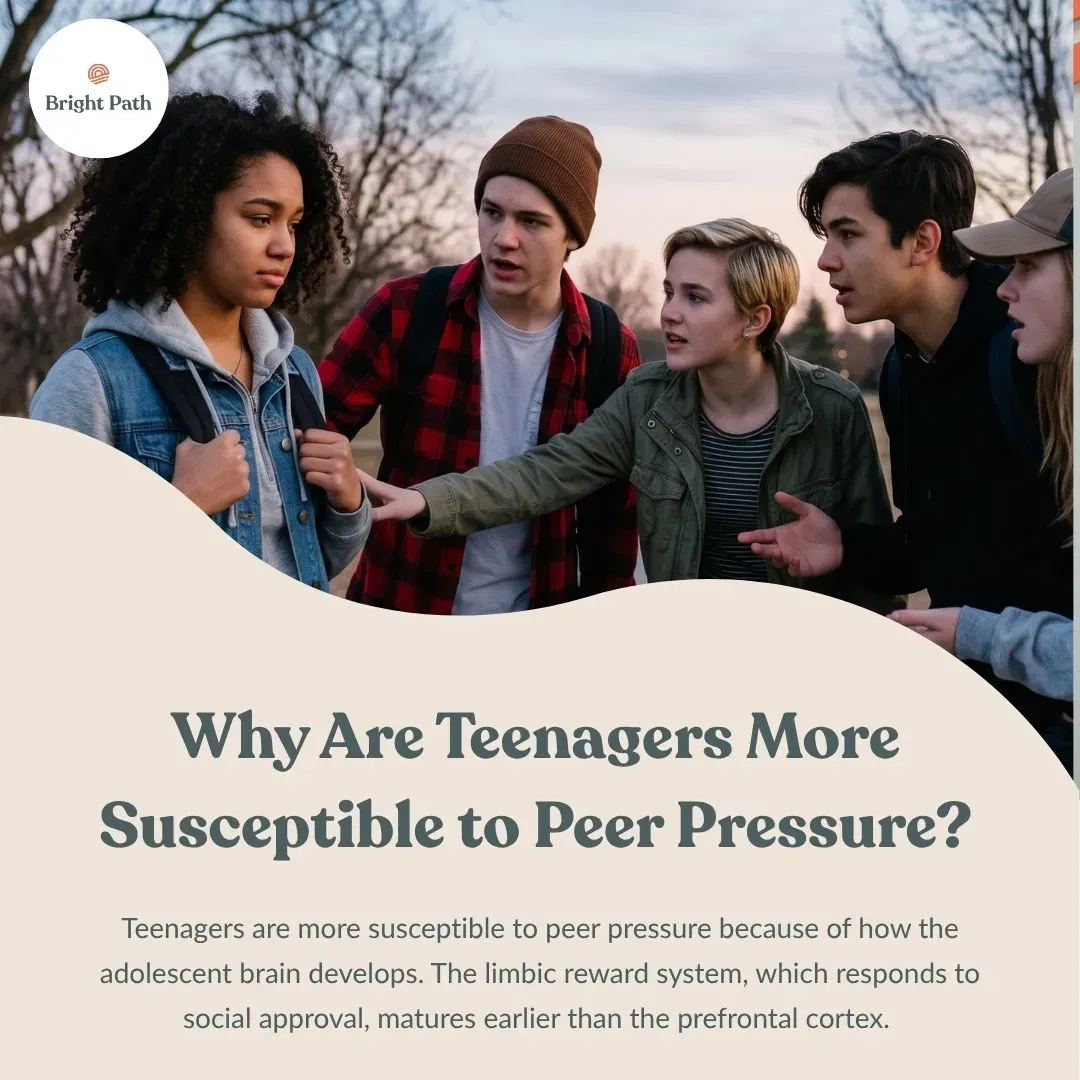
Teenagers are more susceptible to peer pressure because of how the adolescent brain develops. The limbic reward system, which responds to social approval, matures earlier than the prefrontal cortex. The prefrontal cortex, responsible for judgment and impulse control, is not fully mature until about age 25, according to the National Institute of Mental Health.
This imbalance makes peer approval feel intensely rewarding while long-term consequences feel remote. The classic experiments by developmental psychologist Laurence Steinberg showed the effect clearly. The mere presence of peers roughly doubled risk-taking among adolescents, increased it by about half among college-age youth, and had no measurable effect on adults.
Brain imaging studies help explain why. When peers were watching, activity in adolescents' reward-related regions increased, and that activity predicted greater risk-taking. The developing teenage brain and its response to substances follows this same pattern, which is why social settings raise the stakes for teens.
How Does Peer Pressure Affect Teen Mental Health?
Chronic negative peer pressure is linked to anxiety, depression, low self-esteem, chronic stress, and social withdrawal. When a teenager repeatedly acts against their values to gain acceptance, the internal conflict erodes confidence and mood over time.
The scale of teen distress is significant. The CDC's 2023 Youth Risk Behavior Survey found that 39.7 percent of high school students experienced persistent feelings of sadness or hopelessness, and 28.5 percent reported poor mental health. Peer relationships are one of several factors shaping these outcomes.
Unaddressed pressure can also drive risky behavior. When social stress fuels ongoing anxiety or low mood, structured support helps, and many teens benefit from professional treatment for adolescent anxiety that teaches coping skills before symptoms deepen. The connection runs both ways, since managing the stress teenagers carry makes them less vulnerable to giving in.
How Does Social Media Increase Peer Pressure?
Social media amplifies peer pressure by making group norms visible around the clock. Teens no longer leave the pressure at school. Feeds display what peers wear, do, and value, creating constant indirect and unspoken pressure to match.
In 2023, 77.0 percent of high school students reported frequent social media use, meaning they checked platforms at least several times a day, according to CDC data. Frequent use was associated with higher rates of bullying victimization, persistent sadness, and suicide risk.
Teens feel the strain directly. Pew Research Center found in 2025 that 39 percent of teens said social media makes them feel overwhelmed by drama, and 31 percent felt pressure to post content that gets likes and comments. The share of teens who say social media has a mostly negative effect on people their age rose to 48 percent.
How Can Teens Say No to Peer Pressure?
Teens resist negative peer pressure most effectively when they prepare before the moment arrives. Refusal is a skill that improves with rehearsal, not a personality trait some teens simply lack.
- Know your values in advance so decisions are made before pressure hits.
- Give a confident, simple no with eye contact and no long explanation.
- Offer an alternative, such as suggesting a different activity the group can do together.
- Use an exit plan, like a prearranged code text to a parent for a ride home.
- Rely on the buddy system, since one ally makes refusal far easier.
- Choose friends who share your values and respect your choices.
- Leave the situation entirely when something feels unsafe.
Blaming a parent is a legitimate face-saving tactic that many teens use successfully. Saying "my mom would ground me for a month" shifts the refusal onto an outside rule and takes the social sting out of saying no.
Can Peer Pressure Be Positive?
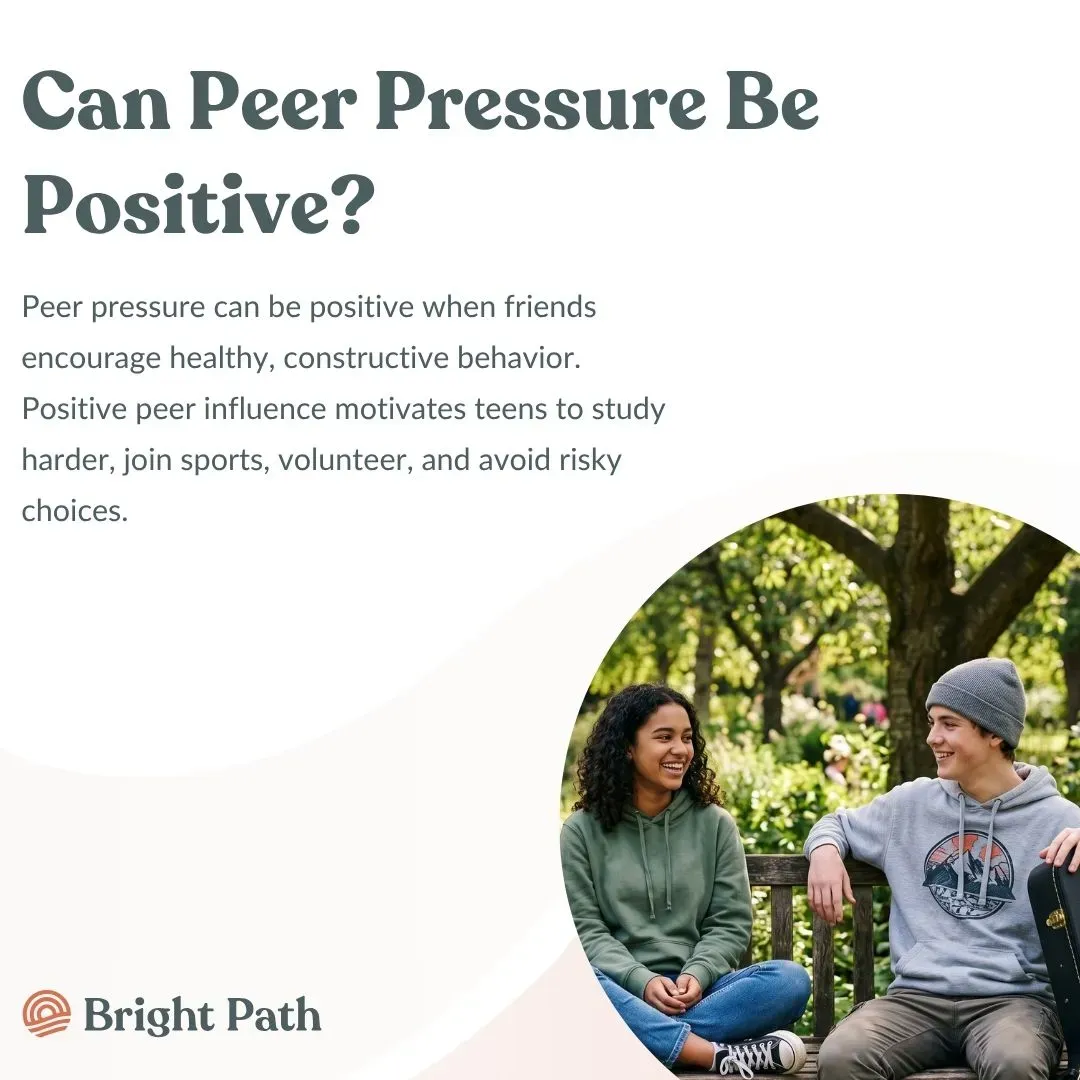
Peer pressure can be positive when friends encourage healthy, constructive behavior. Positive peer influence motivates teens to study harder, join sports, volunteer, and avoid risky choices. The same drive to fit in that creates risk can also reinforce good habits.
Fear-based assumptions often overstate the negative. Research from the University of Michigan found that the large majority of young teens reported no friend pressure toward drinking, drug use, or sex. Many teens actively encourage each other to stay out of trouble.
Parents and mentors can strengthen this effect by helping teens build friendships around shared healthy interests. A supportive peer group becomes a protective factor rather than a source of risk, which is one reason strong social connection is repeatedly linked to better teen mental health.
What Are the Warning Signs a Teen Is Struggling With Peer Pressure?
Parents can watch for behavioral shifts that suggest a teen is struggling with negative peer pressure. No single sign confirms a problem, but a cluster of changes warrants attention and a calm conversation.
- A sudden change in friend group or pulling away from longtime friends.
- New secrecy, withdrawal, or repeated boundary testing at home.
- Declining grades and lost interest in former hobbies or goals.
- Changes in dress, speech, or behavior aimed at fitting in.
- Irritability or moodiness, especially after time with certain peers.
- Signs of substance use or changes in sleep and appetite.
When these signs cluster with substance use, self-harm, or persistent low mood, professional evaluation is appropriate. Ongoing patterns of risky behavior can signal a deeper issue, and early support for substance use in teenagers is more effective than waiting.
When Should a Teen Get Professional Support?
A teen should get professional support when peer-related stress produces persistent changes in mood, functioning, or safety. Peer pressure itself is a normal part of growing up, but its downstream effects sometimes require clinical care.
Warning signs that call for help include ongoing sadness lasting more than two weeks, withdrawal from family and activities, declining daily functioning, substance use, self-harm, or any suicidal thoughts. These signals indicate that a teen needs more than encouragement at home.
Structured programs give teens skills to manage social pressure and the emotions underneath it. At Bright Path Behavioral Health, adolescents build these skills through dialectical behavior therapy and cognitive behavioral therapy.
Frequently Asked Questions
At what age does peer pressure start?
Peer pressure typically begins around age 10 and intensifies through junior high and high school. As children become more independent from parents during early adolescence, friends and classmates take on a larger role in shaping choices, which increases both the frequency and the intensity of peer influence.
Is peer pressure always negative?
No. Peer pressure can be positive when friends encourage healthy behavior such as studying, exercising, or volunteering. Research shows most teens report their friends do not pressure them toward risky behavior. The same desire to belong that fuels negative pressure can also reinforce constructive habits and good decisions.
What is the difference between direct and indirect peer pressure?
Direct peer pressure is an explicit request or dare to act now, such as being offered a substance. Indirect peer pressure involves adjusting to group norms without being asked, like changing how you dress or speak. Indirect pressure is often stronger because it does not feel like pressure.
How does peer pressure affect the teenage brain?
The teenage brain's reward system matures before the prefrontal cortex that controls judgment. This gap makes peer approval feel highly rewarding while consequences feel distant. Studies show the presence of peers can roughly double risk-taking in adolescents, an effect not seen in adults.
Can peer pressure cause anxiety or depression?
Chronic negative peer pressure is associated with anxiety, depression, low self-esteem, and stress in teens. Repeatedly acting against personal values to gain acceptance creates internal conflict that can erode mood over time. When these feelings persist, professional support helps teens build healthier coping skills.
References
- Centers for Disease Control and Prevention. (2024). Mental health and suicide risk among high school students and protective factors: Youth Risk Behavior Survey, United States, 2023. MMWR, 73(4). CDC
- Centers for Disease Control and Prevention. (2024). Frequent social media use and experiences with bullying victimization, persistent feelings of sadness or hopelessness, and suicide risk among high school students: Youth Risk Behavior Survey, United States, 2023. MMWR, 73(4).
- National Institute of Mental Health. (n.d.). The teen brain: 7 things to know. NIH
- Chein, J., Albert, D., O'Brien, L., Uckert, K., & Steinberg, L. (2011). Peers increase adolescent risk taking by enhancing activity in the brain's reward circuitry. Developmental Science, 14(2), F1–F10.
- Pew Research Center. (2025). Social media and teens' mental health: What teens and their parents say. Pew Research Center.
- American Academy of Child and Adolescent Psychiatry. (2018). Peer pressure (Facts for Families No. 104). AACAP.