
-1.svg)
Selective mutism is an anxiety disorder where a teen consistently cannot speak in specific social settings like school, even though they talk normally at home. The silence is not refusal or defiance. Intense anxiety physically blocks speech in situations that feel threatening to the teen.
Anxiety disorders affect roughly one in three adolescents nationally, and in North Carolina an estimated 128,000 teens aged 12 to 17 live with depression that frequently overlaps with anxiety, according to the National Alliance on Mental Illness. Many of these teens stay quiet about what they feel, which makes early recognition difficult.
Key Takeaways
- The Diagnostic and Statistical Manual of Mental Disorders, Fifth Edition, Text Revision (DSM-5-TR) classifies selective mutism as an anxiety disorder, and affected teens have the physical ability to speak.
- Research published in the Journal of Anxiety Disorders reports that the majority of children and teens with selective mutism also meet criteria for social anxiety disorder.
- Behavioral therapy combined with anxiety-focused support helps most teens regain speech across settings, and the National Institute of Mental Health identifies untreated adolescent anxiety as a driver of later depression and school dropout.
- Teens respond to graded exposure and cognitive behavioral therapy, and selective serotonin reuptake inhibitors support recovery when anxiety is severe.
What Is Selective Mutism in Teens?
Selective mutism describes a consistent failure to speak in specific social situations where speaking is expected, despite speaking normally in comfortable settings. The DSM-5-TR places selective mutism within the anxiety disorders category, which reframes the silence as an anxiety response rather than stubbornness. A teen with selective mutism wants to speak but feels physically unable to produce words when anxiety peaks.
The condition typically begins in early childhood, often between ages three and six. In teens, the disorder produces visible distress in classrooms, group projects, and peer interactions where speaking feels exposing.
Selective mutism meets diagnostic criteria only when the silence lasts at least one month, is not limited to the first month of school, and significantly interferes with school or social functioning. The condition is not explained by a communication disorder or a lack of knowledge of the spoken language.
How Selective Mutism Develops?
Selective mutism follows a recognizable progression from early signs to entrenched avoidance, and the timeline below shows how the disorder hardens without intervention. Each stage builds on the anxiety patterns of the one before it.
- Ages 3 to 6, early onset: The first silence usually appears when a child starts preschool or kindergarten, where new social demands trigger the freeze response and adults often mistake it for shyness.
- Ages 7 to 11, reinforcement: Avoidance becomes a habit as the child learns that staying silent reduces anxiety, which strengthens the behavior through negative reinforcement.
- Ages 12 to 14, social escalation: Middle school multiplies speaking demands through class participation and peer groups, and the gap between the teen and talking peers widens visibly.
- Ages 15 to 18, entrenchment: High school pressures around presentations, dating, and independence intensify distress, and untreated selective mutism increasingly limits academic and social opportunities.
What Are the Types of Mutism?
The types of mutism include selective mutism, traumatic mutism and progressive mutism. Several distinct conditions produce reduced or absent speech, and selective mutism represents only one form within this group. Understanding the differences clarifies why selective mutism responds to anxiety treatment rather than speech correction alone.
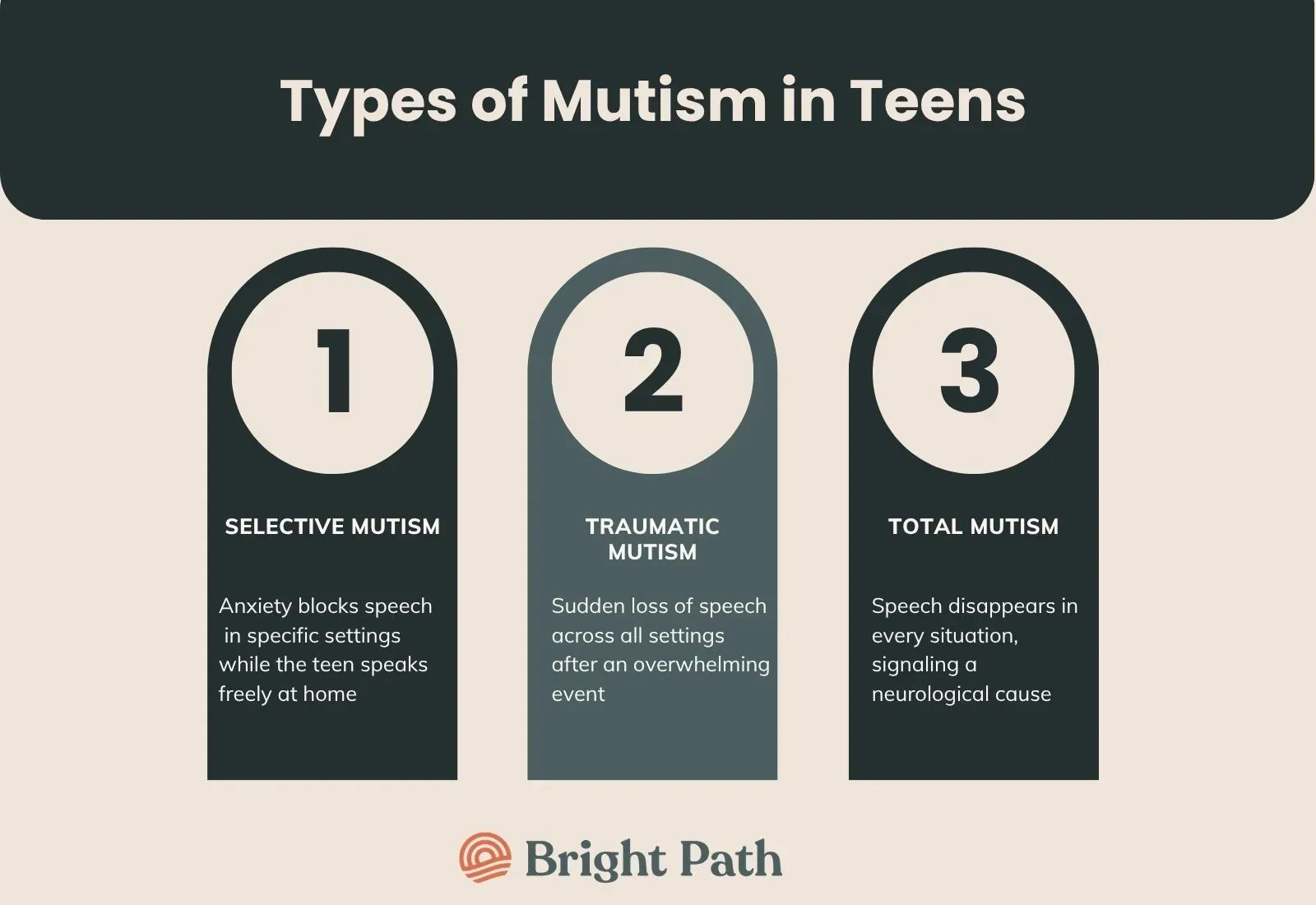
- Selective mutism: Anxiety blocks speech in specific settings while the teen speaks freely in safe environments such as home, which marks this as the situation-dependent, anxiety-driven type.
- Traumatic mutism: A single overwhelming event triggers sudden loss of speech across all settings, distinguishing traumatic mutism from the selective, environment-specific pattern.
- Total or progressive mutism: Speech disappears in every situation, which signals a broader neurological or psychiatric cause rather than social anxiety.
What Are the Signs and Symptoms of Selective Mutism in Teens?
Selective mutism in teens produces a recognizable cluster of behavioral and physical signs that center on anxiety-driven silence. The symptoms range from subtle avoidance to visible panic, and they escalate when a feared setting forces the teen toward speech.
Common Signs of Selective Mutism
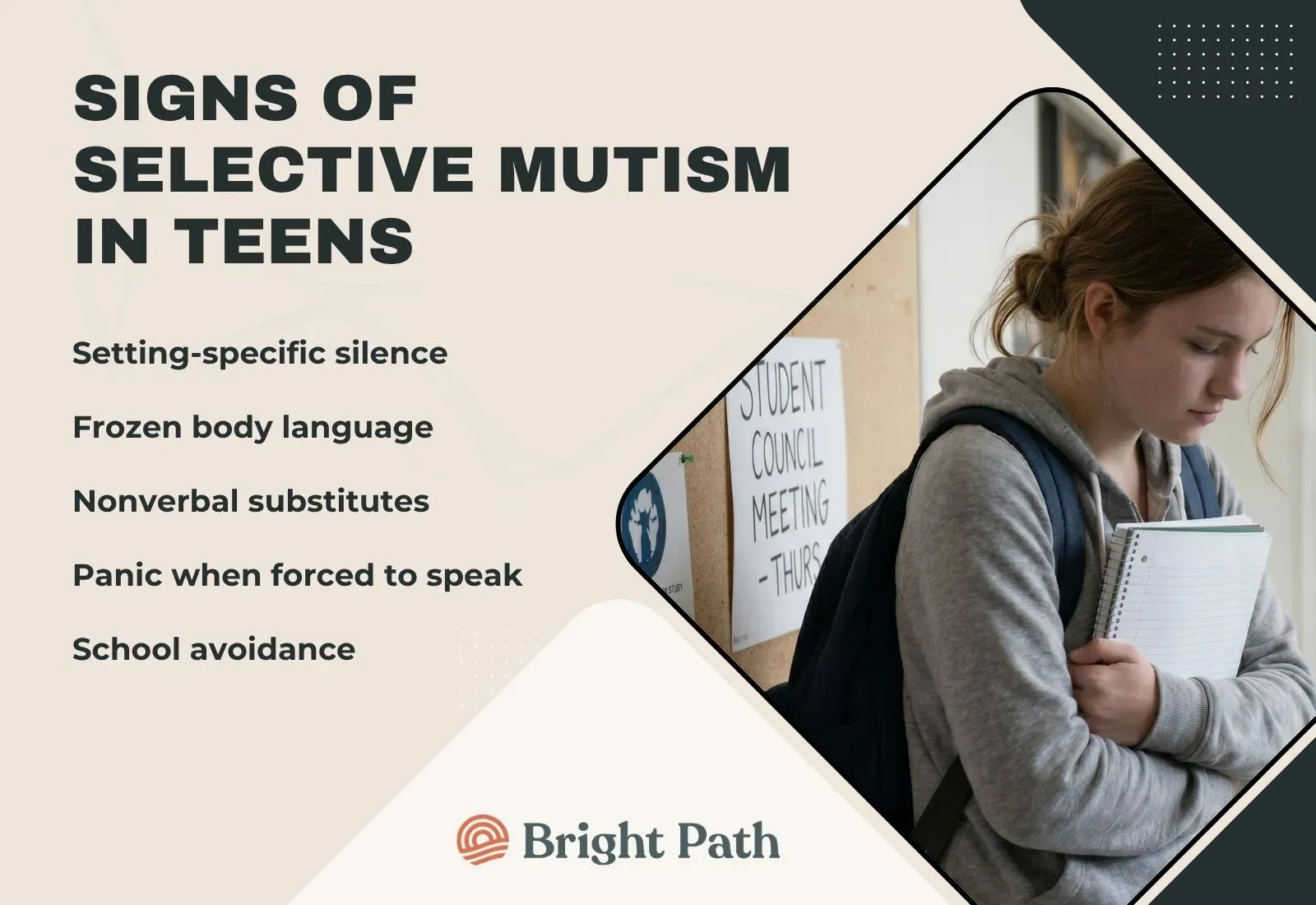
The everyday signs of selective mutism appear most clearly in school and unfamiliar social settings. Parents and teachers often notice the following patterns:
- Setting-specific silence: The teen speaks comfortably at home yet cannot get the words out at school, which is the hallmark sign of selective mutism.
- Frozen body language: A blank expression, stiff posture, and avoidance of eye contact signal that anxiety has taken over in the moment.
- Nonverbal substitutes: The teen nods, points, or writes notes to communicate rather than speaking aloud.
- Delayed responses: Long pauses before any reaction reflect the internal struggle between wanting to answer and being unable to.
Severe Signs When Anxiety Escalates
Selective mutism produces more intense symptoms when a teen feels cornered into speaking. These escalation signs warrant prompt clinical attention:
- Panic responses: A racing heart, sweating, trembling, or stomach distress can appear when speech is demanded directly.
- Complete shutdown: The teen may freeze entirely, unable to move or respond, when anxiety overwhelms their coping capacity.
- School refusal: Mounting dread can drive the teen to avoid school altogether, isolating them further from peers and learning.
Long-Term Effects of Untreated Selective Mutism
Untreated selective mutism produces lasting consequences that extend well beyond the classroom. The disorder restricts development across several areas:
- Academic decline: Inability to participate, ask questions, or present work directly lowers grades and limits learning.
- Social isolation: Persistent silence blocks friendship formation and deepens loneliness through the teen years.
- Secondary depression: Chronic anxiety and isolation raise the risk of mood difficulties and emotional dysregulation over time.
What Causes Selective Mutism?
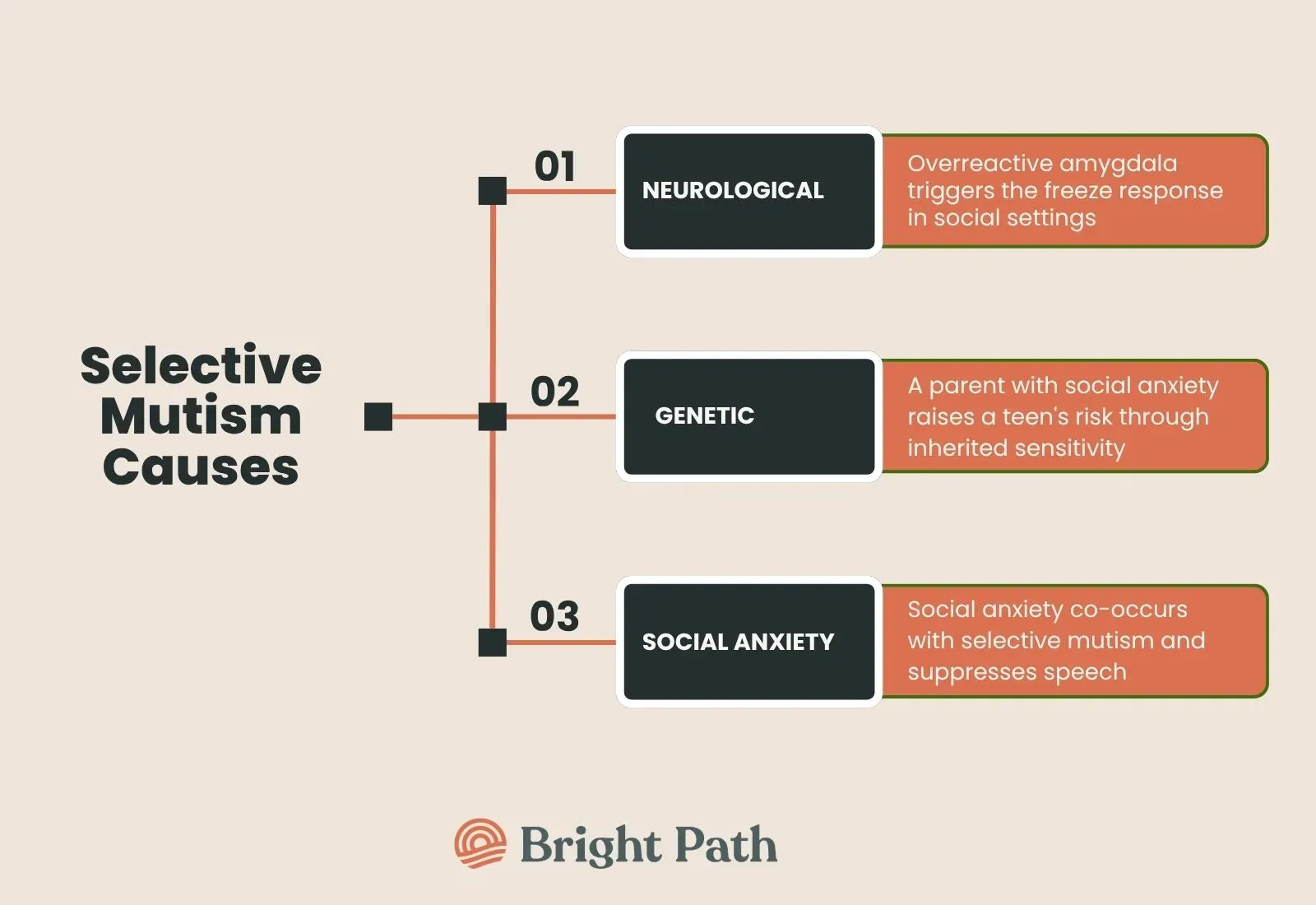
Selective mutism develops through several interacting pathways rather than one single cause, and most teens carry a biological vulnerability that the environment then activates. The condition reflects an overactive fear response rather than a deliberate choice.
Neurobiological Factors
An overreactive amygdala drives much of the silence in selective mutism, since this brain structure processes threat and triggers the freeze response. When a teen with selective mutism enters a feared social setting, the amygdala signals danger and effectively shuts down speech production. Researchers link this pattern to a temperament trait called behavioral inhibition, where a child reacts to unfamiliar people and places with withdrawal and heightened fear.
Genetic and Hereditary Factors
A family history of anxiety substantially raises the risk of selective mutism, because anxiety disorders cluster within families through shared genes. Teens with a parent who has social anxiety disorder inherit a greater tendency toward the same threat sensitivity that underlies selective mutism.
Developmental and Environmental Factors
Early experiences shape how strongly anxiety takes hold, and certain environments intensify a teen's existing vulnerability. The following factors commonly contribute to selective mutism in teens:
- Social anxiety disorder: Social anxiety disorder co-occurs with selective mutism in most cases, and the fear of negative judgment directly suppresses speech in evaluative settings.
- Adverse experiences: Bullying, social rejection, or a frightening public speaking moment can reinforce avoidance and deepen the silence over time.
- Bilingual or immigration stress: Pressure to speak an unfamiliar language in public can heighten anxiety, though selective mutism is diagnosed only when silence exceeds normal adjustment.
Selective Mutism vs Autism
Selective mutism and autism spectrum disorder both involve communication challenges, yet they stem from fundamentally different sources. Families frequently confuse the two because reduced speech appears in both, but the underlying drivers and the pattern of silence separate them clearly.
Feature | Selective Mutism | Autism Spectrum Disorder |
Core driver | Anxiety blocks speech in specific settings | Differences in social communication and development |
Speech at home | Speaks freely and normally | Communication differences persist across all settings |
Social desire | Wants social connection but fear blocks it | May have different social interests or needs |
Setting dependence | Silence is setting-specific | Patterns appear consistently everywhere |
Onset trigger | Triggered by social anxiety | Present from early development |
A teen with selective mutism speaks fluently and warmly in safe settings, which rarely happens with the communication differences seen in autism. The two conditions can co-occur, so a thorough evaluation distinguishes anxiety-based silence from developmental communication needs before treatment begins.
How Selective Mutism Is Diagnosed?
Selective mutism diagnosis relies on clinical observation, structured questionnaires, and ruling out other causes, since no single lab test confirms the condition. A licensed mental health professional gathers information from parents, teachers, and the teen to map where and when the silence occurs.
The Selective Mutism Questionnaire (SMQ) is the most widely used assessment tool, and it measures how often a teen speaks across home, school, and social settings to gauge symptom severity. Clinicians often pair it with the School Speech Questionnaire (SSQ), which captures teacher observations of speaking behavior in the classroom. Higher silence scores across more settings indicate more severe selective mutism.
A complete evaluation also screens for co-occurring conditions and rules out communication disorders, hearing problems, and language barriers. This careful process ensures the silence reflects anxiety rather than another condition that needs different care.
Treatment for Selective Mutism in Teens
Treatment for selective mutism in teens targets the underlying anxiety through behavioral and, when needed, medication-based approaches. The most effective plans combine gradual speaking practice with anxiety reduction, and treatment works at any age when matched to the teen's needs.
Behavioral therapy forms the foundation of selective mutism treatment because it directly targets the avoidance that sustains silence. Cognitive behavioral therapy (CBT) and DBT-based care help teens identify anxious thoughts and gradually face feared speaking situations.
Medication supports recovery when anxiety is severe enough to block behavioral progress. Selective serotonin reuptake inhibitors (SSRIs) such as fluoxetine and sertraline reduce the intensity of the anxiety response, which makes graded exposure more tolerable. A psychiatric provider monitors any medication closely, since SSRIs work best alongside therapy rather than alone.
Selective Mutism Treatment at Bright Path Behavioral Health
Bright Path Behavioral Health treats selective mutism as the anxiety condition it is, using a developmentally matched, exposure-friendly model built specifically for teens. The Wake Forest center separates programming by age and keeps each track small, with a maximum of 12 teens, so quiet teens receive individual attention while practicing communication in a supportive peer group.
The partial care program at Bright Path provides intensive day treatment from 9am to 3pm, five days a week, for teens whose anxiety significantly disrupts school and daily life. Teens join either the Summit track for ages 15 to 18 or the Meadow track for ages 12 to 15, ensuring age-appropriate peer interaction. Dialectical behavior therapy skills, creative expression groups, and horticulture therapy give teens with selective mutism multiple non-verbal entry points before building toward spoken participation.
The intensive outpatient program suits teens who can manage school but need more than weekly therapy to address persistent anxiety. Meeting three afternoons a week, the program builds distress tolerance, interpersonal effectiveness, and gradual social exposure through DBT-informed group work.
Frequently Asked Questions
Can adults have selective mutism?
Yes, adults can have selective mutism, though it usually begins in childhood and continues when left untreated. Adults with the condition often speak freely with close family but freeze in workplaces or public settings. Treatment remains effective in adulthood, especially with cognitive behavioral therapy and anxiety support.
Can selective mutism be cured?
Selective mutism responds very well to treatment, and many teens regain full speaking ability across settings. Recovery depends on early, consistent intervention with behavioral therapy and anxiety reduction. Clinicians describe successful outcomes as full remission rather than a one-time cure, since anxiety management may continue.
Does selective mutism go away on its own?
Selective mutism rarely resolves without treatment and often becomes more entrenched as a teen ages. The silence is reinforced over time because avoidance temporarily lowers anxiety. Structured behavioral treatment is needed to break that cycle and restore speech across settings.
Is there a test for selective mutism?
Yes, clinicians use validated tools such as the Selective Mutism Questionnaire to assess how often and where a teen speaks. A full evaluation also includes parent and teacher input and rules out other communication or developmental conditions. No single medical test diagnoses the disorder on its own.
How do you get a teen with selective mutism to talk?
Forcing or pressuring a teen to speak typically worsens selective mutism. Effective approaches use gradual exposure, low-pressure settings, and rewards for small speaking steps guided by a trained clinician. Reducing demands and building safety allows speech to return at the teen's pace.
References
- American Psychiatric Association. (2022). Diagnostic and statistical manual of mental disorders (5th ed., text rev.). American Psychiatric Association Publishing.
- Muris, P., & Ollendick, T. H. (2021). Selective mutism and its relations to social anxiety disorder and autism spectrum disorder. Clinical Child and Family Psychology Review, 24(2), 294-325.
- National Institute of Mental Health. (2023). Any anxiety disorder among adolescents. U.S. Department of Health and Human Services. NIMH
- Bergman, R. L., Keller, M. L., Piacentini, J., & Bergman, A. J. (2008). The development and psychometric properties of the Selective Mutism Questionnaire. Journal of Clinical Child and Adolescent Psychology, 37(2), 456-464.
- Shipon-Blum, E. (2007). The ideal classroom setting for the selectively mute child. Selective Mutism Anxiety Research and Treatment Center.
- Substance Abuse and Mental Health Services Administration. (2023). Key substance use and mental health indicators in the United States. U.S. Department of Health and Human Services. SAMHSA
- National Alliance on Mental Illness. (2021). Mental health in North Carolina. NAMI.
- Driessen, J., Blom, J. D., Muris, P., Blashfield, R. K., & Molendijk, M. L. (2020). Anxiety in children with selective mutism: A meta-analysis. Child Psychiatry & Human Development, 51(2), 330-341.