
-1.svg)
DBT skills for teens are practical coping tools from dialectical behavior therapy that help adolescents manage intense emotions, reduce self-harm, and handle relationships.
Psychologist Marsha Linehan organized these tools into four modules: mindfulness, distress tolerance, emotion regulation, and interpersonal effectiveness.
For parents, the appeal is concrete. Each skill gives your teen a specific action to take when emotions spike, instead of shutting down or melting down.
Teens learn the skills in structured groups, then rehearse them at home and school until the responses become automatic. The aim is not to erase big feelings but to make them workable.
Which module your teen needs first depends on what they struggle with most right now.
Key Takeaways
- Four skill modules: DBT for teens covers mindfulness, distress tolerance, emotion regulation, and interpersonal effectiveness, and each module targets a different driver of adolescent distress.
- Evidence in adolescents: In a randomized trial led by Lars Mehlum and colleagues (2014), dialectical behavior therapy for adolescents reduced self-harm, suicidal ideation, and depression more than enhanced usual care.
- Why this matters now: The CDC's 2023 Youth Risk Behavior Survey reported that about 40% of U.S. high school students experienced persistent feelings of sadness or hopelessness.
- Acceptance plus change: DBT trains teens to accept painful emotions and change harmful behaviors at the same time, the balance Linehan named the dialectic.
- Skills are taught, not innate: Adolescents build these abilities through repeated practice in group, individual sessions, and real situations, not through willpower alone.
What are DBT skills?
DBT skills are a set of teachable behaviors that help a teen regulate emotions, tolerate distress, stay present, and communicate effectively. Marsha Linehan developed dialectical behavior therapy at the University of Washington, originally for adults with chronic suicidal behavior, and clinicians later adapted it for adolescents as DBT-A.
The word "dialectical" points to the core idea: two things that seem opposite can both be true. A teen can be doing their best and still need to do better. Holding both sides is what the skills make possible.
- Skills, not lectures: DBT teaches named, repeatable moves such as the STOP skill and TIPP, so a teen always has a next step when overwhelmed.
- Built for big emotions: The approach targets emotion dysregulation, the pattern where feelings escalate fast, hit hard, and take a long time to settle.
- Practiced everywhere: Teens use a diary card to track skill use between sessions, which turns classroom and home moments into practice reps.
How does DBT help teens?
DBT helps teens by treating emotional overwhelm as a skills gap rather than a character flaw, then teaching the missing skills directly. Linehan's biosocial model explains the gap as a fit problem between an emotionally sensitive child and an environment that misreads or dismisses those emotions.
Clinicians often measure that sensitivity with the Difficulties in Emotion Regulation Scale (DERS), a questionnaire that scores how well a person manages emotions across six areas, including impulse control and access to coping strategies. Lower difficulty scores over time signal that the skills are taking hold.
- It lowers self-harm risk: The Mehlum 2014 randomized trial found that DBT-A cut self-harm episodes more than standard care, with the advantage holding at one-year follow-up.
- It builds a pause: Distress tolerance skills create space between a trigger and a reaction, which interrupts impulsive responses driven by an overactive threat response.
- It engages the family: Adolescent DBT adds parents to skills training, so the home environment reinforces the same language instead of working against it.
What are the 4 modules of DBT?
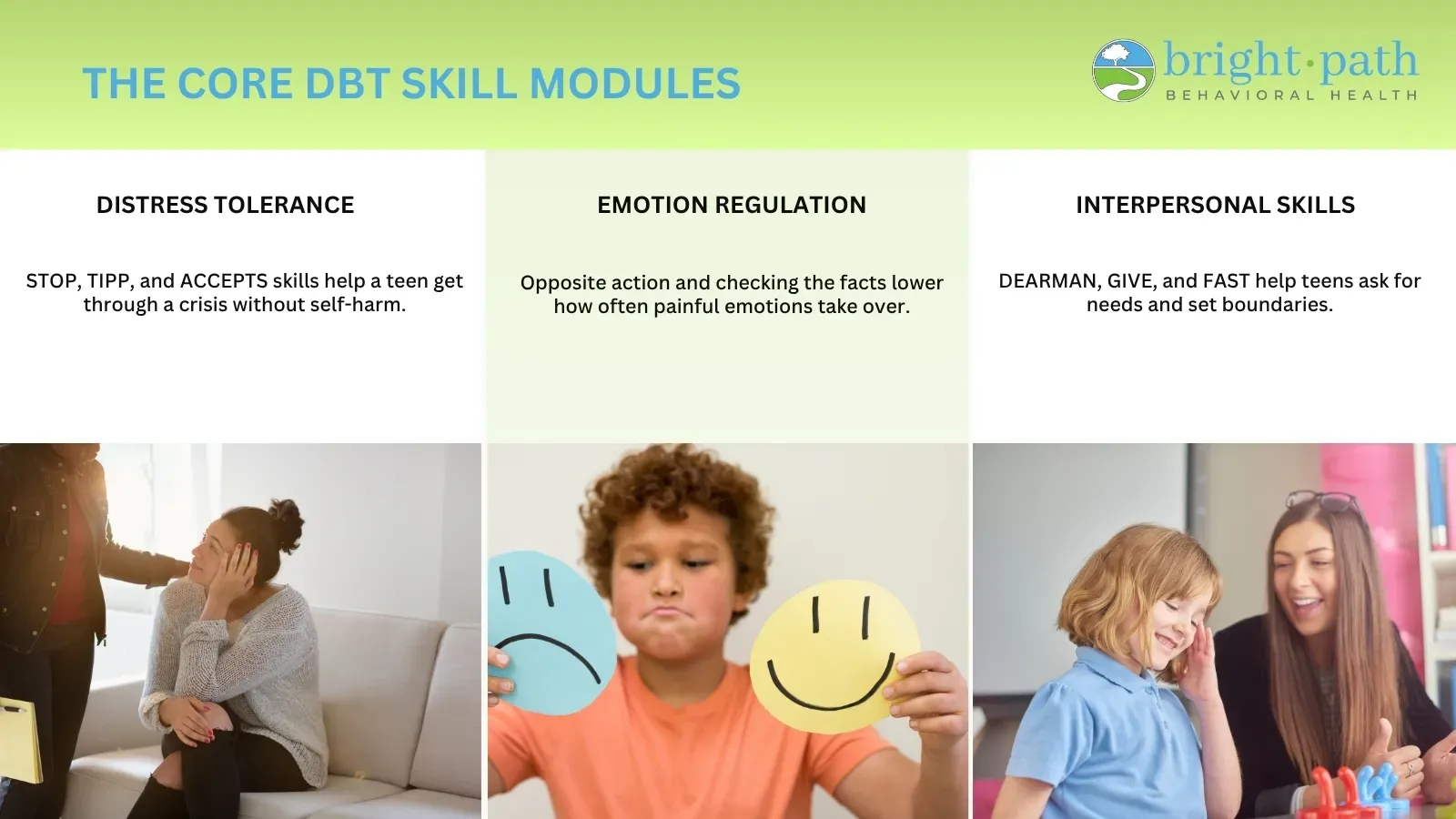
The four DBT modules are mindfulness, distress tolerance, emotion regulation, and interpersonal effectiveness, and a teen learns specific skills inside each one. Bright Path teaches all four across its intensive outpatient program and partial hospitalization program.
Mindfulness
Mindfulness is the foundation module that teaches teens to notice their experience without judging it, which makes every other skill usable under pressure.
- Three states of mind: Teens learn to recognize emotion mind, reasonable mind, and the balanced wise mind they aim for when making decisions.
- What skills: Observe, describe, and participate give teens a way to step back and name what is happening before reacting.
- How skills: Acting non-judgmentally, one-mindfully, and effectively keeps attention on what works rather than on what feels fair.
Distress tolerance
Distress tolerance is the crisis module that helps teens survive intense moments without making them worse through self-harm or impulsive choices.
- Crisis survival skills: The full set of distress tolerance skills includes STOP, TIPP, ACCEPTS, and IMPROVE the moment.
- Change the body fast: TIPP uses cold water, intense exercise, paced breathing, and paired muscle relaxation to bring a racing nervous system down quickly.
- Accept what cannot change: Radical acceptance teaches teens to stop fighting a painful reality so their energy goes toward coping.
Emotion regulation
Emotion regulation is the module that teaches teens to understand, reduce, and recover from painful emotions before those emotions take over.
- Act opposite to the urge: Opposite action directs a teen to do the reverse of what an unhelpful emotion demands, such as approaching instead of avoiding.
- Check the facts: Teens test whether the intensity of an emotion matches the actual situation, which deflates fear and shame that outrun reality.
- PLEASE skills: Treating illness, balanced eating, avoiding mood-altering substances, balanced sleep, and exercise protect the body that emotions run on.
Interpersonal effectiveness
Interpersonal effectiveness is the relationship module that teaches teens to ask for what they need, set boundaries, and keep self-respect during conflict.
- DEARMAN: A scripted approach to make a request clearly, covering describe, express, assert, reinforce, stay mindful, appear confident, and negotiate.
- GIVE: Being gentle, interested, validating, and easy in manner protects the relationship while a teen states a need.
- FAST: Staying fair, avoiding over-apologizing, sticking to values, and being truthful protects a teen's self-respect.
How long does it take a teen to learn DBT skills?
Most teens learn the core DBT skills within a structured program of roughly 12 to 24 weeks, though using them automatically takes longer practice. Skill acquisition is fast; skill generalization, the point where a teen reaches for a skill without prompting, is the longer phase.
- Weeks 1 to 5, foundations: Teens cover states of mind, the STOP and TIPP skills, and emotion basics, which mirrors the 5-week curriculum rotation at Bright Path.
- Weeks 6 to 12, full module pass: A teen works through all four modules at least once and begins logging skill use on a diary card.
- Weeks 12 to 24, strengthening: The adolescent DBT model studied by Mehlum ran about 19 weeks, the window where skills move from classroom to real life.
- Ongoing, generalization: Booster sessions and step-down care keep skills active after the intensive phase ends.
Is DBT the same as CBT?
DBT is not the same as CBT, though DBT grew out of cognitive behavioral therapy and shares its focus on changing thoughts and behaviors. The key difference is that DBT adds acceptance and emotion-survival skills for teens whose feelings are too intense for change strategies alone.
FeatureDBTCBT
Primary goal
Balance accepting emotions with changing behavior
Change unhelpful thoughts to change feelings and behavior
Core technique
Skills training across four modules
Identifying and reframing cognitive distortions
Best fit for
Emotion dysregulation, self-harm, suicidal ideation
Anxiety, depression, distorted thinking patterns
Format
Group skills plus individual therapy and coaching
Usually individual sessions with homework
Bright Path uses both, matching the method to what each teen needs. CBT supports teens whose main struggle is distorted thinking, while DBT leads when emotion dysregulation drives the crisis.
When does a teen need DBT skills?
A teen needs DBT skills when emotions are intense enough to disrupt school, family life, or safety, especially when self-harm or suicidal thoughts are present. DBT was built for exactly this level of distress, which is why it anchors most adolescent intensive programs.
- Emotional intensity: Frequent meltdowns, rapid mood shifts, or going from calm to overwhelmed in seconds point toward a distress tolerance gap.
- Safety behaviors: A teen using self-harm to cope, or expressing suicidal ideation, needs immediate skills and clinical support.
- Co-occurring symptoms: DBT skills also support teens managing major depression and teen anxiety, where avoidance and rumination keep symptoms locked in.
If your teen is in immediate danger or talking about ending their life, call or text 988 for the Suicide and Crisis Lifeline, or call 911.
How does Bright Path teach DBT skills to teens?
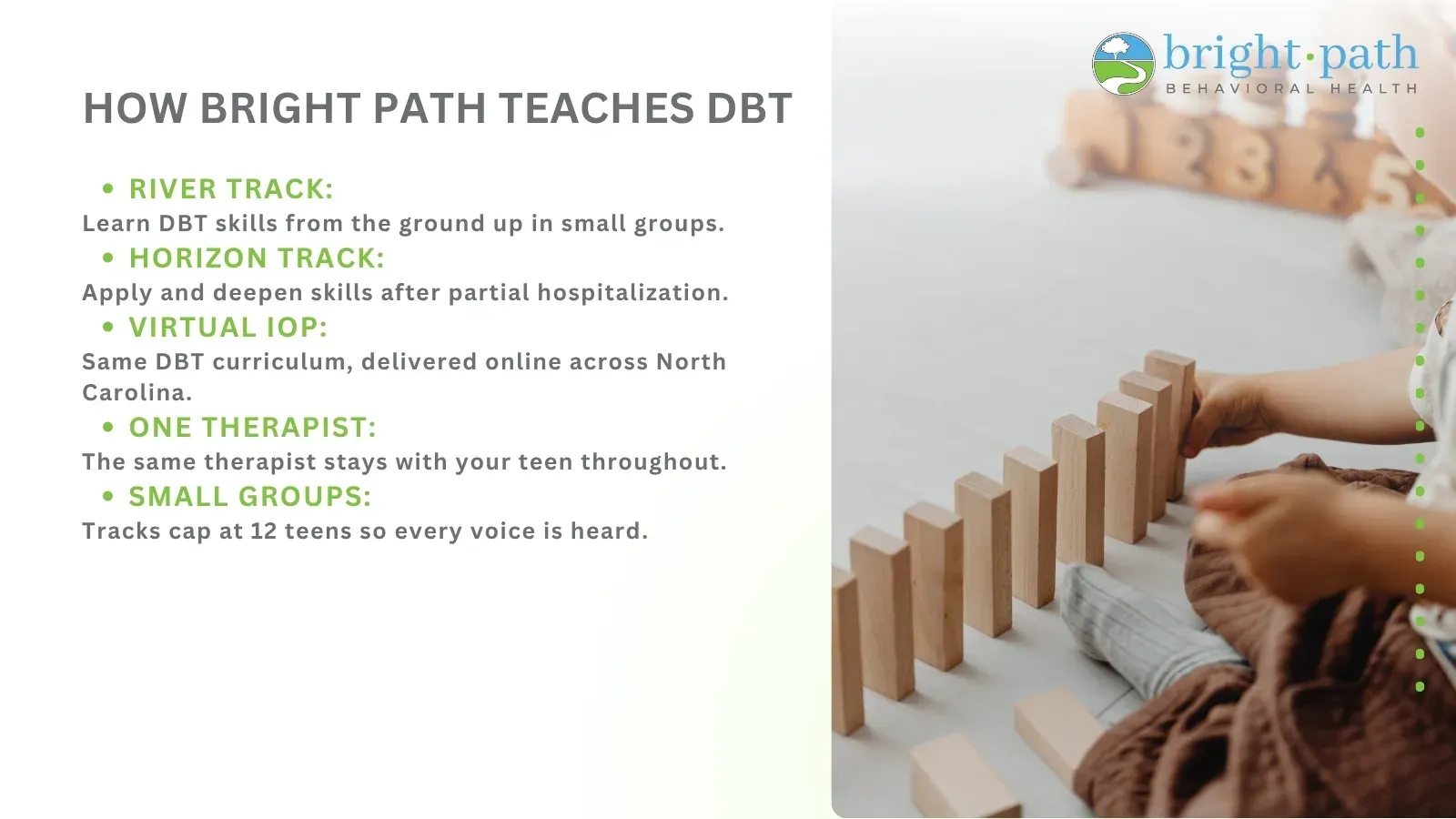
Bright Path teaches DBT skills through small, developmentally matched groups where teens learn each module and practice it the same day. Tracks are capped at 12 teens so every adolescent is heard daily, and the same therapist stays with a teen throughout treatment.
River Track, learning DBT from the start
- For teens new to treatment: The River track in Bright Path's intensive outpatient program teaches DBT skills from the foundation, including STOP, TIPP, IMPROVE, and opposite action.
- Schedule that fits school: River meets three afternoons a week, so teens keep attending school while building their skill base.
Horizon Track, applying skills at a deeper level
- For teens with DBT experience: The Horizon track is for adolescents who completed partial hospitalization or already know the basics and are ready to strengthen and apply skills.
- Focus on relationships: Horizon emphasizes attachment patterns and identity work alongside DBT review.
Jalecia Beatty, LCMHC, Bright Path's Regional Clinical Director, frames the work this way: "We teach DBT skills as everyday tools a teen can actually reach for in the hallway or at the dinner table, not abstract theory. When a teen sees a skill work once in real life, that is the moment it sticks."
Frequently Asked Questions
What are the 4 modules of DBT in simple terms?
The four modules are mindfulness, distress tolerance, emotion regulation, and interpersonal effectiveness. In plain terms, they teach a teen to stay present, survive crises, calm strong feelings, and handle relationships without losing themselves.
Can DBT be used for teenagers who do not self-harm?
Yes. While DBT was first studied for self-harm and suicidal behavior, the skills help any teen who struggles with intense emotions, anxiety, or conflict. Many adolescents use the skills for stress, perfectionism, and shutdown without any history of self-harm.
How is DBT different from regular talk therapy?
Regular talk therapy often focuses on insight and processing. DBT adds structured skills training, between-session practice, and a clear next move for crisis moments. A teen leaves with named tools rather than only understanding.
Do parents need to learn DBT skills too?
In adolescent DBT, yes. Parents learn the same skills so the home reinforces them, and shared language reduces conflict. Bright Path includes a weekly parent support group that builds these strategies.
What is wise mind in DBT?
Wise mind is the balance point between emotion mind, driven by feelings, and reasonable mind, driven by logic. It is the calm, grounded place from which a teen makes decisions they will not regret.
Is DBT effective for adolescents?
Yes. Randomized trials, including Mehlum and colleagues in 2014 and McCauley and colleagues in 2018, found that DBT reduced self-harm and suicidal behavior in high-risk adolescents more than comparison treatments.
How long does DBT treatment last for a teen?
A teen usually learns the core skills in 12 to 24 weeks. Using them automatically takes longer, which is why programs add booster sessions and step-down care to keep the skills active.
References
- Linehan, M. M. (2015). DBT Skills Training Manual (2nd ed.). Guilford Press.
- Mehlum, L., Tørmoen, A. J., Ramberg, M., Haga, E., Diep, L. M., Laberg, S., ... Grøholt, B. (2014). Dialectical behavior therapy for adolescents with repeated suicidal and self-harming behavior: A randomized trial. Journal of the American Academy of Child & Adolescent Psychiatry, 53(10), 1082-1091.
- Mehlum, L., Ramberg, M., Tørmoen, A. J., Haga, E., Diep, L. M., Stanley, B. H., ... Grøholt, B. (2016). Dialectical behavior therapy compared with enhanced usual care for adolescents with repeated suicidal and self-harming behavior: Outcomes over a one-year follow-up. Journal of the American Academy of Child & Adolescent Psychiatry, 55(4), 295-300.
- McCauley, E., Berk, M. S., Asarnow, J. R., Adrian, M., Cohen, J., Korslund, K., ... Linehan, M. M. (2018). Efficacy of dialectical behavior therapy for adolescents at high risk for suicide: A randomized clinical trial. JAMA Psychiatry, 75(8), 777-785.
- Gratz, K. L., & Roemer, L. (2004). Multidimensional assessment of emotion regulation and dysregulation: Development, factor structure, and initial validation of the Difficulties in Emotion Regulation Scale. Journal of Psychopathology and Behavioral Assessment, 26(1), 41-54.
- Centers for Disease Control and Prevention. (2024). Youth Risk Behavior Survey Data Summary & Trends Report: 2013-2023. U.S. Department of Health and Human Services.
- National Institute of Mental Health. (2024). Major depression statistics. U.S. Department of Health and Human Services.
- American Psychiatric Association. (2022). Diagnostic and Statistical Manual of Mental Disorders (5th ed., text rev.).