


A parent asks a teen to put the phone away before dinner. One teen yells and slams a door. Another walks out of the house without a word.
A third teen stares at the floor and cannot answer. A fourth says "Sorry, you're right," hands the phone over and then lies awake worrying about it.
These are fight, flight, freeze and fawn, the four survival responses. None of them is a choice, and each one calls for a different first move from a parent. Each response looks different in a teen, fawning hides behind good behavior, and a pattern that keeps firing needs help.
Key takeaways
- Automatic, not chosen: The body starts each survival response before a teen has time to think.
- Fawn is newer: Walter Cannon described fight or flight in 1915, and Pete Walker added fawn in 2003.
- Fawn hides well: A fawning teen looks cooperative, and that cooperation hides the stress underneath.
- Adversity is common: About three in four U.S. high school students reported at least one adverse childhood experience in 2023.
- Different first moves: Each response needs its own first step from a parent.
What are fight, flight, freeze and fawn?
Fight, flight, freeze and fawn are four automatic survival responses that the nervous system starts when it senses danger, real or remembered. Fight moves toward the threat, and flight moves away from it. Freeze stops all movement, and fawn tries to calm the threat by pleasing it.
Researchers call fight, flight and freeze "innate, hard-wired, automatically activated" defense behaviors, so a teen does not choose them. Fawn is learned, but scholar Sarah Schlote notes that this does not rule out a nervous system role.
Where do the four names come from?
Physiologist Walter Cannon set out "fight or flight" in 1915. In 2004, researcher H. Stefan Bracha proposed "freeze, flight, fight, fright, faint" as a fuller list.
The word fawn comes from psychotherapist Pete Walker, who described it in a 2003 article on codependency and trauma. Fawn is not a diagnosis or a DSM term, and a 2026 research review still calls it understudied.
Every version of the list starts in the body, with the same alarm system behind all four.
What happens in the body during each response?
During fight and flight the body speeds up, and during freeze it puts on a brake while staying on high alert. Stress runs through the sympathetic-adreno-medullary (SAM) axis and the hypothalamic-pituitary-adrenal (HPA) axis, raising heart rate and releasing adrenaline.
Freeze works differently, because heart rate drops while the muscles hold still. Karin Roelofs calls freezing "a parasympathetic brake on the motor system".
No study has measured what the body does during fawning, so fawn stays outside these body findings.
In teens, emotion systems are highly responsive while impulse control is "still relatively immature". That gap is one reason a teen's reaction looks bigger than the moment that set it off.
Popular explanations of the four survival responses draw on Stephen Porges's polyvagal theory. That theory is disputed, and psychophysiologist Paul Grossman argues its five basic premises are untenable or highly implausible.
That body response looks different in each teen, at home and at school.
How does each response look in a teen?
Each survival response has a recognizable look in teenagers, and a teen shifts between them as stress rises. In the defense cascade, freezing comes first and gives way to flight or fight when the threat gets closer.
Fight
A teen in fight mode moves toward the threat with words or force, such as yelling and slammed doors at home or talking back at school. Kozlowska and colleagues note that traumatized children often meet everyday stress by "exploding into a violent rage".
Flight
A teen in flight mode gets away from the threat, such as walking out mid-argument at home or skipping class at school. The same review describes traumatized children who answer everyday stress or trauma reminders by "running away".
Freeze
A teen in freeze mode goes still. Parents see a blank stare or "I don't know" to every question, and teachers see a teen who stops writing or goes silent when called on.
Freezing is not a choice, and it is not consent. In a Swedish study of 298 adult women seen after sexual assault, 70% reported significant tonic immobility, an involuntary inability to move.
Fawn
A teen in fawn mode tries to end the threat by keeping the other person happy. That looks like instant agreement, constant apologies or laughing along with a joke that hurts. Unlike freezing, fawning keeps the teen active and social, and Schlote describes it as being "overly helpful" toward unpredictable authority figures.
The four responses differ in four ways parents see:
| Response | What the body does | At home | At school | What a parent hears |
| Fight | Speeds up to confront | Yelling, slammed doors | Talking back, outbursts | "You can't make me!" |
| Flight | Speeds up to escape | Walking out, locked door | Skipping class, nurse visits | "I'm leaving." |
| Freeze | Holds still as heart rate slows | Blank stare, no answer | Silent when called on | "I don't know." |
| Fawn | Stays social to calm the threat | Instant agreement, apologies | Never pushing back | "Sorry, whatever you want." |
Of the four, fawning is the response adults mistake for a teen who is doing well.
Why is the fawn response easy to miss in teens?
The fawn response is easy to miss because a fawning teen looks polite, helpful and agreeable, and adults reward those traits. A teen who fights or runs gets noticed fast, while a teen who fawns gets praised for being easy.
Walker traced fawning to homes where protesting abuse brought "even more frightening parental retaliation". A 2023 journal letter on appeasement adds that young people appease caregivers who pose a risk of aggression or abandonment.
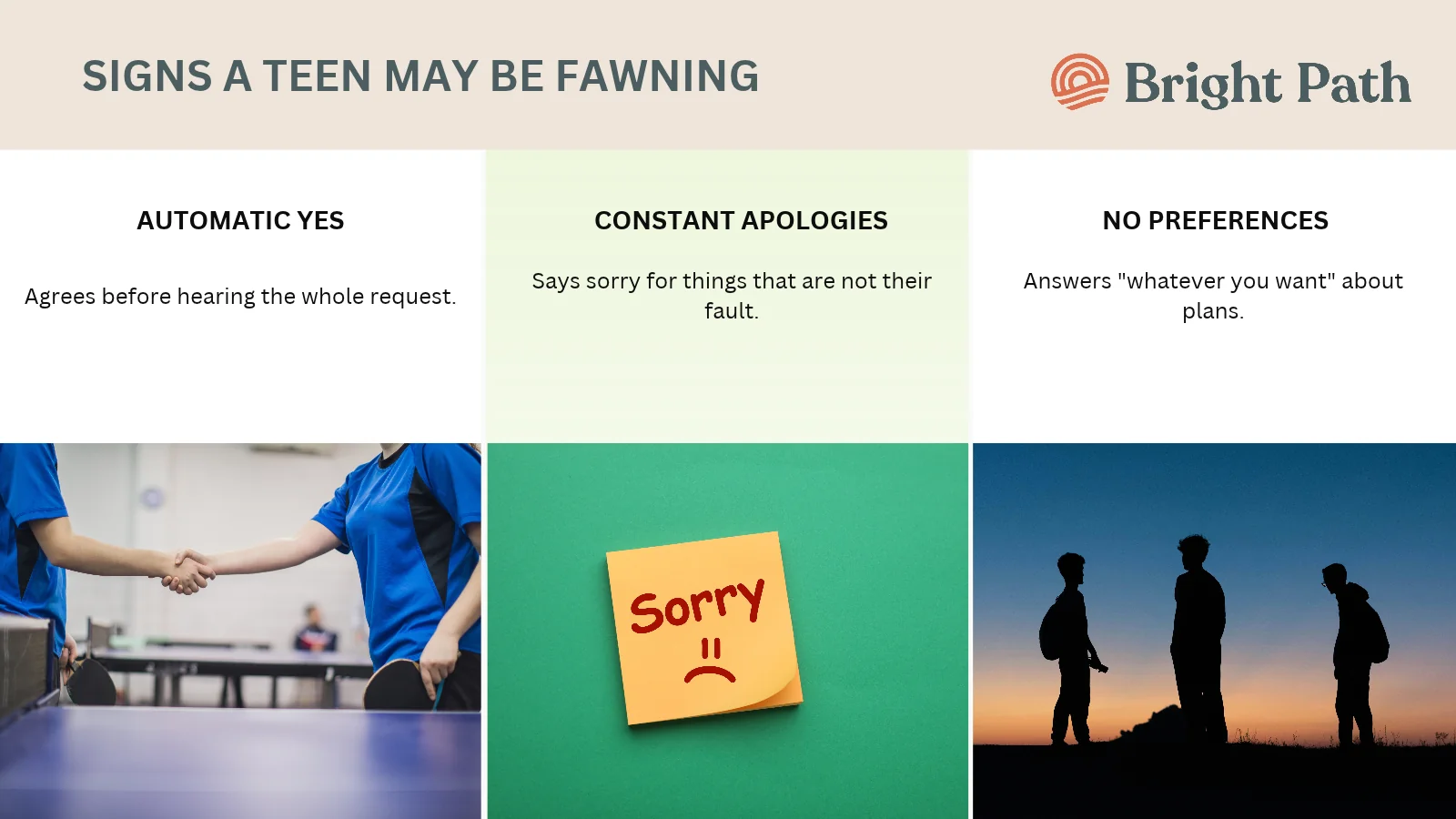
Six signs point to fawning in a teen:
- Automatic yes: The teen agrees before hearing the whole request.
- Constant apologies: The teen says sorry for things that are not their fault.
- No preferences: The teen answers "whatever you want" about food, plans and clothes.
- Mood matching: The teen watches adults' faces and shifts to fit their mood.
- Hidden distress: The teen seems fine in public and falls apart alone.
- Trouble saying no: The teen takes on too much rather than disappoint someone.
A pattern across home, school and friendships matters more than any single sign, especially when a teen stays stuck in one response.
Why do some teens get stuck in one response?
Teens get stuck in one survival response when repeated threat teaches the nervous system that one move keeps them safest. A stress response helps in a short burst but becomes harmful when stress is intense, repeated or prolonged.
In the 2023 Youth Risk Behavior Survey, 76.1% of U.S. high school students under 18 reported at least one adverse childhood experience, according to the CDC. That 76.1% includes the 18.5% who reported four or more.
The most common were emotional abuse at 61.5%, physical abuse at 31.8% and poor mental health in the household at 28.4%. These are lifetime reports, and every item except sexual abuse asks about parents or other adults at home.
An older national survey (2001 to 2004) found that 61.8% of teens aged 13 to 17 had lived through a potentially traumatic event. Repeated danger teaching the body one go-to response is one way trauma shows up in adolescents.
Each stuck pattern calls for a different first move from parents.
How should parents respond to each survival response?
Parents help most by matching their first move to the response, because a teen in survival mode cannot reason until the body feels safer. Each of the four responses has its own first move:
- Fight: Keep safety rules firm in the moment and save consequences for later that day.
- Flight: Agree on a way back instead of blocking the door, such as a time and place to talk.
- Freeze: Use short, calm prompts and gentle movement, which clinicians use to help people out of immobile states.
- Fawn: Make it safe to disagree, and thank the teen for an honest no, the kind of small step Walker's recovery work builds on.
Fight and flight push a teen above their window of tolerance, while freeze drops a teen below it, so a teen above the window needs calming and a teen below it needs grounding. Avoid asking a frozen or fawning teen "Why didn't you say something?" because the body made that call first.
Call or text 988 or chat at 988lifeline.org if a teen is in immediate danger or talking about suicide. Text HOME to 741741 for the Crisis Text Line, or call 911.
A pattern that a parent's first move does not settle needs professional help.
When does a survival response need professional help?
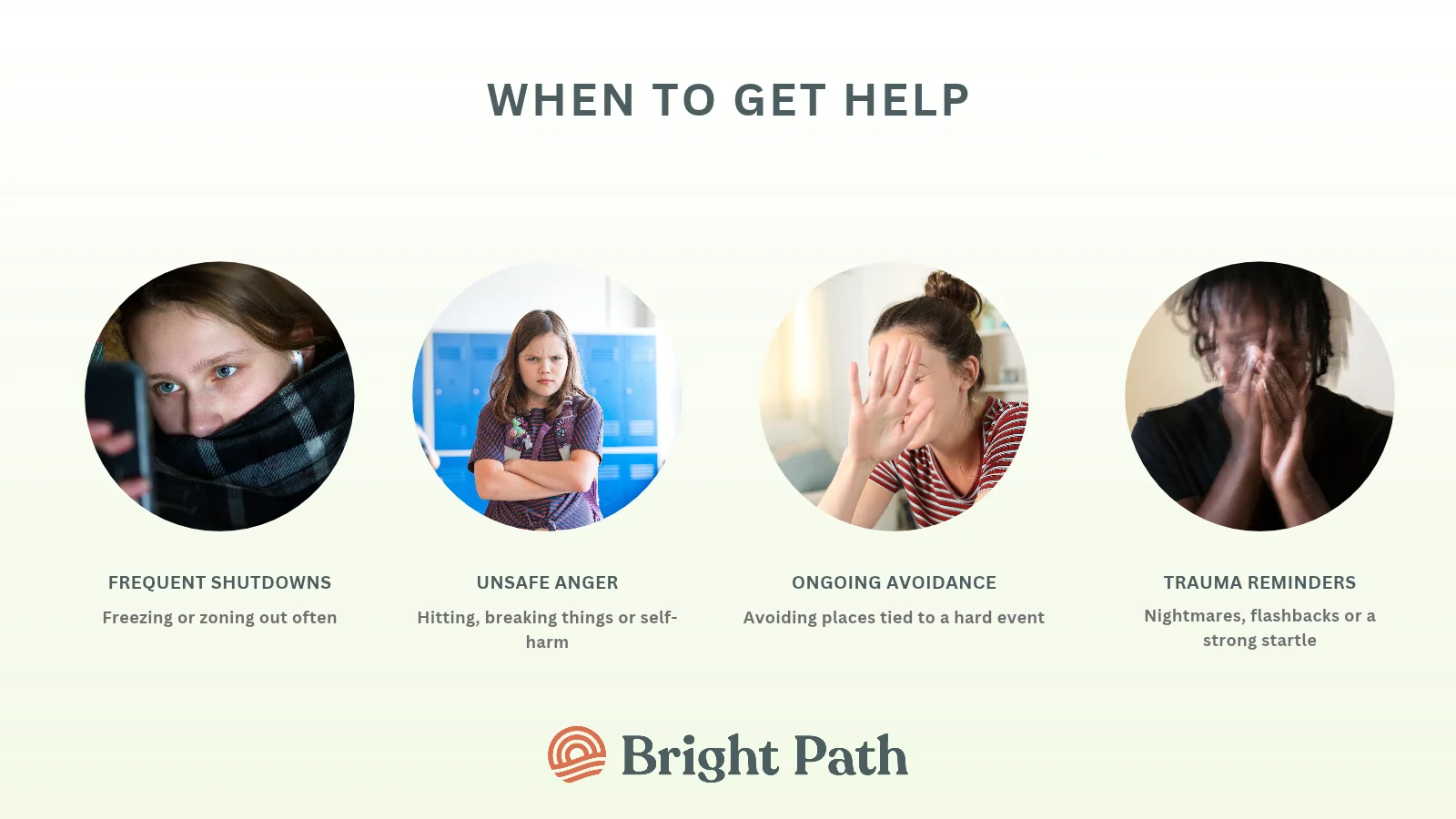
A survival response needs professional help when it keeps firing, outlasts the trigger and gets in the way of school, sleep or relationships. Five signs call for a professional evaluation:
- Frequent shutdowns: The teen freezes or zones out repeatedly, and it disrupts school or family time.
- Unsafe anger: Fight responses lead to hitting, breaking things or self-harm.
- Ongoing avoidance: The teen avoids school, people or places tied to a hard event.
- Lost preferences: A fawning teen cannot name what they want or feel.
- Trauma reminders: Nightmares, flashbacks or a strong startle follow a frightening event.
Nightmares, flashbacks and avoidance point to PTSD in teens, if they follow a frightening event. In the same older national survey, 4.7% of teens had PTSD during their lifetime, girls (7.3%) more often than boys (2.2%).
Bright Path teaches teens to name these responses as part of its skills groups.
How does Bright Path help teens understand survival responses?
Bright Path teaches teens to recognize survival responses through skills and psychoeducation groups, without processing trauma in group.
In the partial hospitalization program, week 3 of the five-week curriculum includes a group on fight-flight-freeze. A group on trauma and the window of tolerance helps teens understand trauma responses and recognize triggers. Interpersonal effectiveness skills such as DEARMAN and boundary setting give teens who fawn practice in saying what they need.
Teens who have completed PHP or know DBT basics qualify for the Horizon track of Bright Path's intensive outpatient program. Horizon focuses on attachment and relationship patterns and on trauma integration, not processing. Each track holds no more than 12 teens, and IOP runs in both Wake Forest and Hillsborough.
The questions below come from what parents search for about these responses.
Frequently asked questions
What is considered a fawn response?
A fawn response is a survival reaction in which a person tries to stay safe by pleasing or agreeing with the source of threat. Psychotherapist Pete Walker named it in 2003. In teens it looks like constant apologies and hiding their own needs.
What are the different types of fight-or-flight responses?
The commonly named types of fight-or-flight responses are fight, flight, freeze and fawn. Fight confronts the threat, flight escapes it, freeze stops all movement and fawn appeases it. Researchers also describe tonic immobility and collapse, when escape seems impossible.
What are the 5 F's of survival?
The 5 F's of survival change by author, and one popular list is fight, flight, freeze, fawn and flop. Stefan Bracha proposed freeze, flight, fight, fright and faint in 2004. Flop and faint both describe the body going limp under extreme threat.
What are the symptoms of the fight-or-flight response?
The main symptoms of the fight-or-flight response are a faster heart rate, a surge of adrenaline and tense, ready muscles. Breathing speeds up too. A teen in this state cannot think clearly until the body settles, so talks work better later.
Is fawning a choice or a personality trait?
Fawning is not a conscious choice or a fixed personality trait, but a survival pattern a teen learned. A teen who fawns is not being fake or manipulative. The pattern formed because pleasing others once felt safer, and with support it can loosen.
Sources
- Kozlowska, K., Walker, P., McLean, L., & Carrive, P. (2015). Fear and the defense cascade: Clinical implications and management. Harvard Review of Psychiatry, 23(4), 263-287. Open source
- Bracha, H. S. (2004). Freeze, flight, fight, fright, faint: Adaptationist perspectives on the acute stress response spectrum. CNS Spectrums, 9(9), 679-685. Open source
- Walker, P. (2003). Codependency, trauma and the fawn response. The East Bay Therapist, January/February 2003.
- Schlote, S. (2023). History of the term "appeasement": A response to Bailey et al. (2023). European Journal of Psychotraumatology, 14(2), 2183005. Open source
- Algarin, A. B., Lee, J.-Y., & Zhan, X. (2026). Fight, flight, fawn, freeze: Rethinking substance use through a stress response lens. Current Addiction Reports, 13(1), 21. Open source
- Chu, B., Marwaha, K., Sanvictores, T., Awosika, A. O., & Ayers, D. (2024). Physiology, stress reaction. StatPearls. StatPearls Publishing. Open source
- Roelofs, K. (2017). Freeze for action: Neurobiological mechanisms in animal and human freezing. Philosophical Transactions of the Royal Society B, 372(1718), 20160206. Open source
- Casey, B. J., Jones, R. M., & Hare, T. A. (2008). The adolescent brain. Annals of the New York Academy of Sciences, 1124, 111-126. Open source
- Porges, S. W. (2009). The polyvagal theory: New insights into adaptive reactions of the autonomic nervous system. Cleveland Clinic Journal of Medicine, 76(Suppl 2), S86-S90. Open source
- Grossman, P. (2023). Fundamental challenges and likely refutations of the five basic premises of the polyvagal theory. Biological Psychology, 180, 108589. Open source
- Möller, A., Söndergaard, H. P., & Helström, L. (2017). Tonic immobility during sexual assault: A common reaction predicting post-traumatic stress disorder and severe depression. Acta Obstetricia et Gynecologica Scandinavica, 96(8), 932-938. Open source
- Swedo, E. A., Pampati, S., Anderson, K. N., et al. (2024). Adverse childhood experiences and health conditions and risk behaviors among high school students: Youth Risk Behavior Survey, United States, 2023. MMWR Supplements, 73(4), 39-50. Open source
- McLaughlin, K. A., Koenen, K. C., Hill, E. D., et al. (2013). Trauma exposure and posttraumatic stress disorder in a national sample of adolescents. Journal of the American Academy of Child and Adolescent Psychiatry, 52(8), 815-830. Open source


Clinically reviewed by Dr. Shantel Sullivan, Ed.D., LCSW, Chief Executive Officer