


The window of tolerance is the range of stress a teen can handle while still thinking clearly, feeling emotions and staying connected to the people around them. Inside that range, a teen can be upset and still talk, listen and solve a problem.
Outside the window, the same teen either blows up or shuts down. A parent sees yelling, slammed doors and a teen who goes from 0 to 100. Or the parent sees a teen who goes quiet, zones out and seems not to care.
The window of tolerance is not fixed. Teens widen it with practiced skills, steady sleep and calm adults nearby. This guide covers what each zone looks like at home and what helps a teen get back inside.
Key Takeaways
- Three zones: A teen is inside the window, above it in hyperarousal, or below it in hypoarousal.
- Named by a psychiatrist: Dr. Daniel Siegel introduced the window of tolerance in his 1999 book The Developing Mind.
- Trauma is common: More than two-thirds of children in a 1,420-child study reported at least one traumatic event by age 16, according to Copeland and colleagues in Archives of General Psychiatry (2007).
- Two directions of help: Calming skills bring a teen down from hyperarousal, and alerting skills bring a teen up from hypoarousal.
- A description, not a diagnosis: The window widens with skills practice, sleep and co-regulation, and a narrow window does not mean a teen has a disorder.
What is the window of tolerance?
The window of tolerance is the zone of nervous system arousal in which a teen manages emotions, thinks clearly and stays connected to others. Arousal is the body's activation level. The autonomic nervous system sets it through two branches, the sympathetic branch that speeds the body up and the parasympathetic branch that slows it down.

A teen inside the window of tolerance shows three qualities:
- Present: The teen notices what is happening now instead of reacting to an old threat.
- Flexible: The teen tolerates frustration, sadness or worry without losing the ability to think.
- Connected: The teen accepts comfort, listens to feedback and keeps a conversation going.
Every teen has a different window width. The width also changes across a single day, narrowing after a bad night of sleep or a hard morning at school.
Who created the window of tolerance?
Daniel J. Siegel, MD, a UCLA psychiatrist, introduced the window of tolerance in The Developing Mind (1999) as part of interpersonal neurobiology. Pat Ogden, Kekuni Minton and Clare Pain carried the model into trauma therapy in Trauma and the Body (2006), where therapists use it to pace treatment.
The window of tolerance is a teaching model that helps people name their state. It is not a test, a score or a diagnosis.
What are the three zones of the window of tolerance?
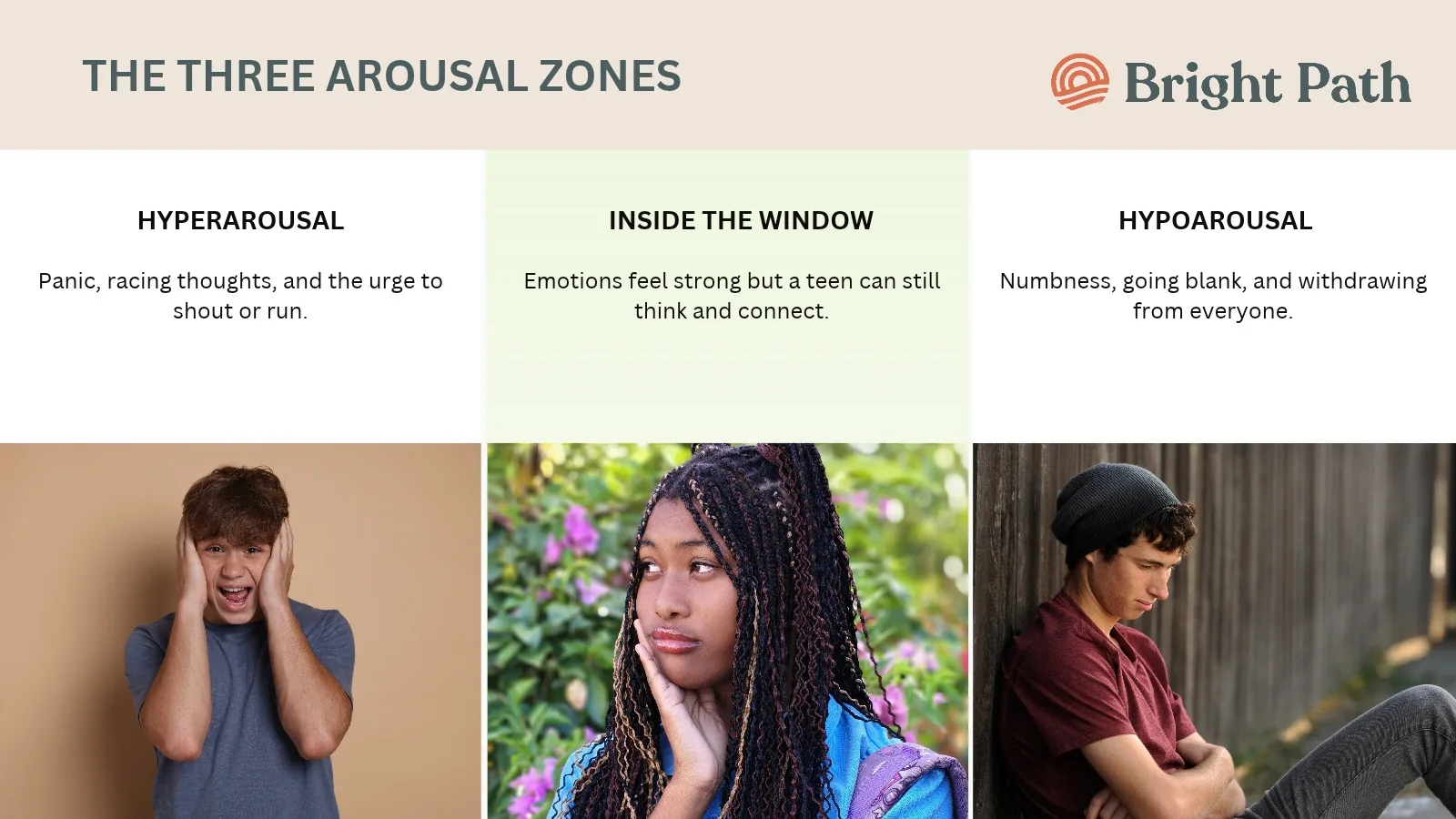
The three zones of the window of tolerance are the optimal zone inside the window, hyperarousal above it and hypoarousal below it. A teen moves between the zones many times a week, and the goal is to spend more time in the middle.
The optimal zone, inside the window
The optimal zone is a state of calm alertness in which emotions and clear thinking work at the same time. A teen in this zone can feel upset about a grade and still finish homework, explain the problem and accept help. Emotions rise and fall here without taking over the teen's thinking.
Hyperarousal, above the window
Hyperarousal is a state of too much activation, driven by the sympathetic fight-or-flight response. The teen's body prepares for danger even when no danger is present. A teen in hyperarousal shows six common signs:
- Racing heart: The teen breathes fast, shakes or feels hot.
- Explosive anger: The teen yells, swears or slams doors over a small request.
- Panic: The teen feels sudden fear, dizziness or a sense of losing control.
- Hypervigilance: The teen scans the room, startles easily and expects criticism.
- Restlessness: The teen paces, fidgets and cannot sit through dinner.
- Sleeplessness: The teen lies awake with racing thoughts.
Hypervigilance and a strong startle response are core features of PTSD symptoms in teenagers. A teen still experiences hyperarousal without having PTSD, because ordinary stress also pushes the body above the window.
Hypoarousal, below the window
Hypoarousal is a state of too little activation, in which the nervous system shuts down to conserve energy. Stephen Porges's polyvagal theory calls this the dorsal vagal or freeze response. A teen in hypoarousal shows six common signs:
- Numbness: The teen says "I don't feel anything" or "I don't care."
- Flat voice: The teen answers in one word with little expression.
- Zoning out: The teen stares, loses track of time or misses questions.
- Exhaustion: The teen sleeps for hours after school or stays in bed all weekend.
- Dissociation: The teen feels detached from the body or describes the world as unreal.
- Withdrawal: The teen stops texting friends and skips activities.
Parents often read hypoarousal as laziness or attitude. The shutdown is a protective response, not a choice the teen is making.
Hyperarousal and hypoarousal differ in five ways that parents can see at home:
| Feature | Hyperarousal | Hypoarousal |
| What drives it | Sympathetic fight-or-flight activation | Shutdown and energy conservation |
| At home | Yelling, arguing, slamming doors | Silence, isolation, sleeping for hours |
| At school | Outbursts, leaving class, fights | Blank stares, missed work, head on the desk |
| What a teen says | "Leave me alone!" | "Whatever" or "I don't care" |
| What helps first | Slowing the body down | Gently waking the body up |
What does a teen outside the window of tolerance look like?
A teen outside the window of tolerance either escalates fast or goes quiet and unreachable, often after a trigger that looks small to adults. The trigger matters less than how much stress the teen was already carrying.
Take one evening and one trigger, a parent collecting a teen's phone at 10 p.m.
One teen screams, throws a pillow and says the parent ruins everything. Another teen hands the phone over, locks the bedroom door and does not speak until morning. Both teens left the window, one upward and one downward.
Parents commonly misread three outside-the-window reactions:
- Defiance: A hyperaroused teen cannot reason in the moment, so arguing back escalates the conflict.
- Laziness: A hypoaroused teen lacks the energy to start a task, even a task the teen wants to do.
- Drama: The size of the reaction reflects the size of the stress underneath, not a wish for attention.
Why do some teens have a narrow window of tolerance?
Some teens have a narrow window of tolerance because trauma, chronic stress, poor sleep or a still-developing brain leave the nervous system quicker to react. A narrow window means a smaller amount of stress pushes the teen into hyperarousal or hypoarousal. Six factors narrow the window:
- Trauma: A nervous system that learned danger reacts sooner and stronger, which is one way trauma shows up in teenagers.
- Chronic stress: Ongoing pressure from grades, friendships or family conflict keeps the body near the top of the window.
- Poor sleep: Teens need 8 to 10 hours of sleep a night, per the American Academy of Sleep Medicine, and short sleep lowers the threshold for both zones.
- Illness or pain: A body fighting infection, headaches or chronic pain has less capacity for emotional load.
- Sensory overload: Noise, crowds and bright light narrow the window faster for many teens with ADHD or autism.
- Brain development: The prefrontal cortex, which plans and brakes impulses, is one of the last brain regions to mature. The brain keeps developing into the mid-to-late 20s, according to the National Institute of Mental Health.
Trauma narrows the window most when it repeats. Copeland and colleagues (2007) found that 13.4% of children exposed to a traumatic event developed some posttraumatic stress symptoms, and that prior exposure to multiple traumas predicted those symptoms.
How can a teen get back inside the window of tolerance?
A teen gets back inside the window of tolerance with a skill that fits the direction of the shift, slowing the body down from hyperarousal or gently waking it up from hypoarousal. Talking through the problem works only after the body settles.
Calming skills for hyperarousal
Calming skills lower heart rate and breathing so the thinking brain comes back online. Five calming skills work for hyperaroused teens:
- Breathe out longer: Inhale for 4 counts and exhale for 6 to 8 counts, for 2 minutes.
- Cool the face: Hold cold water or an ice pack on the face for 30 seconds.
- Move hard: Do 60 seconds of jumping jacks, sprints or stairs to burn off the surge.
- Tense and release: Squeeze each muscle group for 5 seconds, then let it go.
- Step away: Leave the room and name a time to return, such as 20 minutes.
The first four steps come from the TIPP skill and other DBT crisis skills, which Marsha Linehan designed for moments of intense emotion.
Grounding skills for hypoarousal
To get out of hypoarousal, a teen uses grounding skills that add gentle stimulation and bring attention back to the present. Five grounding skills work for shut-down teens:
- Name five things: List 5 things seen, 4 heard, 3 touched, 2 smelled and 1 tasted.
- Stand up: Walk around the house or outside for 5 minutes.
- Taste something strong: Eat a sour candy, a mint or a slice of lemon.
- Play upbeat music: Choose a song with a fast tempo and move to it.
- Hold a texture: Grip a stress ball, a cold can or a rough stone.
How do teens widen their window of tolerance over time?
Teens widen their window of tolerance through repeated small experiences of handling stress while feeling safe, not through a single technique. Each time a teen meets stress and recovers, the nervous system learns that the feeling is survivable. Six habits widen the window:

- Consistent sleep: A fixed bedtime and wake time protects the 8 to 10 hours teens need.
- Co-regulation: A calm adult's steady voice and presence help a teen's nervous system settle, a process called co-regulation.
- Daily mindfulness: Five minutes of attention on breath or senses trains a teen to notice rising stress early.
- Regular movement: Exercise lowers baseline stress and improves sleep quality.
- Predictable routines: Regular meals, school mornings and evening wind-downs reduce surprise and load.
- Skills-based therapy: DBT and trauma-informed care give a teen a practiced plan for each zone.
Small habits add up when they build on everyday stress management skills for teens that a teen already uses.
Many online guides tie widening to vagal tone and polyvagal theory. Researchers debate the physiology behind those explanations, so the strongest choices are habits with direct evidence, such as sleep, exercise and repeated skills practice.
How can parents help a teen who is outside the window?
A parent helps a teen outside the window most by calming their own body first, because a flooded teen borrows calm from an adult before using reason. Logic and consequences work only after the teen is back inside the window. Five steps help in the moment:
- Lower your voice: Speak slowly and quietly, and keep your face relaxed.
- Drop the lecture: Save the discussion of rules and consequences for later that day.
- Offer one choice: Ask "Water or a walk?" instead of listing five options.
- Stay nearby: Sit in the doorway or the next room so the teen has space without feeling alone.
- Return later: Revisit the issue once the teen's breathing, voice and posture are calm.
Parents have windows of tolerance too. A parent running on little sleep and constant crisis leaves the window faster, which is why parent support matters as much as teen support.
If a teen is in immediate danger or talking about suicide, call or text 988, text HOME to 741741 for the Crisis Text Line, or call 911.
How does Bright Path teach the window of tolerance to teens?
Bright Path covers the window of tolerance in a dedicated psychoeducation group, and teens practice the widening skills in other groups across the week. The approach is trauma-informed, meaning groups build safety and understanding, while trauma work itself belongs in individual therapy.
The Trauma and Window of Tolerance group
Bright Path's BPSS group on trauma and the window of tolerance covers four topics:
- Trauma responses: Teens learn why the body reacts the way it does.
- Triggers: Teens learn to recognize the situations that push them outside the window.
- Window expansion: Teens practice ways to stretch the window a little at a time.
- Dysregulation: Teens build a plan for the moments they leave the window.
The partial hospitalization program for teens also teaches fight-flight-freeze in week 3 and trauma psychoeducation in week 5 of its five-week curriculum.
Skills practiced across the week
Teens rehearse window skills in four group formats:
- DBT skills groups: STOP and TIPP appear in week 1, giving teens a plan for hyperarousal from the first days.
- HeartMath workshop: Heart-focused breathing and an "inner weather report" help teens name their zone.
- Horticulture therapy: Planting and caring for plants ground teens through touch and nature.
- Self-compassion practice: Mindfulness-based self-compassion lowers the harsh self-talk that keeps a teen above the window.
Each track holds no more than 12 teens, so staff notice when a teen drifts into a shutdown.
Frequently Asked Questions
Is the window of tolerance a DBT skill?
The window of tolerance is not a DBT skill, because it comes from Dr. Daniel Siegel's interpersonal neurobiology rather than Marsha Linehan's dialectical behavior therapy. DBT skills such as TIPP, STOP and mindfulness are tools that keep a teen inside the window or bring the teen back into it.
Can a teen switch between hyperarousal and hypoarousal?
A teen switches between hyperarousal and hypoarousal when activation climbs past what the body can handle and the nervous system drops into shutdown. A teen who screams and then goes silent and numb has moved from one zone to the other. The swing is common after trauma and during intense conflict.
How long does a hyperarousal state last?
A hyperarousal state lasts until the body registers that the threat has passed, so the length depends on the trigger and the teen's recovery skills. A single surge often settles once the teen is away from the trigger and uses a calming skill. Chronic hyperarousal, common after repeated trauma, lasts for weeks and needs professional support.
Is the window of tolerance the same as polyvagal theory?
The window of tolerance and polyvagal theory are separate models that overlap in describing fight-or-flight and shutdown states. Siegel described the window in 1999, and Stephen Porges developed polyvagal theory in the 1990s. Researchers debate the physiology of polyvagal theory, while the window of tolerance works well as a plain teaching tool.
Do neurodivergent teens have a smaller window of tolerance?
Many neurodivergent teens experience a narrower window of tolerance because sensory overload and heavy executive demands push them out of the window faster. The width is individual, not fixed by a diagnosis. Quiet spaces, movement breaks and predictable schedules give neurodivergent teens more room to stay regulated.
Is a narrow window of tolerance a mental health diagnosis?
A narrow window of tolerance is not a mental health diagnosis, because the term describes a pattern of stress reactions rather than a condition in the DSM-5-TR. Frequent time outside the window, especially with self-harm, school refusal or ongoing shutdown, is a reason to seek a professional evaluation.
How long does it take to widen a window of tolerance?
Widening a window of tolerance takes weeks to months of steady practice, and no fixed timeline applies to every teen. Teens notice early change when they catch rising stress sooner. Lasting change shows when the same trigger that used to cause a blow-up now causes frustration the teen can talk through.
References
- Copeland, W. E., Keeler, G., Angold, A., & Costello, E. J. (2007). Traumatic events and posttraumatic stress in childhood. Archives of General Psychiatry, 64(5), 577-584.
- Siegel, D. J. (1999). The Developing Mind: Toward a Neurobiology of Interpersonal Experience. Guilford Press.
- Ogden, P., Minton, K., & Pain, C. (2006). Trauma and the Body: A Sensorimotor Approach to Psychotherapy. W. W. Norton.
- Porges, S. W. (2011). The Polyvagal Theory: Neurophysiological Foundations of Emotions, Attachment, Communication, and Self-Regulation. W. W. Norton.
- National Institute of Mental Health. (2023). The teen brain: 7 things to know. U.S. Department of Health and Human Services.
- Linehan, M. M. (2015). DBT Skills Training Manual (2nd ed.). Guilford Press.
- Paruthi, S., Brooks, L. J., D'Ambrosio, C., et al. (2016). Recommended amount of sleep for pediatric populations: A consensus statement of the American Academy of Sleep Medicine. Journal of Clinical Sleep Medicine, 12(6), 785-786.


Clinically reviewed by Dr. Shantel Sullivan, Ed.D., LCSW, Chief Executive Officer