


An IEP and a 504 plan come from two different federal laws. Your teen is getting help for depression or anxiety, and now the school is asking whether they need an IEP or a 504 plan. The two terms come up in the same meeting with little explanation.
An IEP changes how your teen is taught. A 504 plan changes the conditions around learning so your teen reaches the same lessons as everyone else. The choice shapes what the school must do and who checks that it happens.
This guide compares the two plans for teens with mental health conditions. It covers who qualifies, what each plan includes, how North Carolina schools evaluate a student and how to ask in writing. It is general information, not legal advice.
Key takeaways
- An IEP comes from IDEA and adds specially designed instruction. A 504 plan comes from Section 504 and removes barriers through accommodations.
- A teen with depression or anxiety qualifies for either plan, depending on whether they need different teaching or different access.
- IDEA uses 13 disability categories, including emotional disturbance and other health impairment. Section 504 has no list.
- In North Carolina, schools have 90 days from a written referral to evaluate and, for an eligible student, put an IEP in place.
- Ask the school for a meeting to review the plan before your teen returns from a partial hospitalization stay.
What is the difference between an IEP and a 504 plan?
An IEP gives a student specially designed instruction under IDEA, while a 504 plan gives accommodations under a civil rights law. The Individuals with Disabilities Education Act (IDEA) is a special education law. Section 504 of the Rehabilitation Act of 1973 bars disability discrimination in programs that receive federal funds, which includes public schools.
An IEP changes what your teen is taught and how. It sets measurable annual goals and reports progress toward them. A 504 plan keeps the same lessons and changes the setting, the timing or the supports around them, if your teen is in regular classes.
The table below compares the two plans on seven points.
| IEP | 504 plan | |
| Federal law | IDEA, a special education law | Section 504, a civil rights law |
| Main purpose | Specially designed instruction and related services | Equal access through accommodations and related aids and services |
| Who qualifies | A student in one of 13 categories who needs special education | A student whose physical or mental impairment substantially limits a major life activity |
| Written plan | Required | Not required by federal rule, though OCR encourages one |
| Goals and progress | Measurable annual goals with progress reports | Not required |
| Review | At least once a year, with reevaluation at least every 3 years | Periodic reevaluation, on a schedule set by the district |
| Parent rights | IDEA procedural safeguards | Notice, records access, an impartial hearing and a review procedure |
Every student with an IEP is also protected by Section 504. The U.S. Department of Education's Office for Civil Rights (OCR) says those students do not need a separate 504 plan, because the IEP already meets the requirement.
The harder question is which teens qualify for an IEP.
Which conditions qualify for an IEP?
A teen qualifies for an IEP when one of IDEA's 13 disability categories affects school performance and creates a need for special education. The categories are defined in the federal rule 34 CFR 300.8, which also sets the test for each one.
The 13 IDEA categories are:
- Autism
- Deaf-blindness
- Deafness
- Emotional disturbance
- Hearing impairment
- Intellectual disability
- Multiple disabilities
- Orthopedic impairment
- Other health impairment
- Specific learning disability
- Speech or language impairment
- Traumatic brain injury
- Visual impairment
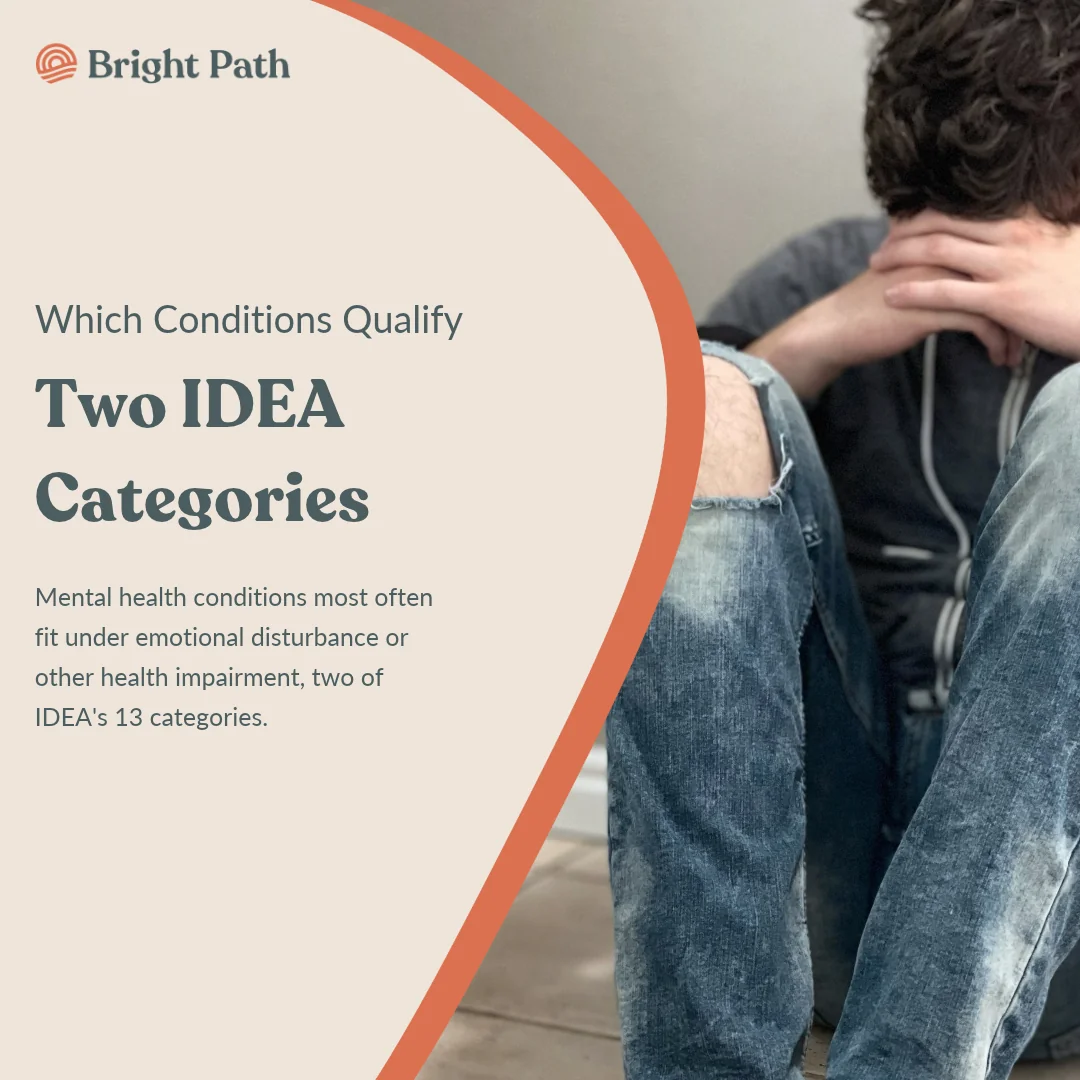
Mental health conditions fit under two IDEA categories, emotional disturbance and other health impairment. Other health impairment covers limited strength, vitality or alertness from a chronic or acute health problem, and the rule names ADHD as an example.
Emotional disturbance requires at least one of five traits, seen over a long period of time and to a marked degree, that harm school performance. The five traits are:
- An inability to learn that intellectual, sensory or health factors cannot explain
- An inability to build or keep satisfactory relationships with peers and teachers
- An inappropriate type of behavior or feeling under normal circumstances
- A general, pervasive mood of unhappiness or depression
- A tendency to develop physical symptoms or fears tied to personal or school problems
A diagnosis alone does not decide eligibility. The school team must also find that the condition affects school performance and that your teen needs specially designed instruction. North Carolina calls this category serious emotional disability and adds its own evaluation steps, covered later in this guide.
A 504 plan, which has no list of categories, covers teens who do not need different teaching.
Can a teen with anxiety or depression get a 504 plan?
Yes, a teen with anxiety or depression qualifies for a 504 plan, if the condition substantially limits a major life activity. Section 504 defines a disability as a physical or mental impairment that substantially limits one or more major life activities. Its rules list "emotional or mental illness" as a mental impairment.
Learning and caring for oneself are major life activities under the Section 504 rules. OCR adds that thinking and concentrating count too.
OCR's 2024 fact sheet on depression makes four points about eligibility:
- The question of whether a condition substantially limits a student "should not demand extensive analysis."
- A condition that comes and goes, or is in remission, counts if it would limit the student when active.
- The helpful effects of medication must be set aside when deciding eligibility.
- A school may accept that a student has a disability without any documentation or medical tests.
Good grades do not settle the question either. OCR's resource guide says that "even if a student earns good grades," the student may still have a disability.
OCR lists five supports Section 504 may require a school to provide for a student with depression:
- A support person, such as a school counselor, to meet with during the school day
- Short breaks built into the daily schedule
- Extended time on quizzes, tests and exams
- Make-up work without penalty, with excused absences for mental health appointments or symptoms
- Medical leave from school to receive treatment
OCR's matching 2024 fact sheet on anxiety disorders describes similar supports, such as extra breaks and taking tests alone in a different location or with extra time. OCR also lists refusal to attend school as a symptom of depression, a pattern that overlaps with school anxiety and refusal.
The national numbers show how many students are served under each plan.
How many students have IEPs and 504 plans?
About 18 in every 100 U.S. public school students had an IEP or a 504-only plan in 2021-22, by OCR's count. Students served under IDEA made up 14% of K-12 public school enrollment that year, and students served only under Section 504 made up 4%. That survey year is the newest with an official OCR summary.
The newest national IDEA count, from fall 2023, found 7,236,548 students ages 5 through 21 served under IDEA, Part B. That total covers 48 states and the other reporting areas. Data for Iowa and New Mexico were not available.
Emotional disturbance made up 4.4% of those IEP students, while other health impairment, which includes ADHD, made up 16.5%. Specific learning disability was the largest category at 33.8%.
Students in the emotional disturbance category also face the hardest road to a diploma. In 2022-23, 65.6% of those who left school earned a regular diploma, compared with 75.8% of all students with disabilities. Their dropout rate was 28.3%, more than double the 13.9% for all students with disabilities.
The same federal report found that emotional disturbance had the highest dropout share of any category in every year from 2013-14 through 2022-23. Those gaps raise the stakes of choosing the plan that fits what your teen needs.
IEP or 504 plan: which fits a teen with a mental health condition?
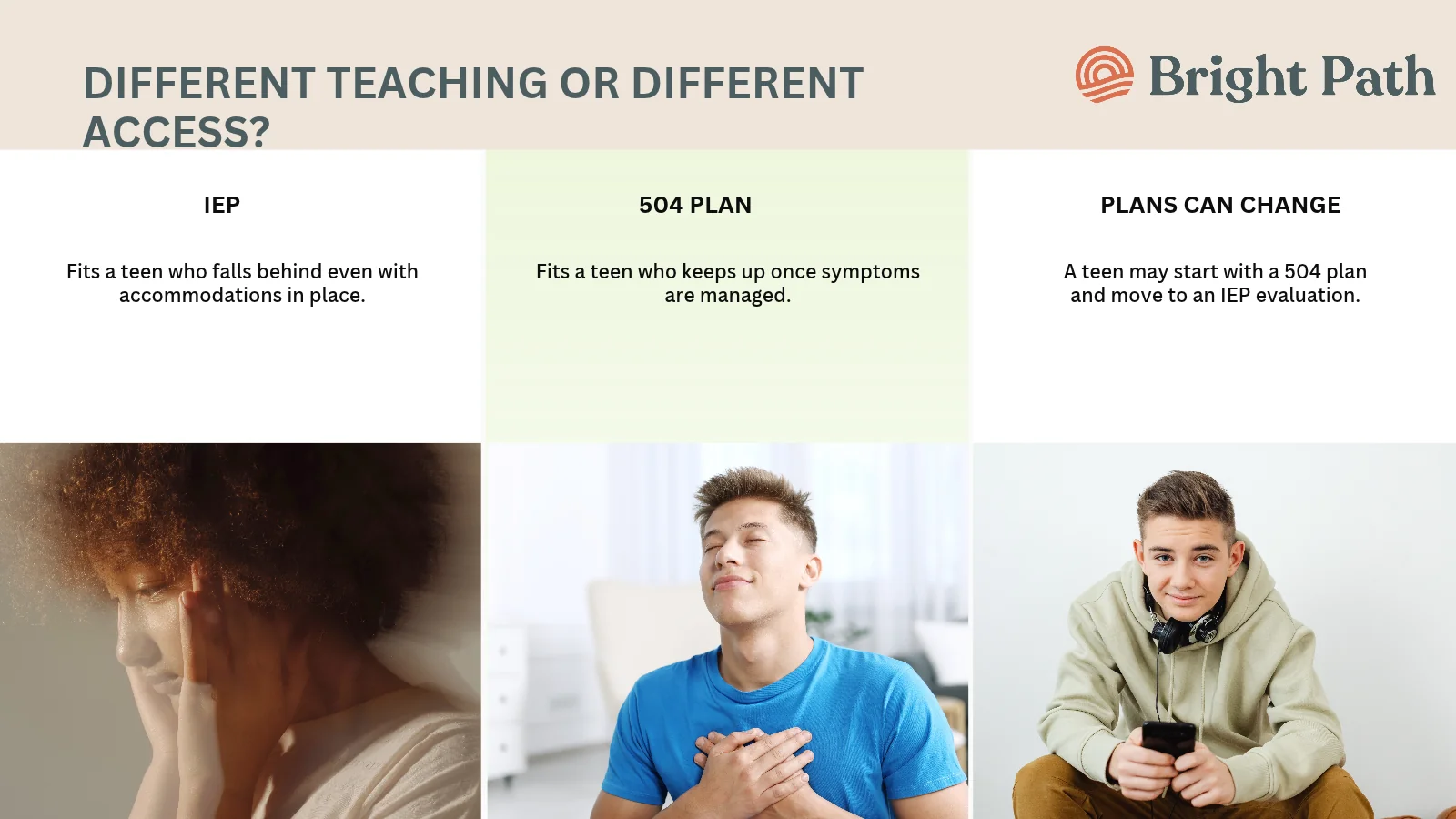
A 504 plan fits a teen who does grade-level work with supports, while an IEP fits a teen who needs different teaching. The deciding question is not the diagnosis. It is whether your teen needs specially designed instruction to make progress, or the same instruction with barriers removed.
A 504 plan is enough when these three things are true:
- Your teen keeps up with the material once symptoms are managed.
- The main barriers are attendance, focus, testing pressure or time.
- Supports like breaks, extended time and counselor check-ins close the gap.
Request an IEP evaluation when these three things are true:
- Your teen falls further behind even with accommodations in place.
- Your teen needs skills taught directly, such as coping or social skills, on a set schedule.
- You want measurable annual goals and regular progress reports written into the plan.
Neither plan is better in every case. An IEP carries more required parts, while a 504 plan is lighter but has no required goals or progress reports. Plans also change, so ask for an IEP evaluation if progress stalls under a 504 plan.
Slipping grades, trouble concentrating and less interest in school are signs OCR links to depression, and each is a way teen depression shows up in academic performance. Whichever plan you lean toward, the process starts with an evaluation, and North Carolina sets its own clock for it.
How do North Carolina schools evaluate a student for an IEP or 504 plan?
North Carolina schools must evaluate, decide eligibility and, for an eligible student, complete the IEP within 90 days of a written referral. Federal IDEA rules give schools 60 days from parent consent, unless a state sets its own timeframe. North Carolina does, and its special education policies start the clock with the written referral.
For serious emotional disability, North Carolina's IEP evaluation asks for more than a diagnosis. The evaluation must include hearing and vision screening, a parent conference, observation across settings, and educational, psychological and behavioral or emotional evaluations. The school must also document two research-based interventions for the behavioral or emotional skill concern, with progress monitoring.
The IEP team then checks four things before finding a student eligible. The traits must have lasted a long time, show to a marked degree, harm school performance and require specially designed instruction.
Section 504 has no fixed federal deadline for evaluation. OCR generally looks to the IDEA timeline, state rules or district policy when it judges whether a 504 evaluation took a reasonable time. OCR also reads Section 504 to require informed parent consent before the first evaluation.
Once a plan is in place, an IEP must be reviewed at least once a year. Your teen must be reevaluated at least every three years, unless you and the school agree it is not needed. Section 504 calls for periodic reevaluation and an evaluation before any significant change in placement.
North Carolina's Department of Public Instruction directs families to the school or district Section 504 coordinator with questions. Knowing the clock helps, and the next step is writing the request itself.
How do you ask for an IEP or 504 evaluation?
You ask for an evaluation by sending a dated, written request to your teen's school that describes what you see. Put the request in writing, because North Carolina's 90-day timeline starts with a written referral. Keep a copy and note the date you sent it.
A clear request has five parts:
- Your teen's name, grade and school
- A short description of what you see at school and at home, such as missed days, slipping grades or panic before tests
- The words "request for evaluation," and whether you are asking about special education, Section 504 or both
- Any letters from your teen's therapist, psychiatrist or pediatrician that describe how symptoms affect school
- A request for written notice of the school's decision and a meeting date
A clinical evaluation documents how a condition limits your teen, but OCR notes a school may accept a disability without one. Ask for that decision in writing so you know your options, if the school declines to evaluate.
North Carolina's parent training center, the Exceptional Children's Assistance Center, helps families with these steps at no cost. A request also comes up at a hard moment, such as when a teen steps away from school for intensive treatment.
What happens to an IEP or 504 plan during a partial hospitalization program?
A partial hospitalization program pauses regular classes while it runs, so the plan's supports need a fresh look before your teen returns. During a full-day program, a school may arrange homebound instruction, which North Carolina's rules define as educational services provided outside the school setting. Treatment also changes what your teen needs, if symptoms shift during the program.
A teen returning after weeks away needs a lighter start, a plan for missed work and a set time to see a counselor. OCR gives the example of a student who meets a school counselor during first period to support the move back into school.
Three questions keep a re-entry meeting practical:
- Which accommodations start on day one, and who tells each teacher?
- How will missed work be handled, and by what date?
- Who is the school contact if symptoms return?
Bright Path plans education and treatment for teens together, with school coordination built into its day program.
How Bright Path coordinates school plans during treatment
Bright Path coordinates school plans through an Education Liaison, who meets families on admission day and contacts the school about any IEP or 504 plan needs. Bright Path provides partial hospitalization (PHP) and intensive outpatient (IOP) care for teens ages 12 to 18 in Wake Forest and Hillsborough, North Carolina.
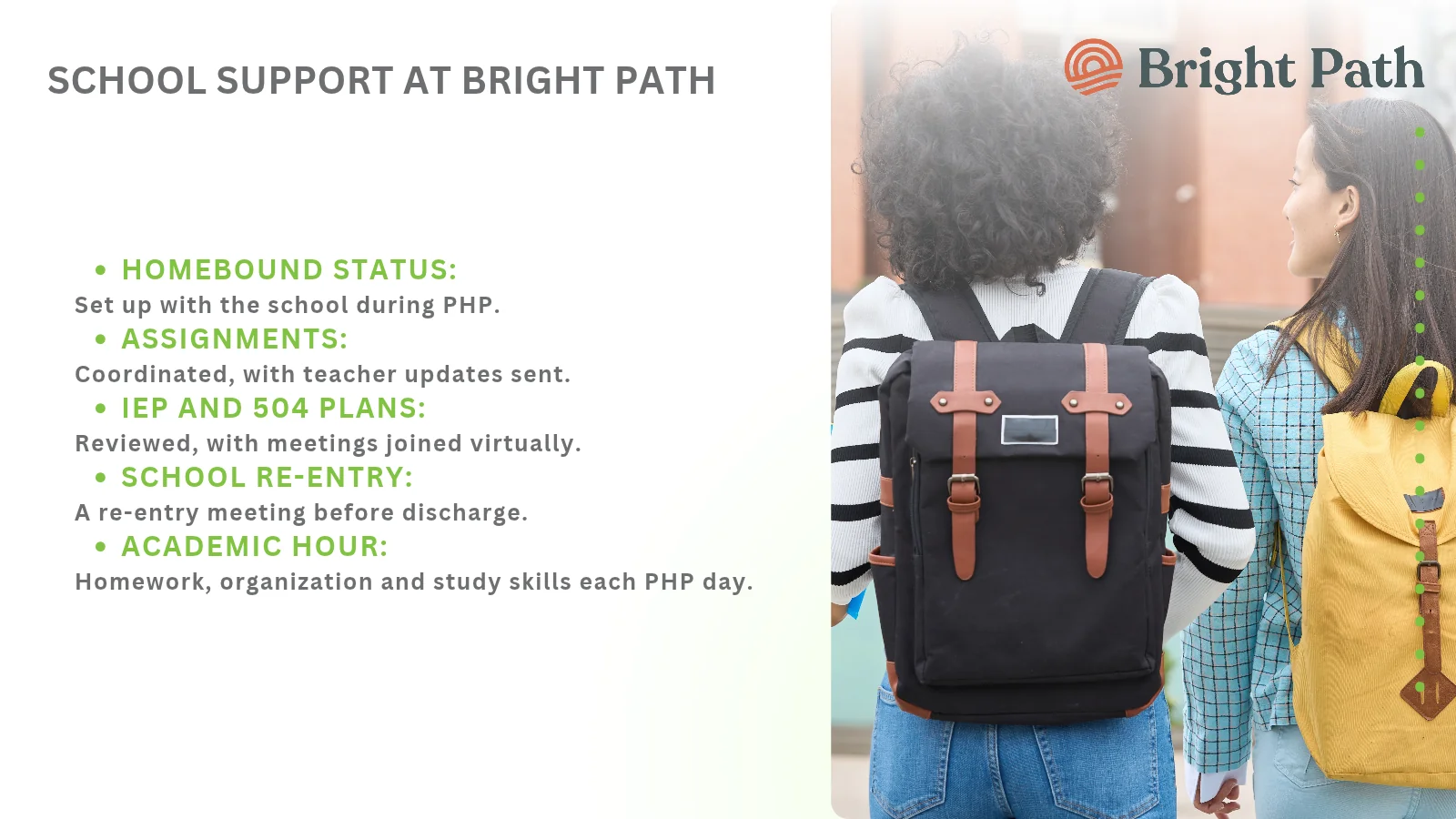
The Education Liaison handles four areas for teens in our partial hospitalization program:
- Setting up homebound status with the school during PHP
- Coordinating assignments and sending teacher updates
- Reviewing IEP and 504 plans and joining IEP or 504 meetings virtually
- Planning school re-entry, including a re-entry meeting before discharge
Each PHP day also includes a structured academic hour for homework, organization and study skills. The six questions below cover what families ask about these plans.
Frequently asked questions
Should ADHD be 504 or IEP?
ADHD qualifies for either plan, depending on whether the student needs specially designed instruction. IDEA names ADHD as an example of other health impairment when it limits alertness and harms school performance. A 504 plan fits a student who keeps up with accommodations such as breaks, testing in a different location or extended time.
What are the 13 disabilities for IEP?
IDEA's 13 categories are autism, deaf-blindness, deafness, emotional disturbance, hearing impairment, intellectual disability, multiple disabilities, orthopedic impairment, other health impairment, specific learning disability, speech or language impairment, traumatic brain injury and visual impairment. The condition must also affect school performance enough that the student needs special education. North Carolina calls emotional disturbance serious emotional disability.
Is IEP or 504 better for autism?
Neither plan is better for autism in every case, because the right plan depends on the student's needs. Autism is an IDEA category, so a student who needs social, communication or behavior skills taught directly qualifies for an IEP, if autism affects school performance. A 504 plan fits a student who mainly needs access supports, like a quiet testing room.
Is there a downside to having a 504 plan?
The main downside of a 504 plan is that federal rules require fewer parts than for an IEP. A 504 plan does not have to include measurable goals or progress reports, and federal rules do not require it in writing, though OCR encourages schools to write one. Request an IEP evaluation, if your family wants tracked goals.
Can a student have both an IEP and a 504 plan?
A student with an IEP does not need a separate 504 plan, because the IEP already meets Section 504's requirements. OCR explains that students with an IEP are still protected by Section 504. Their IEP, written and carried out under IDEA, is enough to meet the school's duty to provide an appropriate education.
Does a 504 plan or IEP follow a teen to college?
Neither plan transfers to college automatically, because colleges do not have to identify or evaluate students with disabilities. Under Section 504, a college student usually tells the disability services office about their condition and asks for what they need. Asking early, even before the term starts, gives the college time to put supports in place.
Sources
- U.S. Department of Education. 34 CFR 300.8, Child with a disability (IDEA Part B regulations). Legal Information Institute, Cornell Law School. Open source
- U.S. Department of Education. 34 CFR Part 104, sections 104.3, 104.33, 104.35 and 104.36 (Section 504 regulations). Legal Information Institute, Cornell Law School. Open source
- U.S. Department of Education. 34 CFR 300.301, 300.303, 300.320 and 300.324 (IDEA Part B regulations). Legal Information Institute, Cornell Law School. Open source
- U.S. Department of Education, Office for Civil Rights. Section 504 Protections for Students with Depression. September 2024. Open source
- U.S. Department of Education, Office for Civil Rights. Section 504 Protections for Students with Anxiety Disorders. September 2024. Open source
- U.S. Department of Education, Office of Special Education Programs. 47th Annual Report to Congress on the Implementation of the Individuals with Disabilities Education Act, 2025 (fall 2023 and 2022-23 data). Open source
- U.S. Department of Education, Office for Civil Rights. 2021-22 Civil Rights Data Collection: A First Look. Released January 2025. Open source
- North Carolina State Board of Education and Department of Public Instruction. Policies Governing Services for Children with Disabilities, amended March 2021. Open source
- U.S. Department of Education, Office for Civil Rights. Parent and Educator Resource Guide to Section 504 in Public Elementary and Secondary Schools. December 2016. Open source
- North Carolina Department of Public Instruction. Students with Disabilities, Parents' Corner. Open source


Clinically reviewed by Dr. Shantel Sullivan, Ed.D., LCSW, Chief Executive Officer