
-1.svg)
ACT (Assertive Community Treatment) is a team-based approach providing comprehensive mental health support for teens within their communities. In North Carolina, where nearly two-thirds of teenagers diagnosed with depression don’t receive treatment, ACT offers accessible alternatives to traditional care.
The ACT process engages you and your family, fostering trusting relationships for open communication. Team members create personalized treatment plans and provide ongoing support through check-ins, skill-building sessions, and crisis intervention to promote stability and recovery.
Key ACT techniques include crisis intervention, case management, and skill-building. Crisis intervention offers immediate support during distress. In 2021, 22% of NC high school students considered suicide, while 10.1% attempted it—a 23.2% increase from 2017. ACT serves diverse populations, including those experiencing psychiatric crises, involvement with criminal justice, homelessness, and serious mental health conditions like schizophrenia, borderline personality disorder, and bipolar disorder.
ACT is particularly effective for adolescents dealing with severe mood disorders, psychosis, or co-occurring substance use issues. The model improves overall functioning, enhances quality of life, and reduces the need for hospitalizations.
The limitations of ACT include maintaining program fidelity, ensuring adequate resources, and providing ongoing staff training, which impacts the quality of care delivered. Commitment and investment in training and resources are essential to maximize the efficacy of ACT.
What is Assertive Community Treatment (ACT)?
Assertive Community Treatment (ACT) is a person-centered, team-based approach to mental health care that provides comprehensive support to individuals with severe mental illnesses, particularly those who find it difficult to engage with traditional services. This modality emphasizes delivering services in the community rather than in hospital settings, ensuring that care is accessible and tailored to individual needs. The primary goals of ACT include reducing psychiatric hospitalizations, improving overall functioning, enhancing quality of life, and promoting social integration.
Forensic Assertive Community Treatment (FACT) extends the principles of ACT to individuals involved in the criminal justice system, especially those with mental health issues. FACT is designed to address the complex needs of this population, emphasizing risk management, rehabilitation, and reintegration into society. Research by Kelly et al. published in 2016 titled “Forensic Assertive Community Treatment: Recidivism, Hospitalization, and the Role of Housing and Support” found that 52% of participants experienced recidivism within nine months post-release, with an average of 0.86 arrests and 0.90 incarcerations. Also, 48% were hospitalized for psychiatric reasons, averaging 1.57 hospitalizations, while 43% secured stable housing in single-room occupancy units. Overall, clients reported a mean of 1.14 episodes of homelessness during the evaluation period, highlighting significant challenges in community reentry- and stability.
How Is ACT different From Traditional Mental Health Treatment?
Assertive Community Treatment (ACT) differs significantly from traditional mental health treatment in its approach and delivery model. While traditional mental health treatment involves episodic care where clients visit a clinic for scheduled appointments, ACT provides continuous, community-based support delivered by a multidisciplinary team that includes psychiatrists, social workers, nurses, and rehabilitation counselors. This team-based model emphasizes personalized, intensive interventions that are available 24/7, addressing not just the mental health needs but also social, vocational, and housing challenges faced by clients. ACT aims to promote independence and stability in the community by offering services directly where clients live and work, thereby fostering a more holistic and integrated approach to mental health and rehabilitation.
How Does Assertive Community Treatment (ACT) Work?
Assertive Community Treatment (ACT) works through a structured, team-based approach that provides comprehensive, individualized support to clients with severe mental illness. The process begins with a multidisciplinary team that includes professionals such as psychiatrists, nurses, social workers, and rehabilitation counselors, who collaboratively develop a personalized treatment plan tailored to each client’s unique needs. Visits are conducted frequently, multiple times per week, and occur in various settings, including clients’ homes, workplaces, or community locations, ensuring that support is accessible and relevant to their daily lives. ACT employs a range of approaches, including crisis intervention, medication management, skills training, and linkage to social services, focusing on improving clients’ overall functioning, social integration, and quality of life. The emphasis on continuous engagement and support helps clients navigate challenges in real time, ultimately promoting recovery and reducing hospitalization rates.
What Types Of Professionals Are Included In An Act Team?
The types of professionals that work in an ACT team include psychiatrists, nurses, social workers, case managers, rehabilitation counselors, and substance use counselors. Psychiatrists oversee medication management and psychiatric evaluations, ensuring clients receive appropriate pharmacological support. Nurses monitor health and medication adherence, providing essential medical care and education. Social workers and case managers connect clients to community resources and assist in navigating social services, housing, and employment opportunities.
Rehabilitation counselors focus on developing daily living skills and providing vocational training to promote greater independence. Lastly, substance use counselors address co-occurring disorders, offering targeted support for clients facing challenges related to addiction. This collaborative approach allows ACT teams to deliver comprehensive care tailored to the unique needs of individuals with severe mental illness.
What Techniques Are Used In Assertive Community Treatment (Act)?
The techniques used in Assertive Community Treatment (ACT) are an individualized focus, a multidisciplinary treatment team, and a holistic approach. Each client receives personalized care tailored to their specific needs, ensuring that treatment plans address their unique circumstances and goals. The multidisciplinary treatment team collaborates closely, integrating the expertise of various professionals, including psychiatrists, nurses, social workers, and rehabilitation counselors, to provide comprehensive support.
This teamwork fosters effective communication and coordination, allowing for timely interventions. Additionally, ACT takes a holistic approach by addressing not only the mental health challenges faced by clients but also their social, vocational, and housing needs. By considering the whole person and their environment, ACT promotes overall well-being and stability, enhancing clients’ chances for successful community integration and recovery.
What Are The Uses Of Assertive Community Treatment (ACT) in North Carolina?
The uses of Assertive Community Treatment (ACT) in North Carolina are to support individuals facing psychiatric crises, those impacted by the criminal justice system, individuals experiencing homelessness, and refugees with mental illness, as well as those diagnosed with conditions such as schizophrenia, delusional disorder, borderline personality disorder, and bipolar disorder. ACT provides tailored interventions to help these individuals manage their symptoms and improve their quality of life.
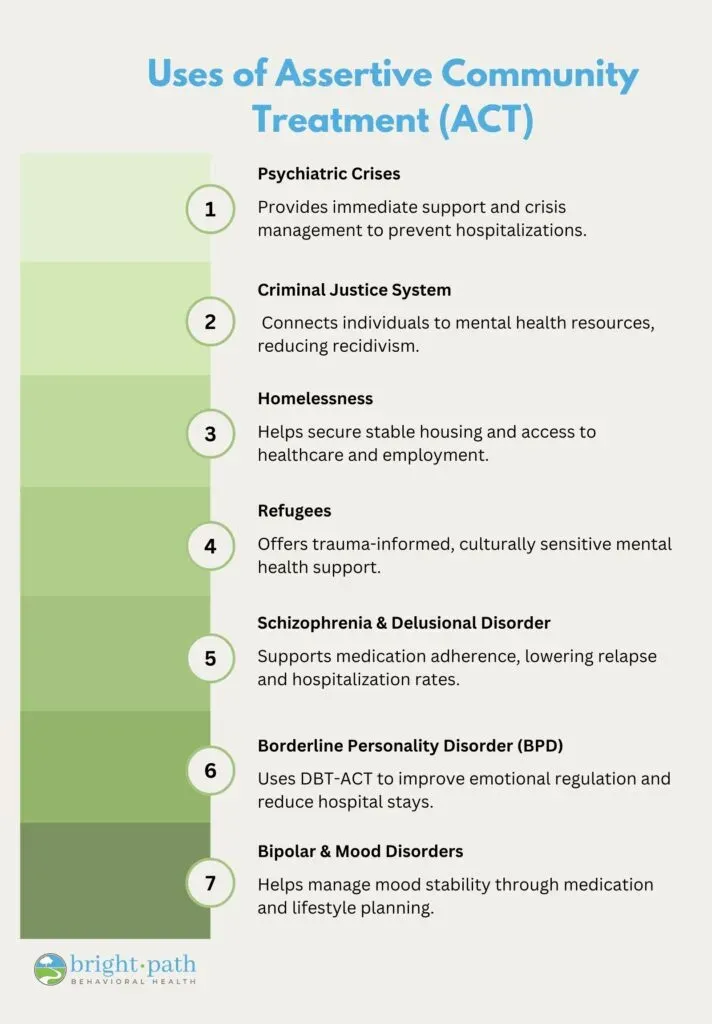
The common uses of Assertive Community Treatment (ACT) include:
- Psychiatric crises: ACT provides immediate intervention by offering on-site support and stabilization. The team works collaboratively with clients to develop crisis management plans, helping to prevent hospitalizations and ensuring that individuals receive appropriate care in their community. ACT is particularly effective for mental health patients with a history of frequent hospitalizations, operating with a low client-staff ratio of approximately 10 clients per full-time practitioner and providing 24/7 coverage, which facilitates intensive support, according to a study by Bond et al., published in Research Gate titled “Assertive Community Treatment for People with Severe Mental Illness.”
- Individuals impacted by the criminal justice system: ACT assists those with mental health issues involved in the criminal justice system by facilitating access to mental health services and resources. This support aims to reduce recidivism by addressing underlying mental health needs and promoting rehabilitation rather than punishment. Approximately 50% of individuals with dual disorders have had prior contact with the criminal justice system, and ACT helps to yield better outcomes in areas such as hospitalization, housing, and mental health, as indicated in a review published in the US Department of Justice titled “Impact of Assertive Community Treatment and Client Characteristics on Criminal Justice Outcomes in Dual Disorder Homeless Individuals.”
- Experiencing homelessness: For individuals facing homelessness, ACT helps secure stable housing while also connecting them to essential services such as healthcare, employment assistance, and social support. This comprehensive approach addresses immediate needs and longer-term stability, fostering a greater sense of security and belonging.
- Refugees with mental illness: ACT provides tailored mental health support for refugees, focusing on the unique traumas and cultural challenges they face. The team helps clients navigate complex systems, offering counseling and integrating culturally sensitive practices to promote healing and resilience.
- Schizophrenia and delusional disorder: Clients with schizophrenia and delusional disorder benefit from ACT’s ongoing support and medication management, which is crucial for symptom stabilization. The team also provides psychoeducation to clients and their families, helping them understand the condition and develop coping strategies. A randomized controlled trial of Assertive Community Treatment (ACT) in China published by Psychol Med in 2019 titled “Effectiveness of an Assertive Community Treatment program for people with severe schizophrenia in Mainland China” involved 60 outpatients with schizophrenia, revealing that ACT significantly outperformed standard community treatment in several key areas. Patients receiving ACT had a 3.3% readmission rate compared to 25% for those in standard treatment, with shorter mean readmission times of 2.4 days versus 30.7 days. Additionally, ACT participants experienced lower relapse rates (6.7% vs. 28.6%) and improved social functioning, demonstrating that culturally adapted ACT is effective for managing severe schizophrenia in urban settings.
- Borderline personality disorder: ACT offers support for individuals with borderline personality disorder by focusing on skills training, emotional regulation, and interpersonal effectiveness. The team helps clients build healthier relationships and cope with intense emotions, fostering a sense of stability and self-efficacy. A study by Andreas S., et al published in BMC Psychiatry in 2024 titled “Dialectical behavior therapy (DBT) in an assertive community treatment structure (ACT)” compares Integrated Care Borderline (ICB), which incorporates Dialectical Behavior Therapy (DBT) within an Assertive Community Treatment (ACT) framework, to Treatment as Usual (TAU) for individuals with severe Borderline Personality Disorder (BPD). Both groups showed significant improvements in psychosocial functioning and psychiatric symptoms after one year. ICB participants experienced a remarkable 89% reduction in psychiatric hospital days and lower annual hospital costs (€5,546 vs. €10,726) compared to TAU.
- Bipolar disorder and other mood disorders: For those with bipolar disorder and other mood disorders, ACT provides consistent monitoring and crisis intervention to manage mood fluctuations effectively. The team collaborates with clients to create personalized plans that include medication adherence, lifestyle changes, and strategies to identify early signs of mood episodes.
How Effective is Assertive Community Treatment (ACT)?
Assertive Community Treatment (ACT) is very effective in managing severe mental illnesses, particularly in improving patient outcomes. ACT leads to a notable reduction in self-reported psychiatric symptoms, with participants experiencing enhanced psychosocial functioning and overall quality of life. The Assertive Community Treatment (ACT) group had significantly lower readmission rates and fewer days spent in the hospital compared to the control group, according to a study by Ulla A., et al published in BMC Psychiatry in 2014 titled “The rise of assertive community interventions in South Africa.” Specifically, the intervention group had a mean of 1.5 readmissions post-intervention, compared to 2 for the control group (p = 0.007). Additionally, the intervention group spent a median of 0 days in the hospital post-intervention, while the control group spent a median of 88 days (p = 0.002), demonstrating that the modified ACT was effective in reducing hospital readmissions and length of stay in an under-resourced setting.
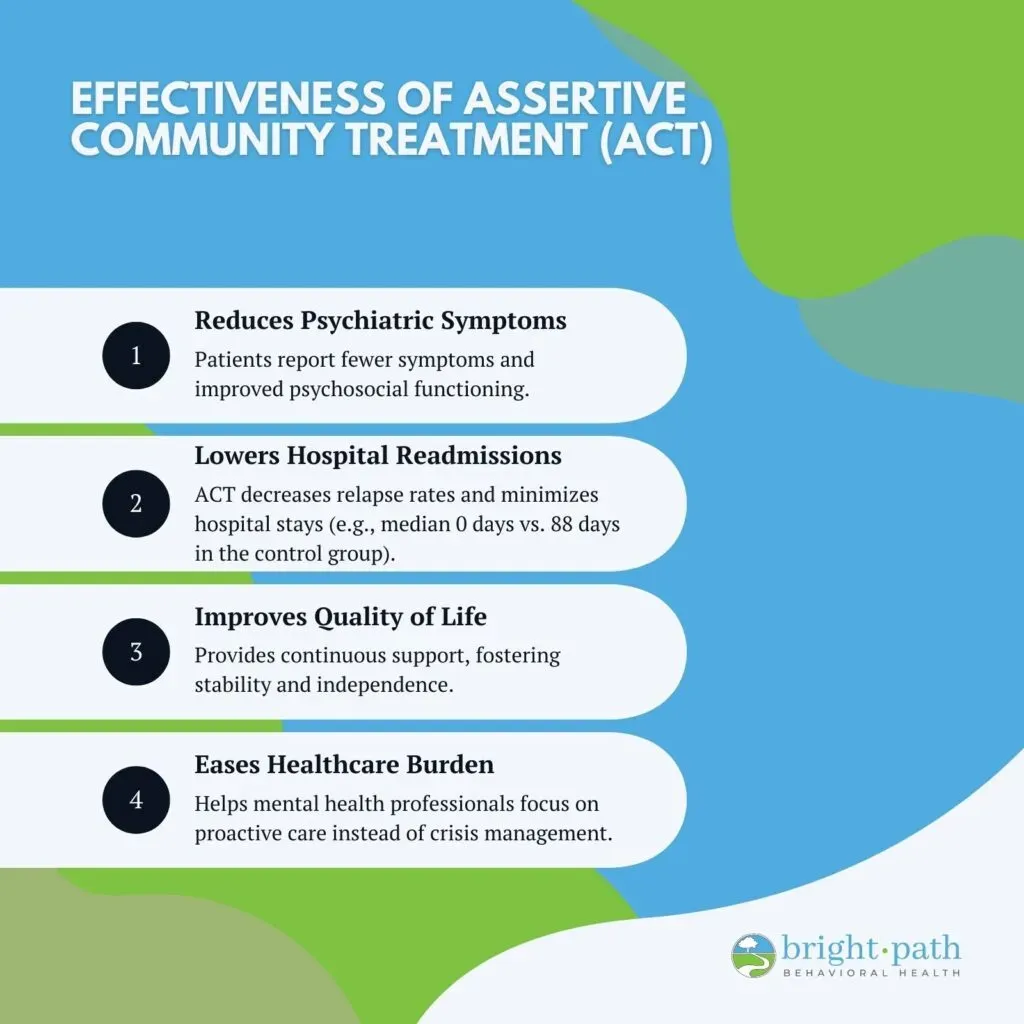
This decrease not only benefits patients by minimizing disruptive hospitalizations but also alleviates the burden on mental health professionals, allowing them to focus on proactive, community-based care rather than reactive crisis management. By employing a multidisciplinary team approach, ACT provides continuous support and resources, fostering a more stable and supportive environment for individuals with severe mental health challenges.
What are the Limitations of Assertive Community Treatment (ACT) in North Carolina?
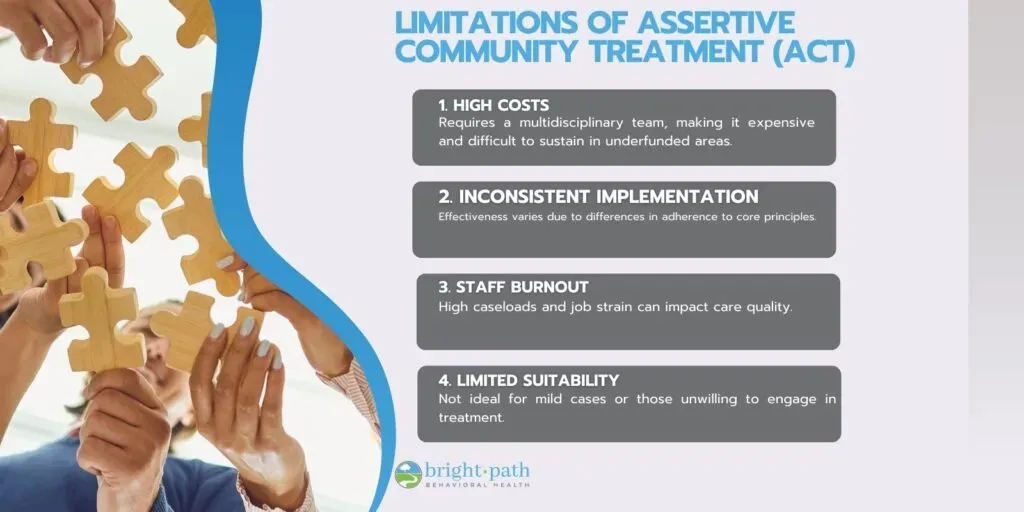
The limitations of Assertive Community Treatment (ACT) in North Carolina are resource constraints, variability in implementation, and challenges in maintaining fidelity to the model.
According to North Carolina Medicaid’s Clinical Coverage Policy for Assertive Community Treatment (ACT), beneficiaries must receive services at a high frequency, with an average of 3 face-to-face contacts per week and a minimum of 60 minutes of engagement weekly, though this intensive approach is expensive to operate due to the need for a multidisciplinary team and consistent staffing, which is particularly challenging in under-resourced settings.
Also, the effectiveness of ACT varies depending on the specific implementation and adherence to the core principles of the model, leading to inconsistent outcomes across different teams. Furthermore, high caseloads and staff burnout jeopardize the quality of care provided to patients.
What Mental Health Conditions Are Treated With Assertive Community Treatment?
The mental health conditions that are treated with Assertive Community Treatment include schizophrenia, schizoaffective disorder, bipolar disorder, and severe major depressive disorder. ACT is also beneficial for individuals with co-occurring disorders, such as substance use disorders combined with severe mental illnesses. The approach is particularly effective for high-frequency users of psychiatric services, aiming to provide comprehensive support and reduce hospitalizations for these individuals.
Is Assertive Community Treatment (ACT) Effective For Schizophrenia?
Yes, Assertive Community Treatment (ACT) is effective for individuals with schizophrenia. ACT significantly reduces hospitalizations and improves overall functioning in this population. For example, a 2019 randomized controlled trial published in Psychological Medicine examined 60 outpatients with schizophrenia and found that Assertive Community Treatment (ACT) significantly outperformed standard community treatment. Patients receiving ACT had a readmission rate of 3.3%, compared to 25% for those in standard treatment, and shorter mean readmission durations of 2.4 days versus 30.7 days.
Additionally, ACT’s comprehensive, team-based approach addresses the complex needs of individuals with schizophrenia, promoting better long-term recovery outcomes and facilitating their integration into the community.
Does Assertive Community Treatment (ACT) Help With Bipolar Disorder?
Yes, Assertive Community Treatment (ACT) helps with bipolar disorder. ACT is recognized as an effective intervention for individuals with severe mental illnesses, including bipolar disorder. Research indicates that ACT leads to improved treatment outcomes by providing comprehensive, team-based support that addresses both psychiatric symptoms and psychosocial needs. A study by Greg P., et al published in the Community Mental Health Journal in 2021 titled “Further Adaptations and Reflections by an Assertive Community Treatment Team to Serve Clients with Severe Mental Illness During COVID‑19” discusses the adaptations made by an Assertive Community Treatment (ACT) team in Minnesota during the COVID-19 pandemic, serving 34 clients, all diagnosed with severe mental illnesses, like bipolar disorder.
The team faced challenges such as a 74% dual diagnosis rate among clients and the need for in-person visits for essential services, while over 48% of Americans reported anxiety regarding COVID-19. Despite the pandemic, the ACT team’s operations continued with adjustments like virtual meetings and outdoor client interactions, maintaining essential services without any reported COVID-19 cases in the first six months.
How to find Assertive Community Treatment programs in North Carolina?
To find Assertive Community Treatment (ACT) programs in North Carolina, contact the North Carolina Department of Health and Human Services Mental Health Services division or reach out to local ACT teams like those at the UNC School of Medicine serving Orange, Chatham, and Wake counties.
In North Carolina, we complement these ACT services with specialized adolescent mental health programs throughout Wake Forest, Raleigh, Durham, and Chapel Hill, offering teens and families a comprehensive continuum of care that includes Partial Hospitalization, Intensive Outpatient, and standard Outpatient Programs designed specifically for the unique needs of struggling adolescents.