



DEAR MAN is a DBT skill that gives a teen a step-by-step way to ask for something or say no, clearly and calmly. The seven letters turn a tense request into a short, planned script.
Teens need the skill because requests at home and school often go sideways. A question about curfew turns into a shouting match, or a teen drops a request to a teacher before saying it.
The DEAR MAN skill fixes both problems. This guide explains each letter, gives three real teen scripts and covers the two companion skills, GIVE and FAST.
Key Takeaways
- Interpersonal effectiveness skill: DEAR MAN belongs to the interpersonal effectiveness module of dialectical behavior therapy (DBT), developed by Marsha Linehan.
- Two halves: DEAR covers what a teen says, and MAN covers how the teen says it.
- Companion skills: GIVE protects the relationship, and FAST protects the teen's self-respect.
- Evidence for teens: Elizabeth McCauley and colleagues ran a 2018 randomized trial of 173 teens aged 12 to 18 at high risk for suicide, published in JAMA Psychiatry. Six months of DBT reduced self-harm more than supportive therapy by the end of treatment.
- Practice over memory: Teens build the skill by rehearsing real requests, not by memorizing the acronym.
What is the DEAR MAN skill in DBT?
DEAR MAN is the interpersonal effectiveness skill in dialectical behavior therapy for reaching an objective, which means making a request or refusing one. Marsha Linehan built the skill into DBT and describes it in the DBT Skills Training Manual (2015).
Psychologists Jill Rathus and Alec Miller adapted DEAR MAN for adolescents in the DBT Skills Manual for Adolescents (2015). Their version keeps the seven steps and uses school, family and friendship examples. DEAR MAN sits in the relationship module, one of the four DBT skill modules teens learn.
Interpersonal effectiveness in DBT balances three goals:
- Objective effectiveness: Getting the request met or the refusal respected, which DEAR MAN targets.
- Relationship effectiveness: Keeping the relationship healthy, which GIVE targets.
- Self-respect effectiveness: Staying true to personal values, which FAST targets.
What does DEAR MAN stand for?
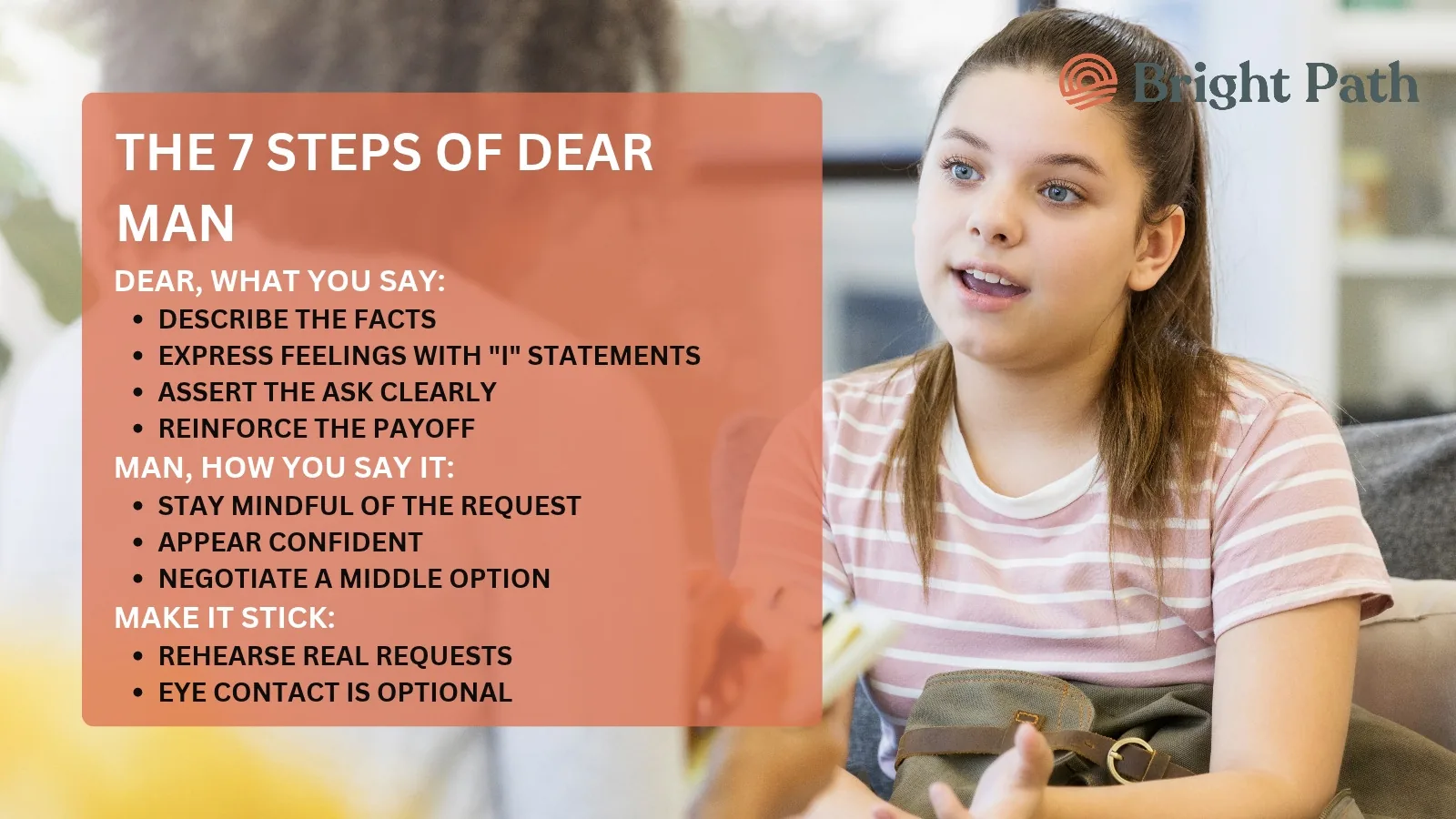
DEAR MAN stands for Describe, Express, Assert, Reinforce, (stay) Mindful, Appear confident and Negotiate. The first four letters set out what a teen says, and the last three shape how the teen says it. The table shows each step with an example line:
| Letter | Step | What the teen does | Example line |
| D | Describe | States the facts, with no judgments | "I have three tests next week." |
| E | Express | Shares feelings with "I" statements | "I feel stressed about fitting in practice." |
| A | Assert | Asks clearly or says no clearly | "Can I skip Saturday's family dinner?" |
| R | Reinforce | Explains the benefit to the other person | "I'll be less cranky all week if I can study." |
| M | (Stay) Mindful | Repeats the request and ignores side arguments | "I hear you. I'm still asking about Saturday." |
| A | Appear confident | Uses a steady voice and an open posture | Speaks at a normal volume and stays seated |
| N | Negotiate | Offers a trade or a middle option | "Could I join for dessert instead?" |
Eye contact under "appear confident" is flexible. A teen who finds eye contact uncomfortable, including many autistic teens, still appears confident through a calm voice and a clear request.
How does a teen use DEAR MAN?
A teen uses DEAR MAN by planning the request first, ideally written down in 2 to 3 minutes, then saying it at a moment when both people are calm. A request made during an argument rarely works, even with a perfect script. The three scripts below show the same seven steps in three situations.
Asking a parent for a later curfew
A 16-year-old wants a later curfew of 11 p.m. on Friday for a friend's birthday movie night. The DEAR MAN script runs seven lines:
- Describe: "Maya's birthday is Friday, and the movie ends at 10:30."
- Express: "I feel left out when I have to leave before everyone else."
- Assert: "Can my curfew be 11 instead of 10 this Friday?"
- Reinforce: "You'd know exactly where I am, and I'd stop asking every weekend."
- Mindful: "I know last month was a problem. I'm asking about this Friday."
- Appear confident: The teen asks after dinner, in a normal voice, without pleading.
- Negotiate: "I'll text you when the movie ends and again when I'm leaving."
Asking a teacher for an extension
A 14-year-old missed a week of school and has a project due Monday. The teen does not need to share a diagnosis to make the request:
- Describe: "I was out for five days last week, and the project is due Monday."
- Express: "I'm worried I'll turn in rushed work."
- Assert: "Could I have until Thursday?"
- Reinforce: "You'd get my best work instead of something half done."
- Mindful: "I understand the deadline is firm for most people. I'm asking about my situation."
- Appear confident: The teen asks before class, standing at the desk, not by a rushed email at midnight.
- Negotiate: "I can turn in my outline Monday so you can see I'm on track."
Saying no to a friend
Saying no is also a DEAR MAN request, and the assert step becomes a clear refusal. A friend wants to copy a teen's homework:
- Describe: "You want my math answers before first period."
- Express: "I'm not comfortable with that."
- Assert: "No, I'm not sharing my homework."
- Reinforce: "Neither of us gets a zero if the teacher checks."
- Mindful: "I get that you're stressed. Still no." The teen repeats this line as often as needed.
- Appear confident: The teen keeps a friendly tone and does not over-explain.
- Negotiate: "I can show you how I did problem 4 at lunch."
Refusals like this one take practice, because peer pressure affects teens most when the friendship feels at risk.
What are the GIVE and FAST skills in DBT?
GIVE and FAST are the two interpersonal effectiveness skills that pair with DEAR MAN, with GIVE keeping the relationship healthy and FAST keeping a teen's self-respect intact. DEAR MAN gets the request said, and GIVE and FAST shape how the request lands.

GIVE: keeping the relationship
The GIVE skill stands for four behaviors that protect a relationship during a hard conversation:
- Gentle: The teen avoids threats, insults and eye-rolling.
- Interested: The teen listens to the other person's side without interrupting.
- Validate: The teen says what makes sense about the other view, such as "I get why you worry when I'm out late."
- Easy manner: The teen uses a light tone and a little humor instead of a lecture.
FAST: keeping self-respect
The FAST skill stands for four behaviors that protect a teen's self-respect:
- Fair: The teen is fair to both people, including the teen.
- (No) Apologies: The teen does not apologize for making a reasonable request or for having an opinion.
- Stick to values: The teen does not drop personal values to keep someone happy.
- Truthful: The teen does not lie, exaggerate or act helpless to win.
Over-apologizing is the FAST mistake teens make most. "Sorry, sorry, I know this is annoying, but could I maybe ask something?" tells the listener the request does not matter. "Can I ask you something about Friday?" respects both people.
How do DEAR MAN, GIVE and FAST work together?
A teen picks which goal matters most in the moment, the outcome, the relationship or self-respect, then leans on DEAR MAN, GIVE or FAST to match it. All three skills appear in most conversations, but one leads. Three scenarios show how the priority shifts:
- Outcome first: Asking for a later curfew puts DEAR MAN in the lead, because the teen wants a specific yes.
- Relationship first: Telling a struggling friend that the teen cannot talk tonight puts GIVE in the lead, because keeping the friendship matters more than the plan.
- Self-respect first: Refusing to share test answers puts FAST in the lead, because the teen's values are on the line.
Why does DEAR MAN feel awkward at first?
DEAR MAN feels scripted at first because a teen is rehearsing new wording, and the skill becomes natural with repetition. Some teens worry the script sounds fake or that adults will notice. Four points help the skill feel real:
- Use your own words: The letters are a checklist, not lines to recite word for word.
- Accept a no: The skill worked when the request was clear, even if the answer was no.
- Keep it honest: DEAR MAN is for asking openly, not for manipulating or wearing someone down.
- Settle first: High emotion wrecks a script, so teens benefit from reaching wise mind before a hard conversation.
DEAR MAN is not the right tool when a teen feels unsafe. A teen in danger goes to a trusted adult, calls or texts 988, or calls 911.
How can parents respond when a teen uses DEAR MAN?
Parents reinforce DEAR MAN by listening to the whole request, validating it and negotiating honestly, even when the answer is no. A teen keeps using the skill only when the skill gets a fair hearing at home. Five responses help:
- Let the teen finish: Hold questions until all seven steps are out.
- Reflect what you heard: Repeat the request in your own words to show you understood it.
- Separate the request from the delivery: Judge what is being asked, not how polished it sounded.
- Answer with a reason: Say yes, no or "let's meet in the middle," and explain why.
- Praise the skill: Thank the teen for asking calmly, whatever the outcome.
Mocking the script, such as saying "Is this your therapy talk?", shuts the skill down fast. A parent who uses GIVE in reply shows the teen that calm requests work better than arguments.
How does Bright Path teach DEAR MAN to teens?
Bright Path teaches DEAR MAN, GIVE and FAST in interpersonal effectiveness groups across its partial hospitalization and intensive outpatient programs. Teens then rehearse the skills in the conversations that are hardest for them, with peers and staff giving feedback.

Interpersonal effectiveness in IOP and PHP
Interpersonal effectiveness appears on the schedule of every Bright Path track:
- River track IOP: Teens new to DBT attend Tuesday, Wednesday and Thursday from 3 to 6 p.m., with Interpersonal Effectiveness on Tuesdays at 4 p.m.
- PHP curriculum: DEAR MAN, GIVE and FAST anchor week 2 of the five-week partial hospitalization rotation.
- Summit track: High school students aged 15 to 18 practice interpersonal effectiveness in the midday interactive therapy block.
- Meadow track: Middle school students aged 12 to 15 work on interpersonal skills each morning, with peer pressure resistance as a track focus.
The after-school intensive outpatient program for teens lets a teen keep attending school while practicing DEAR MAN in group three afternoons a week.
Practice in real conversations
Teens move the skill from worksheet to real life in three settings:
- Process group: Group expectations include "ask for what you need" and "own your stuff" with "I" statements, which mirror the express and assert steps.
- Knowledge Integration Testing: A weekly Jeopardy-style review game checks that teens remember each letter.
- Family therapy in PHP: Teens and parents practice clearer communication together in weekly family sessions.
With 12 teens or fewer in a track, every teen gets several turns to rehearse a request each week.
Frequently Asked Questions
What is an example of DEAR MAN for a teen?
A teen asking for more phone time on weekends is a simple DEAR MAN example. The teen describes the current limit, expresses feeling left out of group chats and asserts a request for one more hour. The teen reinforces by offering to finish chores first, stays mindful, appears calm and negotiates a trial weekend.
Is there a DEAR MAN worksheet?
A teen turns the seven DEAR MAN steps into a worksheet by writing one line for each letter before the conversation. Writing the describe and assert lines first gives the teen the core of the request. Many therapists also hand out printed DEAR MAN practice sheets during DBT skills groups.
What age can a child learn DEAR MAN?
Adolescent DBT programs teach DEAR MAN to teens aged 12 and older, and younger children learn simplified versions with fewer steps. Rathus and Miller wrote the DBT Skills Manual for Adolescents with middle and high school examples, which makes the full seven steps usable from about age 12.
What is the difference between DEAR MAN and GIVE?
DEAR MAN focuses on getting a request met, while GIVE focuses on keeping the relationship healthy during the conversation. DEAR MAN supplies the words of the request. GIVE supplies the tone, through gentleness, interest, validation and an easy manner.
Does DEAR MAN work if the other person says no?
DEAR MAN still works when the other person says no, because success means asking clearly and respectfully, not winning every request. A clear no gives the teen real information. The teen keeps the relationship and self-respect intact, and a negotiated middle option often follows later.
Can a teen use DEAR MAN over text?
A teen can use DEAR MAN over text for planning and low-stakes requests, although tone is easier to misread in writing. Texting works well for drafting the seven lines. For curfew, grades or a conflict, a calm in-person conversation gives the appear confident and negotiate steps more room.
What does "broken record" mean in DEAR MAN?
The broken record technique in DEAR MAN means calmly repeating the same request or refusal instead of arguing new points. It belongs to the stay mindful step. When the other person changes the subject or brings up old conflicts, the teen restates the request in the same words.
References
- Linehan, M. M. (2015). DBT Skills Training Manual (2nd ed.). Guilford Press.
- Rathus, J. H., & Miller, A. L. (2015). DBT Skills Manual for Adolescents. Guilford Press.
- McCauley, E., Berk, M. S., Asarnow, J. R., Adrian, M., Cohen, J., Korslund, K., ... Linehan, M. M. (2018). Efficacy of dialectical behavior therapy for adolescents at high risk for suicide: A randomized clinical trial. JAMA Psychiatry, 75(8), 777-785.
- National Institute of Mental Health. (2018). Therapy reduces risk in suicidal youth. U.S. Department of Health and Human Services.


Clinically reviewed by Dr. Shantel Sullivan, Ed.D., LCSW, Chief Executive Officer