



Parentification happens when a teen takes over a parent's emotional or practical role, and the family starts to depend on the teen to fill it. The teen becomes the listener, the fixer or the second parent at home.
Parentification is easy to miss because a parentified child looks mature, helpful and calm. Teachers call the teen responsible, and relatives say the teen is wise beyond their years.
Parentification usually grows out of family stress, not out of bad parenting. Illness, divorce, money strain and a sibling with high needs all stretch the adults in a home. The good news is that families rebalance these roles once they see the pattern.
Key Takeaways
- Role reversal: Parentification is a family pattern in which a child meets a parent's needs instead of having the child's own needs met.
- Two main types: Emotional parentification makes a teen a parent's confidant, and instrumental parentification makes a teen run the household.
- Young caregivers are common: As many as 1.4 million U.S. children aged 8 to 18 provide care for an adult family member, according to a 2005 United Hospital Fund and National Alliance for Caregiving study.
- Effects reach adulthood: A 2011 meta-analysis of 12 studies and 2,472 people by Lisa Hooper and colleagues found a small but reliable link between childhood parentification and adult psychopathology.
- Roles can be reset: Parents reverse parentification by moving adult problems to adult supports and giving the teen back time for school, sleep and friends.
What is parentification?
Parentification is a family role reversal in which a child or teen meets a parent's emotional or practical needs instead of having the child's own needs met. A parentified child is the son or daughter who carries that adult-sized role over months or years. The teen's needs move to the back of the line.
Family therapists Ivan Boszormenyi-Nagy and Geraldine Spark described parentification in their 1973 book Invisible Loyalties. Their work showed how children absorb duties that belong to adults when a family is under strain.
Parentification describes a pattern inside a family. Parentification is not a diagnosis in the DSM-5-TR, and a parentified teen does not have a disorder because of the role.
What are the types of parentification?
There are two main types of parentification, emotional parentification and instrumental parentification. Many teens carry a mix of both, and researchers also separate helpful forms of caretaking from harmful ones.
Emotional parentification
Emotional parentification makes a teen the parent's confidant, comforter or referee in adult problems. The teen manages the adult's feelings instead of the other way around. Three examples show the pattern:
- Hearing adult problems: A parent confides in the teen about marriage trouble, debt or loneliness.
- Calming a parent: The teen soothes a parent's anger, panic or sadness before the teen's own day starts.
- Taking sides: The teen carries messages between divorced parents or defends one parent to the other.
Emotional parentification is often harder to spot than instrumental parentification, because nothing visible changes in the house. The teen looks fine while carrying a parent's worries through school, practice and homework.
Instrumental parentification
Instrumental parentification makes a teen responsible for the practical adult tasks that keep a home running. Meals, money and younger siblings become the teen's daily job.
Common examples include cooking dinner every night, paying bills, scheduling appointments and acting as the default parent for younger siblings. Language brokering is another form, in which a bilingual teen translates at doctor visits, school meetings or legal appointments for a parent.
Adaptive vs destructive parentification
Psychologist Gregory Jurkovic separated adaptive parentification from destructive parentification in Lost Childhoods (1997). Adaptive parentification is temporary, recognized and supported by adults, such as a teen helping more while a parent recovers from surgery. Destructive parentification is chronic, unseen and beyond the teen's age, with no end date.
Caretaking also splits by who receives it, a parent in parent-focused parentification or a sibling in sibling-focused parentification.
What are the signs of parentification in a teen?
The signs of parentification in a teen are behaviors that put the family's needs ahead of the teen's own, repeated until they feel normal. Seven signs point to a parentified child:

- Acting as a confidant: The teen is the person a parent tells first when something goes wrong.
- Managing siblings: The teen handles a younger sibling's homework, meals and bedtime most days.
- Giving up activities: The teen skips sports, parties or clubs to stay home and help.
- Seeming older than peers: Adults praise the teen as the mature one, and the teen relates better to grown-ups than to friends.
- Hiding problems: The teen keeps grades, worries or friendship trouble private to avoid adding to the family's load.
- Feeling guilty away from home: The teen checks in constantly or feels anxious during a sleepover or a school trip.
- Stopping conflict: The teen steps in to calm arguments between adults.
One question cuts through the list. A parent asks whether the teen still asks for help, because a parentified teen often stops. Some signs overlap with the warning signs that a teen needs mental health support, such as withdrawal, constant worry and slipping sleep.
What causes parentification?
Parentification usually starts when a family's adult capacity drops and a capable child fills the gap. The cause is rarely one decision. It builds through months of strain, and six situations raise the chance most:
- Parental mental illness: A parent's depression, anxiety or bipolar disorder reduces the energy left for parenting.
- Parental substance use: A parent's drinking or drug use leaves the teen covering for care that is missing or unpredictable.
- Serious illness or disability: A parent or grandparent with cancer, chronic pain or a disability needs daily help the teen provides.
- Divorce or single parenting: One adult carries two adults' work, and the teen steps into the missing role.
- Financial strain: Long work hours or two jobs leave a teen in charge of the house and siblings.
- A sibling with high needs: A brother or sister with medical, developmental or behavioral needs draws the parents' time, and the teen manages everyone else.
Immigrant families add a seventh pathway through language brokering, when the teen speaks English more fluently than the parents and becomes the family's voice with schools, banks and doctors.
How is helping at home different from parentification?
Chores and caring for siblings are healthy, and parentification starts only when the load becomes adult-sized, ongoing and impossible for the teen to turn down. Six markers separate healthy contribution from parentification:
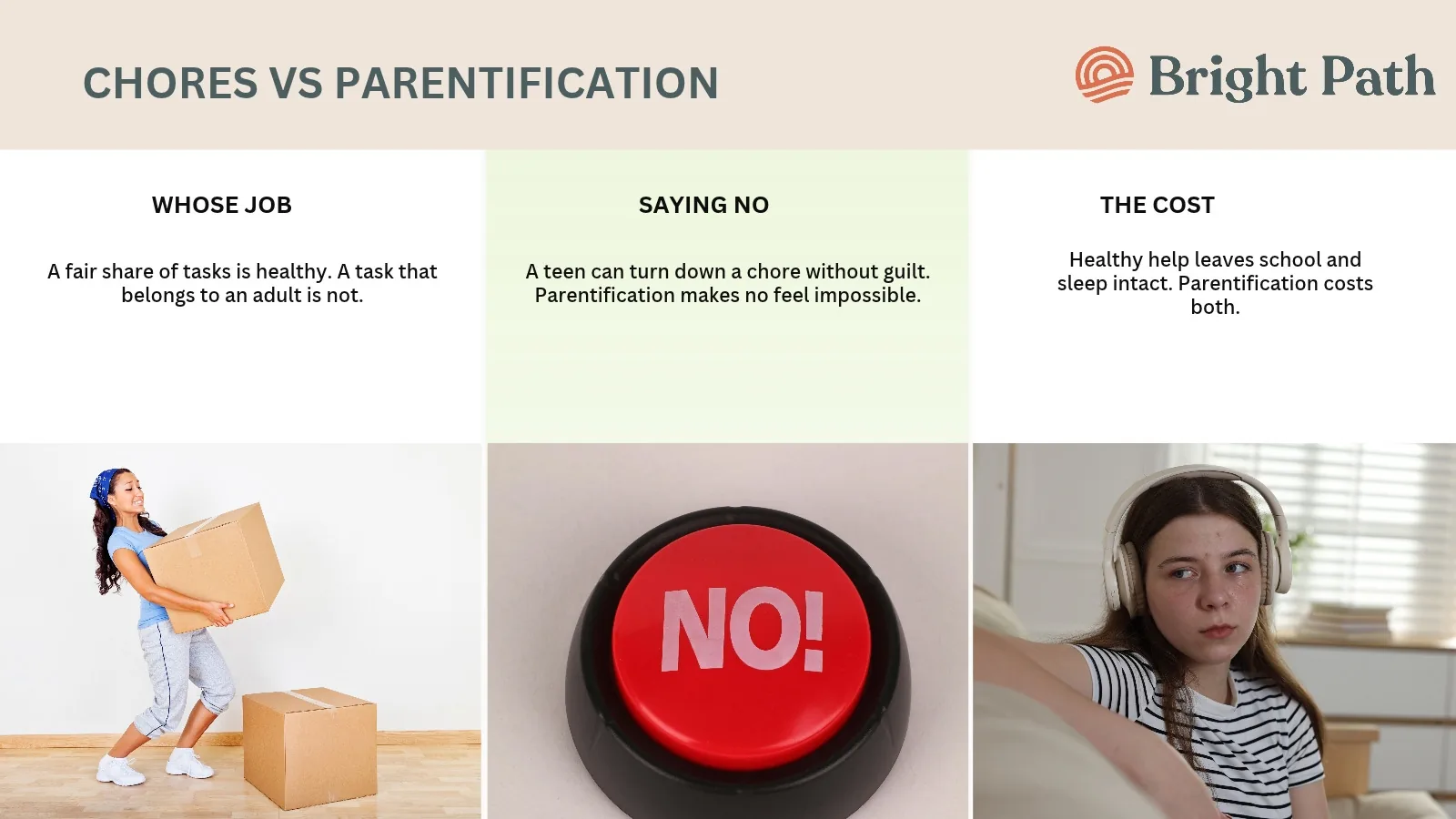
| Marker | Healthy contribution | Parentification |
| Whose job it is | A fair share of family tasks | A task that belongs to an adult |
| How long it lasts | Short-term or rotating | Months or years with no end date |
| Saying no | The teen can decline without guilt | Saying no feels like letting the family fall apart |
| Recognition | Thanked and noticed | Expected and invisible |
| Cost to the teen | Little effect on school, sleep or friends | Missed school, short sleep, lost friendships |
| Who is in charge | An adult still leads the household | The teen leads when an adult cannot |
Parents check their own home with three questions:
- Fairness: Does the teen do this task because it is fair, or because no adult is available?
- Cost: Has the teen missed anything important because of the task this month?
- Freedom: Would the teen feel free to stop?
What are the effects of parentification on teens?
Parentification builds real competence in some teens, but chronic parentification costs a teen rest, friendships and the experience of being cared for. The effects show up during the teen years and often follow the teen into adulthood.
Effects during the teen years
Parentified teens commonly show six effects during adolescence:
- Anxiety: The teen stays on alert for the next family problem.
- Low mood: Constant giving with little receiving drains the teen over time.
- Perfectionism: The teen believes mistakes are not allowed because others depend on the teen.
- School changes: Grades slip from lost study time, or the teen over-performs to stay in control.
- Isolation: Friendships fade because the teen is rarely free.
- Resentment: Anger builds toward a sibling or parent, then turns into guilt.
Low mood lasting more than two weeks deserves attention, and practical next steps are covered in how parents can help a teen with depression. Adaptive parentification also brings strengths, such as empathy, responsibility and problem-solving.
How parentification carries into adulthood
Parentification carries into adulthood as hyper-independence, people-pleasing, trouble resting and difficulty letting others help. Hooper and colleagues (2011) measured a correlation of r = .14 between childhood parentification and adult psychopathology, a small effect across 12 studies. The finding is a reason to rebalance roles now, not a prediction about any single teen.
How can parents reverse parentification?
Parents reverse parentification by taking adult problems back to adult supports and handing the teen back an age-appropriate life. The change works best in steps, so the household does not collapse when the teen steps back. Seven steps guide the shift:
- Notice without shame: Name the pattern privately first, as a result of strain rather than a failure.
- Move adult venting to adults: Take worries about money, marriage or health to a partner, friend, therapist or support groups for parents of teens.
- Reassign adult tasks: Return bills, appointments and nightly cooking to adults, and keep fair, age-appropriate chores.
- Arrange backup first: Line up sibling care, rides or meal help before removing the teen's role.
- Protect teen time: Put the teen's practices, study time and weekends with friends on the family calendar.
- Have a repair conversation: Thank the teen for what the teen carried, then say clearly that the job now belongs to the adults.
- Get your own support: Find a therapist or group for the parent, because the gap the teen filled still needs filling.
Expect some pushback. A parentified teen often resists losing a role that made the teen feel needed and in control, and the teen needs time to trust that the adults will cope.
How does Bright Path support families working through parentification?
Bright Path supports families working through parentification with weekly family therapy in partial hospitalization and with support built for parents. Bright Path's family approach starts from the belief that families are stressed, not broken, and that change comes from communication rather than blame.

Family therapy in partial hospitalization
Family therapy runs 60 minutes a week in the teen partial hospitalization program. Sessions focus on stabilization, not deep trauma processing. Family therapy at Bright Path covers six topics:
- Communication patterns: Families learn how messages and roles travel through the household.
- Family rules and expectations: Parents and teens agree on who handles what.
- Boundary setting: Families mark which problems belong to adults and which belong to the teen.
- Family safety planning: Everyone knows the plan for a hard night.
- Conflict reduction: Families practice calmer ways through disagreements.
- Support building: Families add people outside the home who share the load.
Support for the parents, too
Parents get support of their own at Bright Path, because the gap a parentified teen filled belongs to the adults. Bright Path's CEO leads a weekly parent support group at no added cost, and parents can keep attending for up to six weeks after discharge.
At admission, a Teen Care Advocate meets with parents to plan around barriers such as sibling care, work schedules and parent burnout.
If a teen is in immediate danger or talking about suicide, call or text 988, text HOME to 741741 for the Crisis Text Line, or call 911.
Frequently Asked Questions
Is parentification a form of emotional abuse?
Parentification is not automatically emotional abuse, because the harm depends on how heavy the role is, how long it lasts and whether the teen's own needs still get met. Gregory Jurkovic called the harmful form destructive parentification, which is chronic, unseen and beyond the teen's age. Most parentification grows from family strain rather than intent.
Is parentification trauma?
Parentification acts as a chronic relational stressor that becomes traumatic for some teens, especially when it combines with parental illness, substance use or violence. Many parentified teens do not develop trauma symptoms. The risk rises with how long the role lasts and how little support the teen receives.
Who coined the term parentification?
Family therapists Ivan Boszormenyi-Nagy and Geraldine Spark introduced the term parentification in their 1973 book Invisible Loyalties. Psychologist Gregory Jurkovic expanded the concept in 1997 by separating adaptive parentification from destructive parentification, a distinction researchers still use.
Can an only child be parentified?
An only child is parentified when the child becomes a parent's main emotional support, even without siblings to care for. Only children most often experience emotional parentification, serving as a confidant or companion to a single, divorced or struggling parent.
Is parentification the same as adultification?
Parentification and adultification overlap but differ, because parentification describes a child taking on a parent's role while adultification describes treating a child as older than the child's age. Adultification also refers to adults outside the family, such as teachers, seeing a child as more mature and less in need of protection.
Can parentification happen in a loving family?
Parentification happens in loving families, most often during a parent's illness, a divorce, a job loss or a sibling's medical crisis. Love and parentification exist together when a family runs short of adult capacity. The pattern changes once adults notice it and rebuild support around the teen.
How do I talk to my teen about parentification?
Start the conversation about parentification by thanking your teen for what the teen has carried, then explain that the adults are taking those jobs back. Ask what the teen wants more time for. Keep the talk short, avoid blaming anyone, and expect the teen to test whether the change lasts.
References
- Boszormenyi-Nagy, I., & Spark, G. M. (1973). Invisible Loyalties: Reciprocity in Intergenerational Family Therapy. Harper & Row.
- Jurkovic, G. J. (1997). Lost Childhoods: The Plight of the Parentified Child. Brunner/Mazel.
- Hooper, L. M., DeCoster, J., White, N., & Voltz, M. L. (2011). Characterizing the magnitude of the relation between self-reported childhood parentification and adult psychopathology: A meta-analysis. Journal of Clinical Psychology, 67(10), 1028-1043.
- National Alliance for Caregiving & United Hospital Fund. (2005). Young Caregivers in the U.S.: Findings from a National Survey.
- American Psychiatric Association. (2022). Diagnostic and Statistical Manual of Mental Disorders (5th ed., text rev.).


Clinically reviewed by Dr. Shantel Sullivan, Ed.D., LCSW, Chief Executive Officer