


Radical acceptance is a DBT skill that helps a teen stop fighting a painful fact they cannot change right now. It does not ask anyone to like what happened, approve of it or give up.
Radical acceptance sounds like "just get over it" to a parent, if a teen brings the term home from group. Linehan's teaching notes name the two misreadings to avoid, approval and being against change.
Linehan wrote 10 steps for practicing radical acceptance, and teens pair them with short coping statements in the moment. Acceptance is the wrong tool when a situation is still open to change or a teen is unsafe, and parents have a role at home.
Key takeaways
- A reality acceptance skill: Radical acceptance belongs to DBT's distress tolerance module, for painful facts that cannot be changed right now.
- Not approval: Linehan's handouts say acceptance is not approval, passivity or a stand against change.
- Ten written steps: Linehan's 2015 handouts lay out 10 steps, from noticing the fight with reality to doing pros and cons.
- Evidence for DBT: A 2021 meta-analysis in Psychological Medicine of 21 studies and 1,673 adolescents found DBT reduced self-harm more than comparison treatments.
- Common distress: In 2025, 33.3% of U.S. high school students reported persistent sadness or hopelessness, according to the CDC.
What is radical acceptance in DBT?
Radical acceptance is the DBT skill of fully acknowledging a painful fact, with mind, heart and body, when that fact cannot be changed right now. "Radical" means all the way, so a grudging "fine, whatever" does not count.
Distress tolerance is one of the four modules in DBT skills for teens. Its crisis survival skills get a teen through a peak moment. Distress tolerance's reality acceptance skills, led by radical acceptance, reduce suffering when painful facts cannot change.
Linehan's Handout 11 names four things a person has to accept:
- The facts are the facts: What happened stays true, even when a teen hates it.
- The future has limits: Everyone's future has limits, though only realistic limits need accepting.
- Everything has a cause: A painful event came from a chain of earlier events.
- Life can still be worth living: Painful events sit inside a life that still has value.
Jill Rathus and Alec Miller's DBT Skills Manual for Adolescents (2015) pairs radical acceptance with turning the mind, which means choosing acceptance again each time the fight returns.
Those definitions make more sense once you see why fighting a fact makes it hurt more.
Why does fighting reality make pain worse?
Fighting reality makes pain worse because the protest adds a second layer of suffering on top of the original hurt. Linehan puts it in one line: "Rejecting reality turns pain into suffering." A breakup hurts, and weeks of "this should not have happened" stack more on top.
Linehan also notes that rejecting reality does not change it, and that changing a situation starts with accepting it. She warns that acceptance may bring sadness first, with calm usually following.
In a 2025 study in Current Psychology, 92 young adults used either radical acceptance or a skill called check the facts on a distressing personal event. Negative feelings fully returned to baseline only in the radical acceptance group.
That study tested healthy adults in one session, not teens in treatment. The harder question for a teen is what acceptance is not.
What is radical acceptance not?
Radical acceptance is not approval, forgiveness, giving up or pretending a situation is fine. Linehan's Handout 11a says acceptance is not approval, compassion, love, passivity or a stand against change. A teen accepts that a friend spread a rumor and still sets a firm boundary.
The table compares radical acceptance with three ideas it gets confused with:
| Idea | Means agreeing it was okay? | Effect on the teen's next move | What it is about |
| Radical acceptance | No | Frees energy for coping or change | The facts of what happened |
| Approval | Yes | Not about action | Whether the event was right |
| Resignation | No | Stops effort | The teen's own effort |
| Forgiveness | No | Not tied to action | Feelings toward a person |
Handout 11a also names three blocks to acceptance:
- Missing skills: The teen does not yet know how to accept something this painful.
- The approval fear: The teen believes accepting means saying it was fine.
- Strong emotions: Sadness, anger, shame or guilt crowd out everything else.
Those blocks show up at home as recognizable signs.
What does fighting reality look like in a teen?
A teen fighting reality sounds stuck, replaying the same unfair event and arguing with it long after it happened. The five signs are:
- Repeated protest: The teen keeps saying "this is not fair" weeks after the event.
- Replaying the past: The teen goes over how things could have gone differently.
- Avoiding reminders: The teen skips the class or practice linked to the painful fact.
- Misdirected anger: Siblings, teachers or parents get the anger meant for the loss.
- Escape behavior: The teen reaches for fast ways to numb the feeling, self-harm among them.
Acceptance is not the tool, if a teen talks about suicide or is in danger. Call or text 988, text HOME to 741741 or call 911.
These signs are where the first of Linehan's 10 steps begins.
What are the 10 steps of radical acceptance?
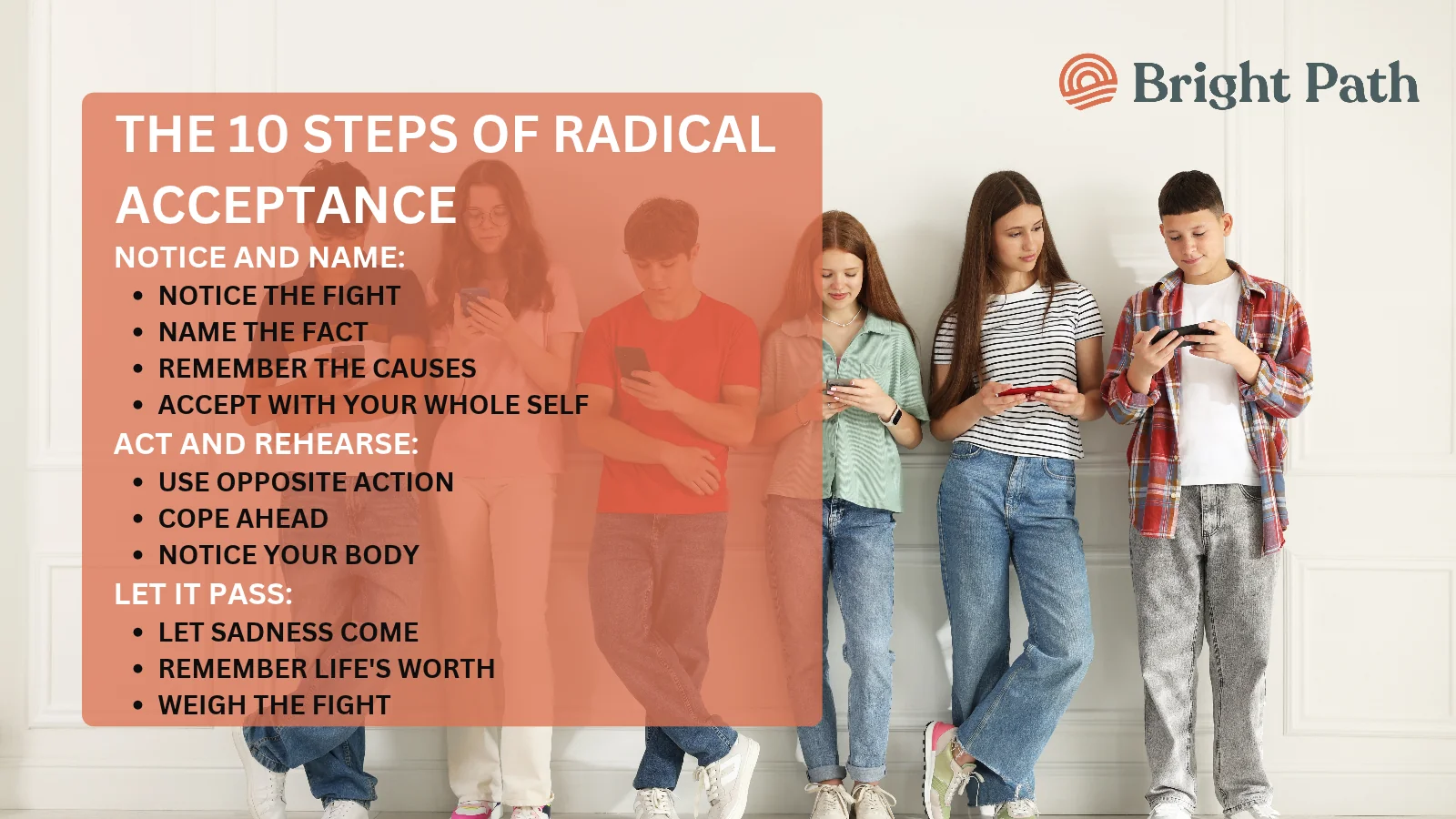
Linehan's Handout 11b lists 10 steps that move a teen from noticing the fight with reality to allowing grief and weighing pros and cons when resistance returns. The 10 steps, in Linehan's order, are:
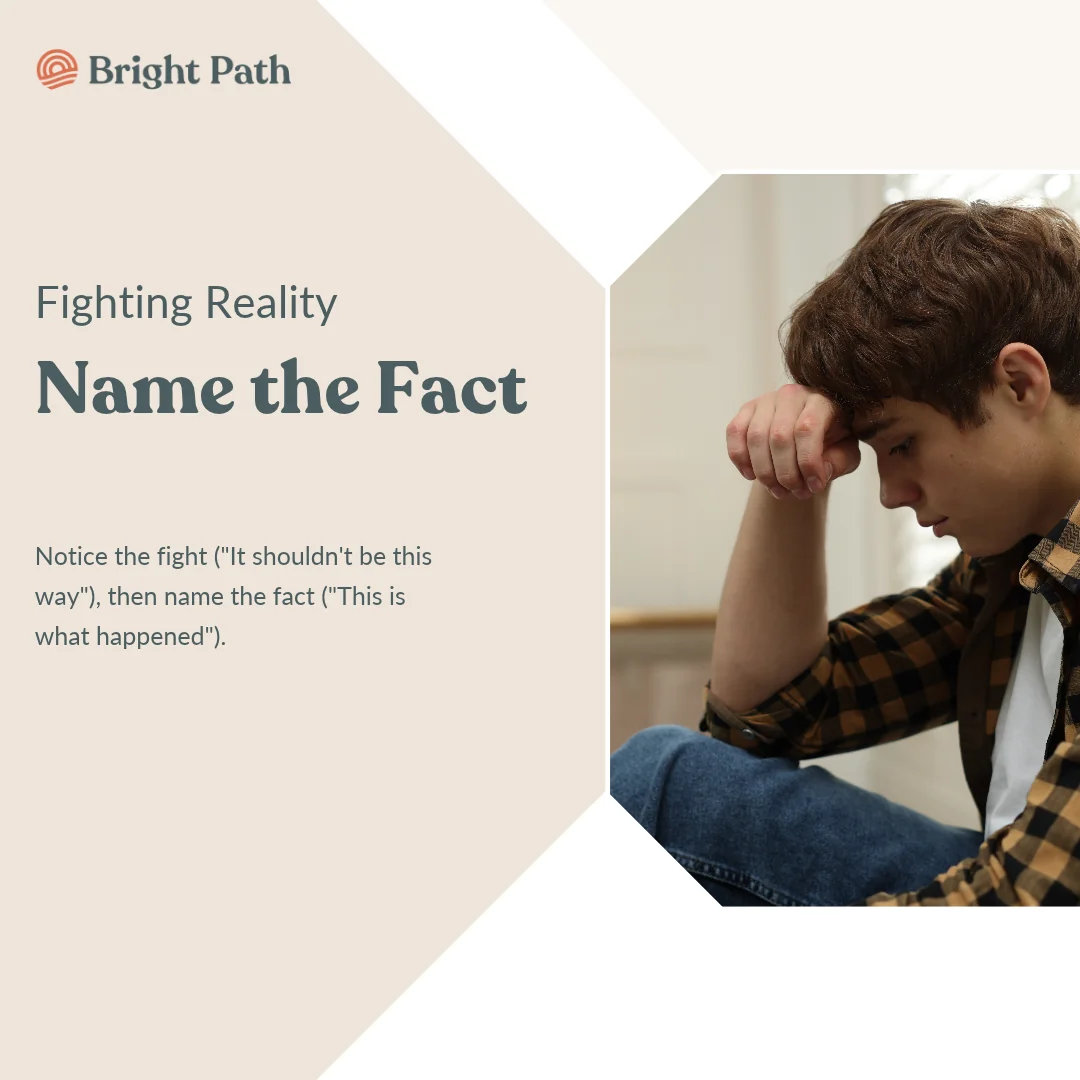
- Notice the fight: Observe that you are fighting reality ("It shouldn't be this way").
- Name the fact: Remind yourself the reality cannot be changed ("This is what happened").
- Remember the causes: A history of causes led to this moment ("This is how things happened").
- Accept with your whole self: Use accepting self-talk, slow breathing, half-smiling, willing hands, prayer or imagery.
- Use opposite action: List what you would do if you had accepted the facts, then do it.
- Cope ahead: Imagine accepting the fact, and rehearse how you would respond.
- Notice your body: Pay attention to body sensations as you think about the fact.
- Let sadness come: Allow disappointment, sadness or grief to rise.
- Remember life's worth: Life can be worth living even when there is pain.
- Weigh the fight: Do pros and cons if you notice yourself resisting.
Picture a 15-year-old practicing radical acceptance after missing the varsity team. Step 1 is catching "the coach is wrong," and step 2 is "The roster is posted, and I'm not on it." Step 8 is letting the disappointment hurt instead of starting a fight at dinner.
Linehan's teaching notes tie pros and cons to trusting a person's wise mind, the steady state between pure emotion and pure logic.
Once the steps feel familiar, short coping statements help a teen use them in the moment.
What are radical acceptance coping statements?
Radical acceptance coping statements are short sentences a teen says silently to stop arguing with a fact and turn back toward acceptance. The following five statements come straight from Linehan's Handouts 11 and 11b, so they match what teens hear in group:
- "This is what happened."
- "This is how things happened."
- "Rejecting reality does not change reality."
- "Changing reality requires first accepting reality."
- "Life can be worth living even when there is pain."
Linehan's step 4 pairs accepting self-talk with two body skills, half-smiling and willing hands.
Coping statements only help when acceptance is the right skill, which is not every time.
When is radical acceptance the wrong skill?
Radical acceptance is the wrong skill when the situation is still open to change or when a teen is unsafe. A failing grade with six weeks left calls for problem solving. Accepting it instead teaches a teen to stop trying.
Three situations call for a different skill:
- A fixable problem: Problem solving fits, because effort still changes the outcome.
- An emotion that does not fit the facts: Check the facts and opposite action fit.
- A peak crisis: Skills such as TIPP and STOP come first, as covered in our guide to distress tolerance skills for teens.
Safety comes before acceptance. Abuse, bullying and any risk of self-harm need action from adults, not tolerance from the teen.
Sorting situations this way is part of what DBT teaches, which raises a fair question about the evidence.
Does radical acceptance help teens?
Radical acceptance alone has not been tested in teens, but DBT, the treatment that teaches it, has strong evidence for teens. Teens learn it inside a full program of skills groups and therapy.
Kothgassner and colleagues pooled 21 studies of 1,673 adolescents in Psychological Medicine (2021). DBT reduced self-harm and suicidal thoughts more than comparison treatments.
In McCauley's 2018 trial in JAMA Psychiatry, 173 teens aged 12 to 18 at high risk for suicide received DBT or supportive therapy. By the end of treatment, 90.3% of the DBT group had no suicide attempts, versus 78.9% with supportive therapy. That advantage faded between 6 and 12 months.
The CDC's 2025 Youth Risk Behavior Survey found 33.3% of U.S. high school students reported persistent sadness or hopelessness, down from 40% in 2023.
The NC Department of Public Instruction reported that nearly 30% of the state's high school students felt persistently sad or hopeless in 2025, down from 39% in 2023 and 43% in 2021.
In adolescent DBT, parents learn the skills alongside their teen, which shapes how they help at home.
How can parents help a teen practice radical acceptance?
Parents help by modeling acceptance themselves and never using "just accept it" to end a conversation. A teen hears that phrase as dismissal. Rathus and Miller added a fifth module for teens and families, Walking the Middle Path, which teaches methods for reducing family conflict.
Four habits help at home:
- Name facts, not judgments: Say "the trip is canceled," not "this always happens to us."
- Validate first: Acknowledge that the situation hurts before mentioning acceptance.
- Ask, don't assign: Ask which part is in your teen's control, and let them answer.
- Practice on yourself: Parents have facts to accept too, such as a slower recovery than hoped.
Those habits use the same language teens hear in DBT skills groups, which is how Bright Path builds the skill.
How does Bright Path teach radical acceptance?
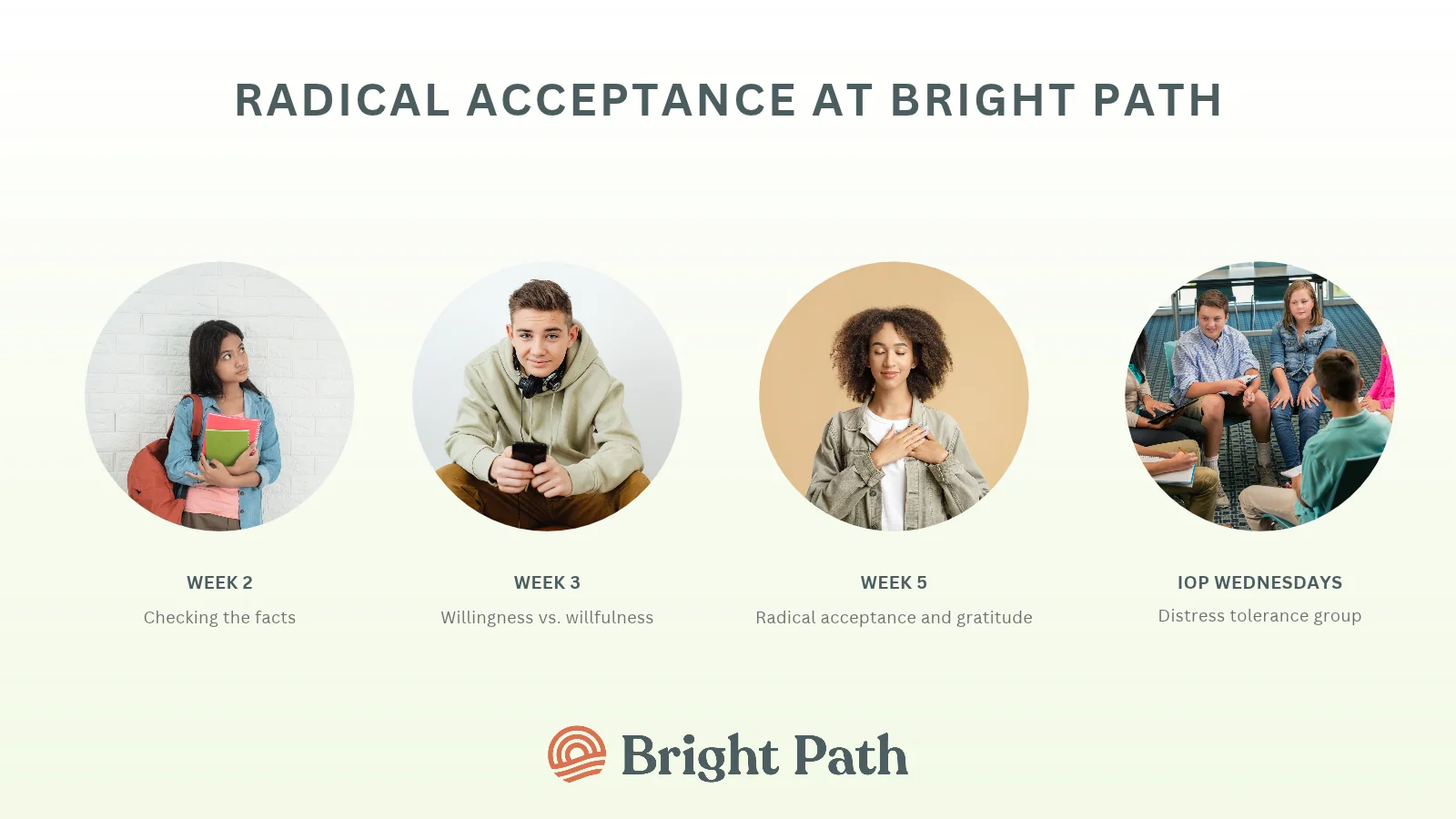
Bright Path teaches radical acceptance in DBT skills groups, building up to it from week 2 to week 5. Teens in our partial hospitalization program follow a 5-week curriculum, Monday to Friday from 9 a.m. to 3 p.m., on age-based Summit and Meadow tracks.
The curriculum builds toward the skill:
- Week 2, Tuesday: Checking the facts, so teens learn to tell a fact from a judgment.
- Week 3, Thursday: Willingness vs. willfulness.
- Week 5, Thursday: Radical acceptance and gratitude.
In the after-school intensive outpatient program, River Path teens have a distress tolerance group, the module that holds radical acceptance, every Wednesday at 3 p.m. Each track holds no more than 12 teens, so every teen is heard in group.
The five questions below cover what families ask once their teen starts practicing.
Frequently asked questions
What is half smiling in DBT?
Half-smiling is a DBT body skill where a teen relaxes the face and lifts the corners of the lips slightly. Linehan teaches it with radical acceptance because facial expression partly shapes emotion, so a relaxed half-smile helps a person feel more accepting. It pairs with willing hands, which means resting the hands unclenched with palms up.
Is there a radical acceptance worksheet?
Linehan's DBT Skills Training Handouts and Worksheets includes Distress Tolerance Worksheets 9 and 9a for practicing radical acceptance. For a simple version, a teen writes down the painful fact, its causes, the feelings it brings and one thing they would do if they had accepted it.
How long does it take a teen to learn radical acceptance?
Teens need repeated practice before radical acceptance holds up in hard moments, even after they understand the idea. Linehan's teaching notes say accepting a painful reality usually takes multiple efforts over time, so the choice to accept gets made again and again. Bigger losses take more practice than small disappointments, and that is normal.
What are some effective distress tolerance skills for kids?
Five effective distress tolerance skills for kids and teens are TIPP, STOP, ACCEPTS, IMPROVE and radical acceptance. TIPP and STOP help in a peak crisis by calming the body and pausing before acting. ACCEPTS and IMPROVE help a young person ride out a hard stretch, and radical acceptance helps with pain that cannot change.
How do you tolerate emotional discomfort?
You tolerate emotional discomfort by letting the feeling be there without acting on it, then using a skill matched to its intensity. At peak intensity, body skills like paced breathing come first. The 10 steps of radical acceptance help the feeling pass instead of building, if the discomfort comes from a fact that cannot change.
Sources
- Linehan, M. M. (2015). DBT Skills Training Handouts and Worksheets (2nd ed.). Guilford Press. Distress Tolerance Handouts 11, 11a and 11b; Distress Tolerance Worksheets 9 and 9a.
- Linehan, M. M. (2015). DBT Skills Training Manual (2nd ed.). Guilford Press.
- Rathus, J. H., & Miller, A. L. (2015). DBT Skills Manual for Adolescents. Guilford Press.
- Segal, O., Bronshtein, K., & Weinbach, N. (2025). The benefits of radical acceptance of reality as a standalone strategy for emotion regulation. Current Psychology, 44(3), 1780-1792. Open source
- Kothgassner, O. D., Goreis, A., Robinson, K., Huscsava, M. M., Schmahl, C., & Plener, P. L. (2021). Efficacy of dialectical behavior therapy for adolescent self-harm and suicidal ideation: A systematic review and meta-analysis. Psychological Medicine, 51(7), 1057-1067. Open source
- McCauley, E., Berk, M. S., Asarnow, J. R., Adrian, M., Cohen, J., Korslund, K., Avina, C., Hughes, J., Harned, M., Gallop, R., & Linehan, M. M. (2018). Efficacy of dialectical behavior therapy for adolescents at high risk for suicide: A randomized clinical trial. JAMA Psychiatry, 75(8), 777-785. Open source
- Kiplagat, S. J., Verlenden, J. V., Petrosky, E., et al. (2026). Unmet need for mental health services among high school students experiencing persistent feelings of sadness or hopelessness: Youth Risk Behavior Survey, United States, 2025. MMWR Supplements, 75(Suppl-1), 35-43. Centers for Disease Control and Prevention. Open source
- North Carolina Department of Public Instruction. (2026, August 5). 2025 North Carolina high school survey shows improvement in student safety, risk behaviors. Open source
- North Carolina Department of Public Instruction. (2024, June 5). NC Youth Risk Behavior Surveys show improvement in student mental health. Open source


Clinically reviewed by Dr. Shantel Sullivan, Ed.D., LCSW, Chief Executive Officer